
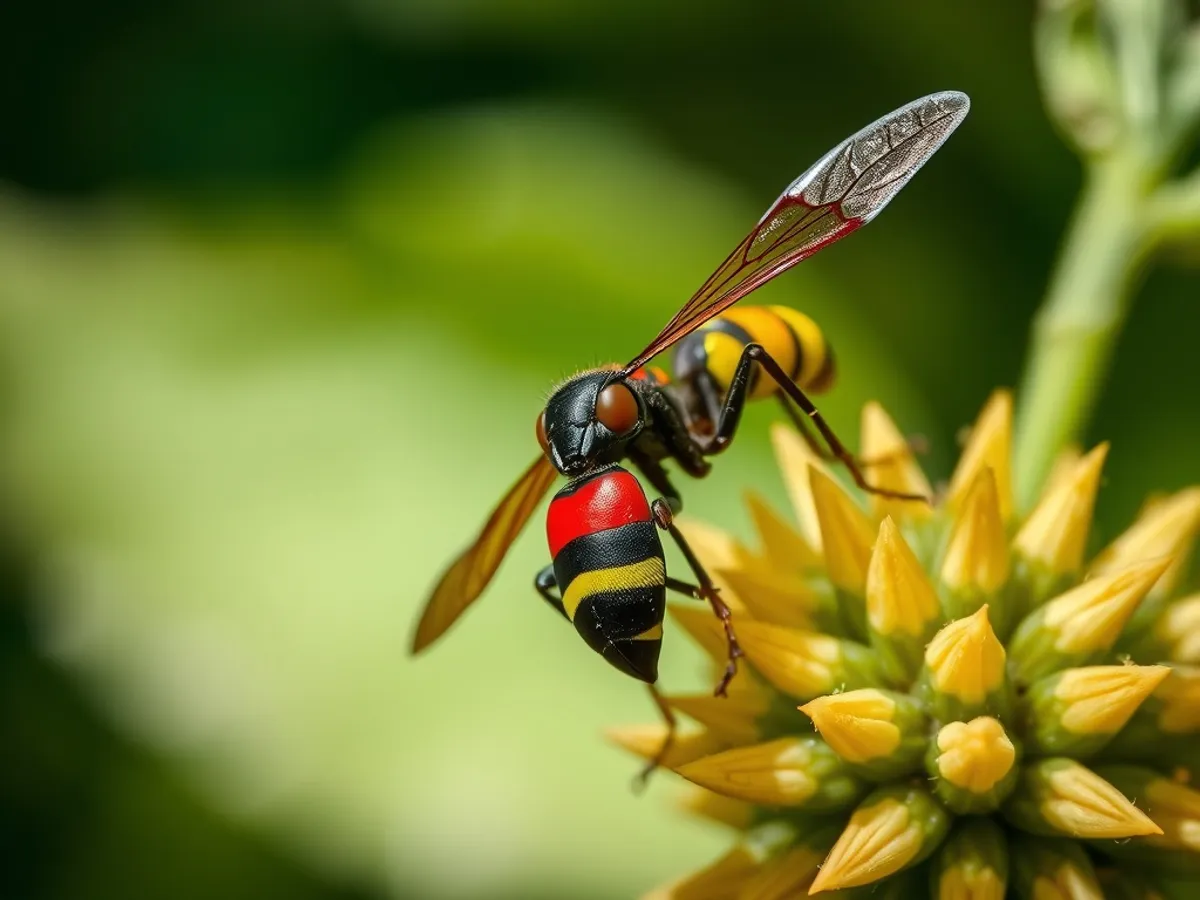
About the Ruby-tailed wasp
The Ruby-tailed wasp is a brilliantly colored metallic insect renowned for its vivid iridescent blue, green, and red hues. This small solitary wasp is part of the cuckoo wasp family and is often seen basking on sunlit wooden fences, walls, and tree trunks during warm months. Ruby-tailed wasps are cleptoparasites, laying their eggs in the nests of other solitary bees and wasps. Their striking appearance and unique life cycle make them a favorite among entomologists and nature enthusiasts.
Fascinating facts
Iridescent Beauty
The Ruby-tailed wasp's shimmering colors are produced by light refracting through layers of its exoskeleton, rather than by pigment.
Parasitic Lifestyle
Females lay their eggs in the nests of solitary bees and wasps; the larvae then consume the host egg or larva and the food stored in the nest.
Defensive Armor
When threatened, the wasp curls into a ball, using its hard exoskeleton to shield itself from attacks, especially from the host insects.
Detailed description
Chrysis ignita, commonly known as the ruby-tailed wasp, is a small, brilliantly iridescent hymenopteran measuring 6–13 mm in length. Its exoskeleton is heavily sculptured and metallic, displaying vivid blue-green on the head and thorax, with a striking ruby-red abdomen. The body is compact and robust, with a domed thorax and a deeply concave ventral surface, allowing it to curl into a defensive ball (conglobation) when threatened. The antennae are filiform and relatively short, adapted for exploring crevices in search of host nests. The wings are transparent with a faint brownish tint and are held flat over the abdomen at rest. Unlike most aculeate wasps, C. ignita lacks a functional stinger; instead, it relies on its armor for defense. Its legs are short and strong, suited for clinging to rough surfaces and maneuvering within narrow nest cavities. The ruby-tailed wasp is solitary, with no colony structure, and is most active in warm, sunny conditions from late spring to early autumn. Its vivid coloration serves as both camouflage among flowers and a warning to potential predators.
Did you know?
The Ruby-tailed wasp's exoskeleton is so tough that it can resist stings from the host insects it parasitizes.
Research & sources
Wikipedia summary
Chrysis ignita is a species of cuckoo wasp. It is one of a group of species which are difficult to separate and which may be referred to as ruby-tailed wasps.
Behaviour & social structure
Chrysis ignita exhibits highly specialized parasitic behavior, spending much of its adult life searching for the nests of solitary bees and wasps, particularly potter wasps (Ancistrocerus spp.) and mason bees. Adults are diurnal and are often observed sunning themselves on wooden surfaces or stone walls, where they use their acute vision and chemosensory antennae to detect host nest entrances. Upon locating a suitable nest, the female waits for the host to leave before infiltrating the nest cavity. She quickly lays a single egg near or on the host larva or egg, minimizing detection. Adults feed primarily on nectar from flowers such as umbellifers and composites, contributing to incidental pollination. They exhibit little to no social interaction beyond mating, and males are often seen patrolling territories or visiting flowers. Defensive behaviors include rapid flight, dropping to the ground, and curling into a ball to protect vulnerable body parts from host attacks.
Reproduction & life cycle
Reproduction in C. ignita is characterized by a parasitic strategy known as kleptoparasitism. Mating occurs on sunlit surfaces or near host nesting sites, typically from late May through August. After mating, females seek out active nests of suitable hosts. The female's ovipositor is adapted for precise placement of eggs within the host nest, often requiring only seconds to deposit an egg. The egg hatches within a few days, and the larva immediately consumes the host egg or larva, followed by the stored provisions. Development from egg to adult takes several weeks, depending on temperature and host availability. There is usually one generation per year (univoltine), with larvae overwintering in the host nest as prepupae and emerging as adults the following spring. There is no parental care beyond egg-laying, and the survival of offspring depends entirely on the success of nest infiltration.
Adaptations & survival
Chrysis ignita has evolved a suite of adaptations for its parasitic lifestyle. Its heavily sclerotized exoskeleton provides protection against stings and bites from host species. The ability to roll into a tight ball (conglobation) shields vulnerable appendages and soft tissues. The lack of a functional sting is compensated by the wasp's armor and agility. The metallic coloration may serve as both camouflage among flowers and a form of aposematism. Chemosensory adaptations in the antennae allow precise detection of host pheromones and nest odors. The ovipositor is slender and flexible, enabling egg deposition in concealed or protected nest chambers. Larval adaptations include rapid development and specialized mandibles for consuming host eggs, larvae, and provisions.
Cultural significance
While not a major figure in folklore or mythology, the ruby-tailed wasp is admired by naturalists and entomologists for its dazzling appearance and fascinating life cycle. It is often featured in educational materials and nature photography, symbolizing the hidden complexity and beauty of invertebrate life. In some cultures, its iridescence is associated with good luck or the magical qualities of nature. There are no known traditional uses, but its presence is valued as an indicator of healthy ecosystems supporting diverse pollinator communities.
Recent research
Recent research has focused on the taxonomy and cryptic diversity within the Chrysis ignita complex, revealing that what was once considered a single species may comprise several morphologically similar but genetically distinct taxa. Molecular studies using DNA barcoding have improved species identification and clarified host associations. Behavioral studies have examined the wasp's host-finding strategies, demonstrating the importance of chemical cues and visual landmarks. Ongoing research explores the ecological impacts of cuckoo wasps on solitary bee and wasp populations, as well as their potential role in pollination networks. Conservation studies are assessing the effects of urbanization and climate change on population dynamics.
Videos
Habitat
Sunny woodland edges, gardens, and open habitats with abundant solitary bee and wasp nests
 Various Continental Regions
Grassland
Open areas dominated by grasses rather than trees, supporting numerous herbivores and their predators.
 Elevated Terrain
Mountain
High-altitude environments with varying climates and specialized wildlife adapted to rugged terrain and thin air.
 Global
Forest
Wooded areas with significant tree cover and diverse plant and animal communities.
Conservation
The Ruby-tailed wasp is currently classified as Least Concern on the IUCN Red List.
Threats & challenges
Currently, Chrysis ignita is classified as Least Concern, with stable populations across much of its range. However, it faces localized threats from habitat loss due to urbanization, intensive agriculture, and the removal of dead wood and old masonry, which are critical for host nesting. Pesticide use can indirectly affect C. ignita by reducing host populations. Climate change may alter the phenology of both the wasp and its hosts, potentially leading to mismatches in life cycles. Despite these challenges, the species remains widespread and adaptable, benefiting from the proliferation of urban gardens and artificial nesting sites.
Taxonomy
Scientific name
Chrysis ignita
- Kingdom
- Animalia
- Phylum
- Arthropoda
- Class
- Insecta
- Order
- Hymenoptera
- Family
- Chrysididae
- Genus
- Chrysis
- Species
- ignita
Community notes
Share your observations about the Ruby-tailed wasp.
No community notes yet. Be the first!
Discover more wildlife
More fascinating animals from the encyclopedia.