
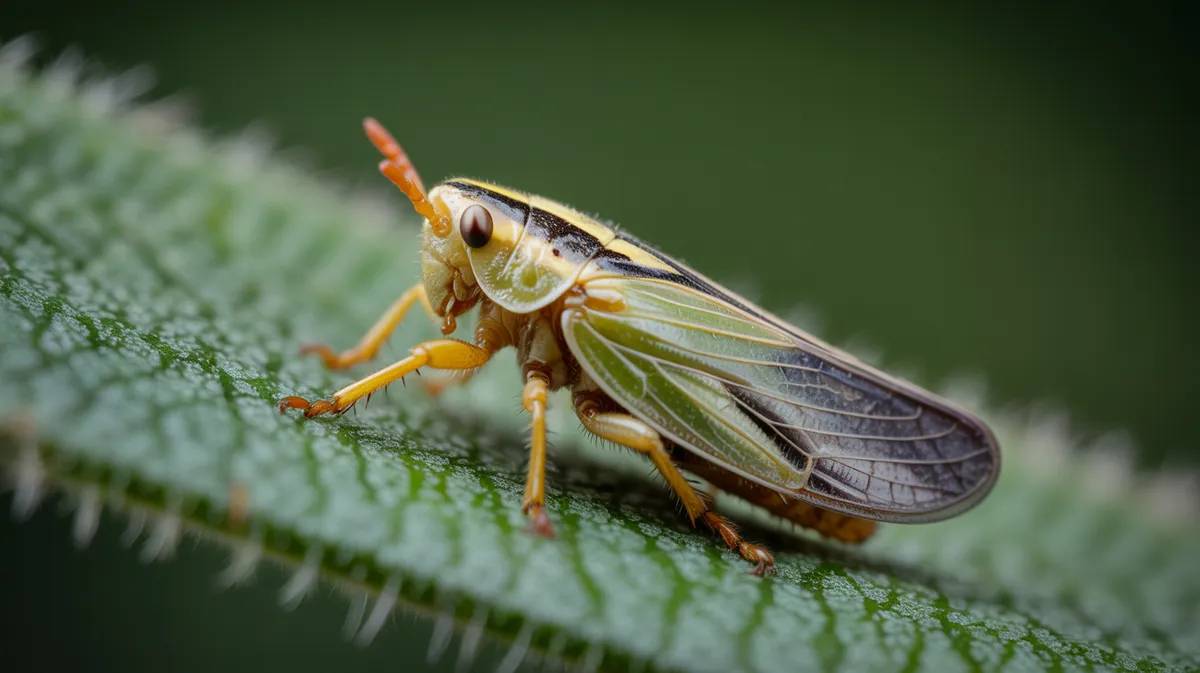
About the Saddled Leafhopper
The Saddled Leafhopper is a small, wedge-shaped insect known for its distinctive, saddle-like marking on its back. This species is found throughout North America, commonly inhabiting forests, meadows, and gardens where it feeds on plant sap. The Saddled Leafhopper is an agile jumper, using its powerful hind legs to leap away from predators. Its unique coloration and body shape provide camouflage among leaves, helping it avoid detection. Despite its small size, it plays a significant role in the ecosystem by participating in plant-insect interactions and serving as prey for various predators.
Fascinating facts
Impressive Jumpers
Saddled Leafhoppers can leap up to 40 times their body length, making them excellent at escaping predators.
Plant Sap Feeders
They use their piercing mouthparts to feed on the sap of a variety of plants, sometimes causing damage to crops and ornamentals.
Silent Communicators
These insects communicate with one another by producing vibrations through plant stems, which are detected by other leafhoppers.
Detailed description
The Saddled Leafhopper (Ceresa taurina) is a member of the family Membracidae, commonly known as treehoppers, and is distinguished by its prominent, saddle-shaped pronotum that arches over its thorax and partially covers its wings. Adults typically measure between 6 and 8 millimeters in length, with a green to brown coloration that provides effective camouflage among foliage. The saddle-like structure is not only a visual adaptation for mimicry but also serves as a deterrent to predators by disrupting the insect's outline. Ceresa taurina possesses piercing-sucking mouthparts adapted for extracting sap from a wide variety of host plants, including deciduous trees, shrubs, and herbaceous vegetation. Its compound eyes afford a wide field of vision, aiding in predator detection. The species is primarily solitary, although nymphs may be found in loose aggregations on host plants. Activity peaks during the warmer months, with adults most commonly observed from late spring through early autumn. The life cycle includes egg, nymph, and adult stages, with nymphs undergoing several molts before reaching maturity. The Saddled Leafhopper plays a role in nutrient cycling and serves as a food source for birds, spiders, and predatory insects, thus contributing to the complexity of its ecosystem.
Did you know?
Unlike many other leafhoppers, the Saddled Leafhopper's nymphs and adults look remarkably different, undergoing a noticeable transformation as they mature.
Research & sources
Behaviour & social structure
Ceresa taurina is diurnal, with peak activity during daylight hours when temperatures are moderate. It spends most of its time on the stems and undersides of leaves, where it feeds by inserting its stylets into plant vascular tissue to access phloem sap. Feeding is typically sedentary, but the leafhopper is highly alert and capable of rapid escape jumps—often covering distances up to 30 times its body length—when threatened. While generally solitary, individuals may be found in proximity when host plant resources are abundant. Communication is primarily vibrational, with nymphs and adults producing substrate-borne signals to deter rivals or attract mates. The species does not exhibit cooperative behavior or parental care, and there is little evidence of territoriality. Predation risk from birds, spiders, and predatory insects shapes much of its cryptic and evasive behavior.
Reproduction & life cycle
Breeding occurs primarily from late spring to midsummer, coinciding with optimal plant growth. Males attract females using vibrational signals transmitted through plant stems. After mating, females use their ovipositor to insert eggs into the soft tissues of host plants, often in small clusters. The incubation period varies with temperature but generally lasts 1–3 weeks. Upon hatching, nymphs resemble miniature adults but lack fully developed wings and the characteristic saddle. Nymphs undergo five instar stages, molting between each, and reach adulthood in approximately 4–6 weeks. There is no parental care; nymphs are independent from hatching. In warmer regions, two or more generations may occur per year (multivoltine), while in cooler climates, the species is typically univoltine.
Adaptations & survival
The most striking adaptation of Ceresa taurina is its enlarged, saddle-shaped pronotum, which provides camouflage by mimicking thorns, leaf galls, or plant debris, making it less conspicuous to predators. Its green or brown coloration further enhances this cryptic effect. The powerful hind legs are specialized for jumping, providing a rapid escape mechanism. The piercing-sucking mouthparts allow efficient feeding on a variety of plant hosts, and the ability to utilize multiple plant species reduces dependence on any single food source. Vibrational communication enables mate location and intraspecific signaling even in dense vegetation where visual cues are limited. Eggs are inserted into plant tissue, offering protection from desiccation and some predators.
Cultural significance
The Saddled Leafhopper has limited direct cultural significance but is occasionally referenced in entomological literature as an example of remarkable insect mimicry and adaptation. Its unique appearance has made it a subject of interest for naturalists, photographers, and educators, often used to illustrate concepts of camouflage and evolutionary adaptation. There are no known traditional uses or symbolic associations in folklore or mythology.
Recent research
Recent research on Ceresa taurina and related Membracidae has focused on the biomechanics of their jumping ability, vibrational communication, and the evolutionary development of the pronotum. Studies using high-speed videography have elucidated the mechanics of their rapid escape jumps, highlighting specialized muscle and leg morphology. Molecular phylogenetics has provided insights into the evolutionary relationships within the Membracidae, revealing multiple independent origins of pronotal elaboration. Ongoing ecological studies are examining the role of treehoppers in plant-insect interactions, including their impact on plant health and their relationships with mutualistic ants, although Ceresa taurina is less commonly associated with ant-tending than some relatives.
Videos
Habitat
Forest edges, meadows, and gardens


Conservation
The Saddled Leafhopper is currently classified as Least Concern on the IUCN Red List.
Threats & challenges
Currently, Ceresa taurina is not considered threatened and is classified as Least Concern. However, localized threats include habitat loss due to urbanization, agricultural expansion, and pesticide use, which can reduce host plant availability and directly impact populations. Climate change may alter the distribution and phenology of both the leafhopper and its host plants. While not a major agricultural pest, high densities can cause minor damage to ornamental and fruit trees by feeding and oviposition, occasionally resulting in cosmetic injury or secondary infections. Natural predators and parasitoids help regulate populations, maintaining ecological balance.
Taxonomy
Scientific name
Ceresa taurina
- Kingdom
- Animalia
- Phylum
- Arthropoda
- Class
- Insecta
- Order
- Hemiptera
- Family
- Membracidae
- Genus
- Ceresa
- Species
- taurina
Community notes
Share your observations about the Saddled Leafhopper.
No community notes yet. Be the first!
Discover more wildlife
More fascinating animals from the encyclopedia.