
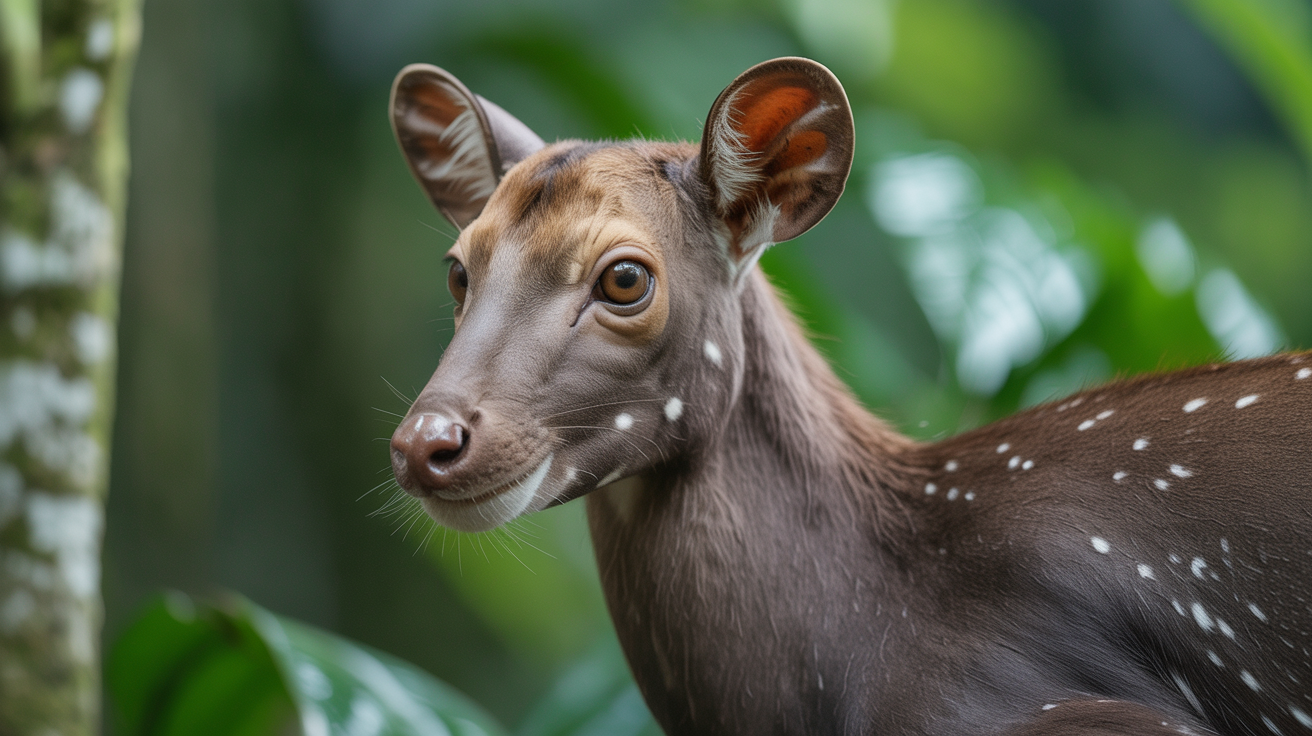
About the Saola
The saola (Pseudoryx nghetinhensis) was unknown to science until 1992, when researchers surveying Vu Quang in Vietnam's Annamite Mountains found a strange skull with long, straight horns nailed to a hunter's wall. Despite the nickname "Asian unicorn," it is not an antelope but a bovid whose closest relatives are wild cattle, and both sexes carry the near-parallel horns, which can exceed 50 centimetres. Its most extraordinary feature is a pair of maxillary scent glands beneath flaps on the muzzle, the largest of any living mammal, which it opens and rubs on vegetation to mark territory. Saola live in wet evergreen forest along the Vietnam-Laos border and appear to be quiet, solitary browsers of streamside leaves. No biologist has ever reliably observed one in the wild; every animal brought into captivity has died within weeks or months. The last confirmed record is a single camera-trap photograph from 2013, and no confirmed sighting has followed. The chief threat is not hunting for the saola itself but the wire snares set by the thousand for civets, muntjac and pigs, which kill indiscriminately. Conservation now focuses on snare removal patrols and on the desperate hope of finding enough animals for a rescue breeding programme.
Fascinating facts
Recent Discovery
The Saola was first discovered by scientists only in 1992, when skulls and horns were found in a remote Vietnamese village.
Secretive Habitat
Saolas live in dense, montane evergreen forests, making direct observation in the wild incredibly rare.
Unique Horns
Both male and female Saolas have long, straight, parallel horns that can grow up to 50 centimeters in length.
Detailed description
The saola (Pseudoryx nghetinhensis) is a medium-sized bovid, standing about 80–90 cm at the shoulder and weighing 80–100 kg. It is characterized by its long, slender, nearly parallel horns, which can reach up to 50 cm in length in both sexes, and by its striking facial markings: a white facial stripe, dark brown to black nose, and white spots above the eyes. The coat is a sleek, chocolate-brown with lighter underparts and white markings on the legs. The saola’s body is compact, with a short tail and relatively small ears. Adapted for dense forest life, it has a flexible neck and elongated limbs that allow it to move quietly through thick undergrowth. Its large preorbital glands are prominent and may play a role in scent-marking territory. The saola is extremely elusive, with most knowledge derived from camera-trap images, local ecological knowledge, and a handful of short-lived captive individuals. It is believed to be primarily crepuscular, active at dawn and dusk, and solitary or found in small family groups. Its diet consists mainly of leafy plants, young shoots, and fruit, foraged from the forest understory. The species is the sole member of its genus and represents one of the most phylogenetically distinct lineages within the Bovidae, diverging from other bovines millions of years ago.
Did you know?
The Saola was unknown to science until 1992, making it one of the most spectacular zoological discoveries of the 20th century.
Research & sources
Wikipedia summary
The saola, also called spindlehorn, Asian unicorn, or infrequently, Vu Quang bovid, is a forest-dwelling bovid native to the Annamite Range in Vietnam and Laos. It was described in 1993 following a discovery of remains in Vũ Quang National Park by a joint survey of the Vietnamese Ministry of Forestry and the World Wide Fund for Nature. Saolas have since been kept in captivity multiple times, although only for short periods as they died within a matter of weeks to months. The species was first reported in 1992 by Do Tuoc, a forest ecologist, and his associates. The first photograph of a living saola was taken in captivity in 1993. The most recent one was taken in 2013 by a movement-triggered camera in the forest of central Vietnam, which represents the most recent record of the species. There is concern that the species may already be extinct. It is the only species in the genus Pseudoryx and the earliest diverging member of the tribe Bovini, placing buffalo, cattle and bison as its closest relatives.
Behaviour & social structure
Saolas are highly secretive and avoid open areas, preferring dense evergreen or semi-evergreen forests at elevations between 300 and 1,800 meters. They are believed to be solitary or to form small groups, typically consisting of a female and her offspring, or occasionally pairs. There is no evidence of large herds. Their activity is mainly crepuscular, with peak feeding and movement at dawn and dusk, likely to avoid predators and human disturbance. Saolas are browsers, feeding selectively on a variety of herbaceous plants, young leaves, ferns, and occasionally fruit, using their prehensile lips to grasp foliage. They are known to use established animal trails and are adept at moving quietly through thick vegetation. Scent-marking with their large preorbital glands is thought to play a role in communication, possibly for marking territory or signaling reproductive status. There is no evidence of aggressive behavior; when threatened, saolas reportedly freeze or flee rather than confront.
Reproduction & life cycle
Very little is known about saola reproduction due to the scarcity of direct observations. Based on limited captive data and local reports, it is believed that saolas are seasonal breeders, with births likely occurring at the start of the rainy season (May–July), which would ensure abundant food for lactating females. Gestation is estimated at 8–9 months, similar to other bovids of comparable size. Females likely give birth to a single calf, which remains hidden in dense vegetation for the first weeks of life. Parental care is presumed to be provided solely by the mother, with weaning occurring at several months of age. There is no evidence of paternal care or extended family groups. Sexual maturity is thought to occur at 2–3 years of age, but lifespan in the wild is unknown; captive individuals have survived only a few months, likely due to stress and dietary issues.
Adaptations & survival
Saolas possess several adaptations for survival in dense, humid forests. Their slender, parallel horns allow them to move through thick vegetation without becoming entangled, and their cryptic coloration provides camouflage from predators. The large preorbital glands may be used for scent-marking, an important adaptation for communication in low-visibility environments. Their prehensile upper lips facilitate selective browsing on a variety of forest plants. Saolas have a keen sense of smell and hearing, aiding in predator detection and navigation. Physiologically, they are adapted to a low-nutrient, high-moisture diet typical of forest understory plants. Their evolutionary divergence from other bovines suggests unique immunological and metabolic traits, though these remain poorly studied.
Cultural significance
The saola holds significant cultural value in local communities of Vietnam and Laos, where it is sometimes referred to as the 'Asian unicorn.' Its discovery generated considerable national pride and international interest, symbolizing the rich biodiversity of the Annamite forests. In local folklore, saolas are sometimes associated with forest spirits or considered omens, though they have not been widely hunted for traditional medicine or food due to their rarity. The saola has become a flagship species for conservation in the region, representing the urgent need to protect Southeast Asia’s unique and threatened wildlife.
Recent research
Since its discovery, research on the saola has been hampered by its rarity and secretive nature. Most data comes from camera traps, genetic analysis of dung and hair samples, and interviews with local hunters. Recent advances include the use of environmental DNA (eDNA) to detect saola presence in streams and soil, offering hope for non-invasive monitoring. The Saola Working Group (SWG), established under the IUCN SSC Asian Wild Cattle Specialist Group, coordinates research and conservation efforts, including anti-snare patrols and community engagement. Genetic studies have confirmed the saola’s deep evolutionary divergence from other bovids, highlighting its conservation importance. There is ongoing discussion about the feasibility of establishing a managed breeding program, but no individuals are currently in captivity. The most recent confirmed wild sighting was in 2013, underscoring the urgent need for intensified survey and protection efforts.
Sources
A new species of living bovid from Vietnam
Dung, V.V., Giao, P.M., Chinh, N.N., Tuoc, D., Arctander, P., & MacKinnon, J. (1993)
scientificPseudoryx nghetinhensis: The IUCN Red List of Threatened Species 2016
Timmins, R.J., Hedges, S., Robichaud, W.
conservationThe Saola Working Group (SWG): Conservation Action for the Saola
IUCN SSC Asian Wild Cattle Specialist Group
scientificVideos
Habitat
Evergreen forests of the Annamite Mountains


Conservation
The Saola is currently classified as Critically Endangered on the IUCN Red List.
Threats & challenges
The saola faces severe threats from habitat loss due to logging, agricultural expansion, and infrastructure development in the Annamite Range. However, the most acute threat is indiscriminate snaring for the bushmeat trade, which targets a wide range of mammals and has decimated saola populations. Saolas are not specifically hunted, but are highly susceptible to these wire snares. Fragmentation of habitat further isolates populations, reducing genetic diversity and increasing extinction risk. The population is estimated to be fewer than 100 individuals, with some estimates as low as 20. No viable captive population exists, and all attempts at captive management have failed. Conservation challenges include the species’ extreme rarity, elusive behavior, and the difficulty of implementing anti-poaching measures in remote, rugged terrain. The IUCN lists the saola as Critically Endangered, and it is included in CITES Appendix I.
Taxonomy
Scientific name
Pseudoryx nghetinhensis
- Kingdom
- Animalia
- Phylum
- Chordata
- Class
- Mammalia
- Order
- Artiodactyla
- Family
- Bovidae
- Genus
- Pseudoryx
- Species
- nghetinhensis
Community notes
Share your observations about the Saola.
No community notes yet. Be the first!
Discover more wildlife
More fascinating animals from the encyclopedia.