
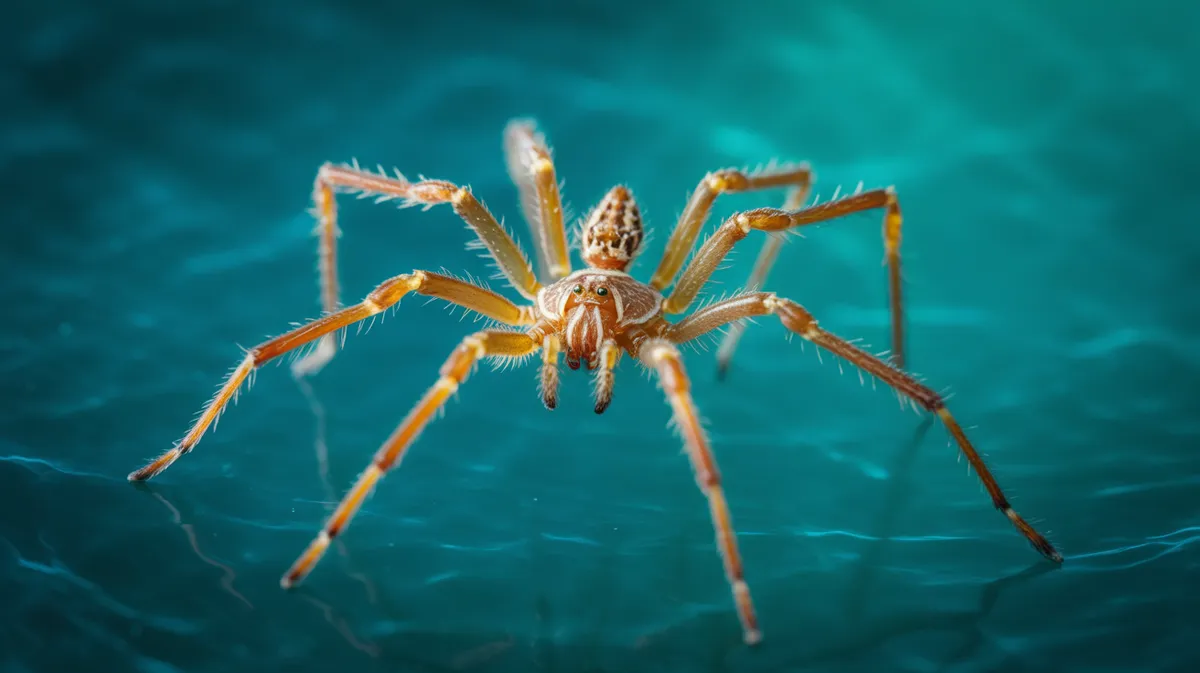
About the Sea Spider
Sea spiders (class Pycnogonida) are marine arthropods that look like a bundle of legs with almost nothing in between, and that impression is close to the truth: the body is so slender that the gut and gonads have been pushed out into the legs. A female's eggs mature inside her thighs, and the branching gut runs down each limb, so a sea spider effectively digests its meal in its legs. Because the body is too small to house a proper heart-driven circulation, the gut itself does much of the work, and researchers found that waves of peristalsis in the gut, not the feeble heart, drive haemolymph around the animal. Sea spiders have no dedicated gills or lungs; oxygen simply diffuses through the cuticle, which is why they can be long-legged but never thick-bodied. Most feed by pressing a long proboscis against soft-bodied prey such as anemones, hydroids and sponges and sucking out their tissues. Males, not females, carry the eggs, cementing them into balls on a pair of specialised legs called ovigers and hauling them about until they hatch. In the cold, oxygen-rich waters of the Antarctic and the deep sea they undergo polar gigantism, reaching leg spans of 50 to 70 centimetres, a body plan impossible in warm water where diffusion alone could not supply the tissues.
Fascinating facts
Leggy Anatomy
Sea spiders have extremely long legs compared to their tiny bodies, sometimes with a leg span over 10 times their body length.
Parental Care
In many species, males carry and protect the eggs on specialized appendages called ovigers until the young hatch.
Worldwide Distribution
Sea spiders inhabit every ocean, from shallow coastal waters to deep-sea environments, and are especially abundant in polar regions.
Detailed description
Pycnogonum littorale, commonly known as the sea spider, is a marine arthropod distinguished by its elongated, slender legs and compact, reduced body, resulting in a spindly appearance. Adults typically measure 1–3 cm in leg span, though some deep-sea relatives can exceed 70 cm. The body is divided into a cephalon (head), trunk, and a reduced abdomen, with most internal organs—such as the digestive tract and gonads—extending into the legs due to limited body space. Sea spiders lack respiratory and excretory organs; instead, gas exchange occurs directly through their cuticle and the extensive surface area of their legs. Their mouthparts are adapted into a proboscis, which is used to pierce and suck fluids from prey such as sea anemones, hydroids, and sponges. They possess four pairs of walking legs, with some species exhibiting additional appendages for feeding or reproduction. Pycnogonum littorale is generally solitary but may aggregate in areas with abundant prey. Their slow, deliberate movements are well-suited to their benthic lifestyle, often crawling over rocks, algae, and soft sediments in shallow coastal waters. The species is euryhaline, tolerating a range of salinities, and is found from the intertidal zone to depths of several hundred meters. Their coloration varies from pale yellow to reddish-brown, often providing camouflage among their invertebrate prey and substrates.
Did you know?
Sea spiders are found in all the world's oceans, including the frigid waters of Antarctica, where some reach extraordinary sizes due to polar gigantism.
Research & sources
Wikipedia summary
Sea spiders are marine arthropods of the class Pycnogonida, hence they are also called pycnogonids. The class includes the only now-living order Pantopoda, alongside a few fossil species which could trace back to the early or mid Paleozoic. They are cosmopolitan, found in oceans around the world. The over 1,300 known species have leg spans ranging from 1 mm (0.04 in) to over 70 cm (2.3 ft). Most are toward the smaller end of this range in relatively shallow depths; however, they can grow to be quite large in Antarctic and deep waters.
Behaviour & social structure
Sea spiders are primarily slow-moving, benthic predators and scavengers. They use their long legs to carefully traverse the seafloor, probing with their proboscis to locate soft-bodied invertebrates. Feeding involves inserting the proboscis into the tissues of prey and extracting bodily fluids, a process that can take several minutes. They are mostly solitary, showing little evidence of social interaction outside of mating. Activity levels are influenced by water temperature and prey availability, with individuals sometimes remaining stationary for extended periods while feeding. Pycnogonum littorale does not exhibit territoriality and may be found in loose aggregations where prey is abundant. They are primarily nocturnal or crepuscular, reducing predation risk and competition. Escape responses are limited; when threatened, they may retract their legs or remain motionless to avoid detection.
Reproduction & life cycle
Reproduction in Pycnogonum littorale involves external fertilization and a unique form of parental care. Males possess specialized ovigerous legs, which are used to carry fertilized eggs. During mating, the male and female align ventrally, and the female deposits eggs onto the male's ovigers, where they are fertilized. The male then carries the egg masses for several weeks, aerating and cleaning them until hatching. Larvae are released into the water column and undergo several planktonic stages before settling to the benthos and metamorphosing into juveniles. Breeding typically occurs in spring and summer, coinciding with increased prey availability. There is no further parental care after larval release.
Adaptations & survival
Pycnogonum littorale exhibits several adaptations for its marine lifestyle. The reduction of the body and extension of organs into the legs is a key adaptation to minimize body volume while maximizing surface area for gas exchange. The absence of gills or lungs is compensated by cutaneous respiration. The proboscis is highly specialized for piercing and sucking, allowing efficient exploitation of sessile or slow-moving prey. Ovigerous legs in males represent a rare case of paternal care among arthropods. Their cryptic coloration and slow movements aid in avoiding predators, while their ability to tolerate varying salinities allows them to inhabit a range of coastal environments. Some species can survive temporary desiccation, enabling them to persist in intertidal zones.
Cultural significance
Sea spiders have minimal direct significance in human culture, lacking economic or traditional uses. However, their unusual morphology and evolutionary distinctiveness have made them subjects of scientific curiosity and popular marine exhibits. In some cultures, their spider-like appearance has contributed to local myths or misconceptions, but they are not generally featured in folklore or symbolism.
Recent research
Recent research on Pycnogonum littorale and related pycnogonids has focused on their phylogenetic position within Chelicerata, revealing that they are a highly divergent lineage with ancient origins dating back to the Cambrian. Studies of their developmental biology have provided insights into arthropod segmentation and limb evolution. Ongoing research is investigating their physiological adaptations to hypoxia and cold, particularly in polar species. Advances in molecular genetics are clarifying species boundaries and evolutionary relationships, while ecological studies are examining their role in benthic food webs and responses to environmental stressors.
Videos
Habitat
Ocean

Conservation
The Sea Spider is currently classified as Least Concern on the IUCN Red List.
Threats & challenges
Currently, Pycnogonum littorale faces few direct threats and is classified as Least Concern. However, localized populations may be affected by habitat degradation, pollution, and climate change, particularly ocean acidification and warming, which can impact prey availability and reproductive success. Coastal development and eutrophication may alter benthic habitats, while invasive species could introduce new competitors or predators. Despite these potential challenges, the species' broad distribution and ecological tolerance contribute to its overall stability.
Taxonomy
Scientific name
Pycnogonum littorale
- Kingdom
- Animalia
- Phylum
- Arthropoda
- Class
- Pycnogonida
- Order
- Pantopoda
- Family
- Pycnogonidae
- Genus
- Pycnogonum
- Species
- littorale
Community notes
Share your observations about the Sea Spider.
No community notes yet. Be the first!
Discover more wildlife
More fascinating animals from the encyclopedia.