
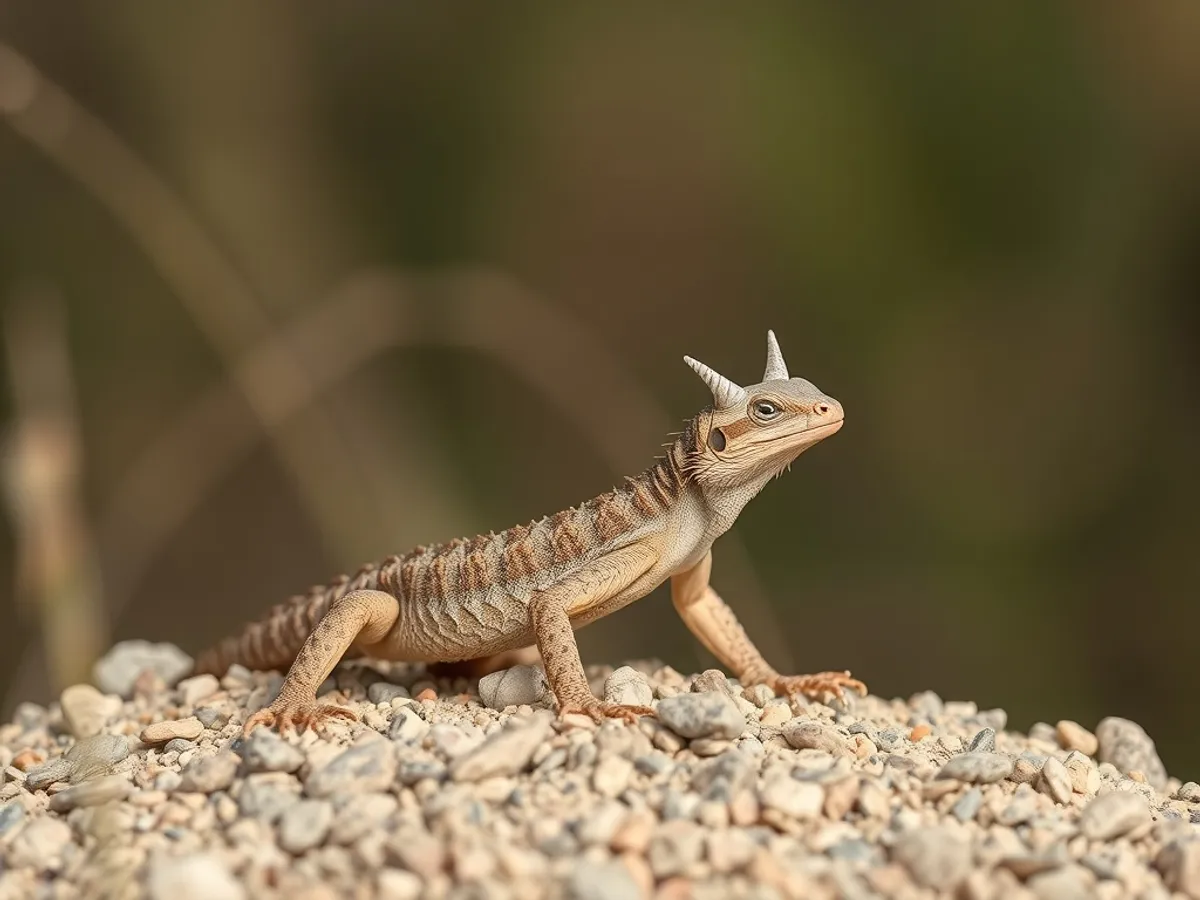
About the Short-horned Lizard
The Short-horned Lizard is a small, flat-bodied reptile known for its distinctive short, blunt horns on the back of its head. Its coloration typically ranges from gray to reddish-brown, helping it blend seamlessly into the arid and rocky environments of western North America. This species is well-adapted to life in open, dry habitats, often relying on its camouflage and stillness to avoid predators. When threatened, it can employ several defensive behaviors, including puffing up its body to appear larger.
Fascinating facts
Distinctive Body Shape
Short-horned Lizards have a broad, flattened body and short, pointed horns on their heads, which help deter predators.
Ant Specialist
These lizards are highly specialized insectivores, with ants making up the bulk of their diet.
Blood-Squirting Defense
When threatened by predators, especially canines, Short-horned Lizards can squirt blood from their eyes as a defense.
Detailed description
The greater short-horned lizard (Phrynosoma hernandesi) is a small, robust lizard typically measuring 5–11 cm (2–4.3 in) in snout-to-vent length, with a total length up to 15 cm (6 in). Its most distinctive features are the short, conical horns projecting from the back of the head, which are actually modified scales. The body is broad, flat, and covered with spiny scales, providing both camouflage and protection against predators. Coloration varies widely, from gray and tan to reddish-brown, often matching the local substrate, and may include subtle banding or blotching. The ventral surface is lighter, usually cream or white. The limbs are short and strong, adapted for digging and rapid bursts of movement. The tail is short and blunt. The eyes are positioned high on the head, giving a wide field of view to detect predators. This species is primarily diurnal, basking in the morning and late afternoon to regulate its body temperature. When threatened, it can inflate its body, hiss, and in rare cases, squirt blood from the eyes as a defense mechanism against predators.
Did you know?
Unlike many lizards, the Short-horned Lizard gives birth to live young instead of laying eggs.
Research & sources
Wikipedia summary
The greater short-horned lizard, also commonly known as the mountain short-horned lizard or Hernández's short-horned lizard, is a species of lizard in the family Phrynosomatidae. The species is endemic to western North America. Like other horned lizards, it is often called a "horned toad" or "horny toad", but it is not a toad at all. It is a reptile, not an amphibian. It is one of seven native species of lizards in Canada.
Behaviour & social structure
Greater short-horned lizards are solitary and territorial, with individuals maintaining overlapping home ranges that can vary from 100 to 500 square meters depending on habitat quality. They are sit-and-wait predators, relying on their cryptic coloration and stillness to ambush prey, which consists mainly of ants (especially harvester ants), beetles, spiders, and other small invertebrates. Foraging activity peaks in the morning and late afternoon, coinciding with optimal thermal conditions. These lizards are adept at burrowing into loose soil or leaf litter to escape extreme temperatures or evade predators. Social interactions are limited outside of the breeding season, with occasional displays of head-bobbing and push-ups to establish dominance or territory. During cooler months, they enter brumation (a form of reptilian hibernation), typically from late fall to early spring, burrowing below the frost line.
Reproduction & life cycle
Phrynosoma hernandesi is viviparous, giving birth to live young rather than laying eggs—a rare trait among lizards in temperate regions. Mating occurs in late spring to early summer (May–June), with males engaging in courtship behaviors such as head-bobbing and circling. Females undergo a gestation period of approximately 8–10 weeks, depending on environmental temperature. Litter sizes range from 6 to 30 young, with an average of 10–15. Neonates are fully independent at birth, measuring about 2.5 cm (1 in) in length, and receive no parental care. Breeding frequency is typically annual, but may be biennial in colder or higher elevation populations due to shorter active seasons.
Adaptations & survival
The greater short-horned lizard exhibits several remarkable adaptations for survival in arid and semi-arid environments. Its cryptic coloration and spiny body provide camouflage and deter predation. The ability to squirt blood from the ocular sinuses is a unique anti-predator defense, primarily effective against canid predators, as the blood contains chemicals that are distasteful to them. The lizard's flattened body increases surface area for thermoregulation, allowing efficient heat absorption and dissipation. Specialized jaw and tongue morphology enable efficient consumption of ants, which are a challenging prey due to their small size and chemical defenses. Viviparity is an adaptation to cooler climates, as internal gestation allows for temperature regulation of developing embryos. The lizard also exhibits water-conserving behaviors, such as burrowing and activity timing, to minimize desiccation.
Cultural significance
Horned lizards, including Phrynosoma hernandesi, hold cultural significance for many Indigenous peoples of North America, often symbolizing protection, patience, and resilience. They appear in traditional stories and artwork, and some groups historically used them in rituals or as totem animals. The lizard's unique appearance and defensive behaviors have made it a subject of fascination in popular culture, sometimes erroneously referred to as 'horned toads.' There is no evidence of significant medicinal or utilitarian use, but the species is occasionally kept as an educational animal in zoos and nature centers.
Recent research
Recent research on Phrynosoma hernandesi has focused on its genetic diversity and taxonomy, as populations across its range exhibit significant morphological and genetic variation. Some studies suggest that what is currently recognized as P. hernandesi may represent a complex of closely related species or subspecies. Ongoing work includes radio-telemetry studies of movement patterns, investigations into the physiological mechanisms of blood-squirting, and the impacts of climate change on reproductive timing and habitat use. Conservation genetics is also a growing field, particularly for isolated northern populations. A 2022 study used environmental DNA (eDNA) to improve detection of populations in fragmented habitats.
Videos
Habitat
Semi-arid grasslands, sagebrush plains, and open forests
 Arid Regions
Desert
Arid lands with minimal rainfall, extreme temperatures, and specialized wildlife adapted to harsh conditions.
 Various Continental Regions
Grassland
Open areas dominated by grasses rather than trees, supporting numerous herbivores and their predators.
 Elevated Terrain
Mountain
High-altitude environments with varying climates and specialized wildlife adapted to rugged terrain and thin air.
 Global
Forest
Wooded areas with significant tree cover and diverse plant and animal communities.
Conservation
The Short-horned Lizard is currently classified as Least Concern on the IUCN Red List.
Threats & challenges
Although currently listed as Least Concern by the IUCN, the greater short-horned lizard faces several localized threats. Habitat loss and fragmentation due to agriculture, urbanization, and resource extraction reduce available habitat and prey abundance. Pesticide use can diminish ant populations, the lizard's primary food source. Road mortality and illegal collection for the pet trade pose additional risks in some areas. Climate change may alter habitat suitability, particularly at the northern and elevational limits of its range. In Canada, where populations are isolated and declining, the species is considered at risk and is protected under provincial legislation. Conservation efforts focus on habitat protection, public education, and research on population trends.
Taxonomy
Scientific name
Phrynosoma hernandesi
- Kingdom
- Animalia
- Phylum
- Chordata
- Class
- Reptilia
- Order
- Squamata
- Family
- Phrynosomatidae
- Genus
- Phrynosoma
- Species
- hernandesi
Community notes
Share your observations about the Short-horned Lizard.
No community notes yet. Be the first!
Discover more wildlife
More fascinating animals from the encyclopedia.