
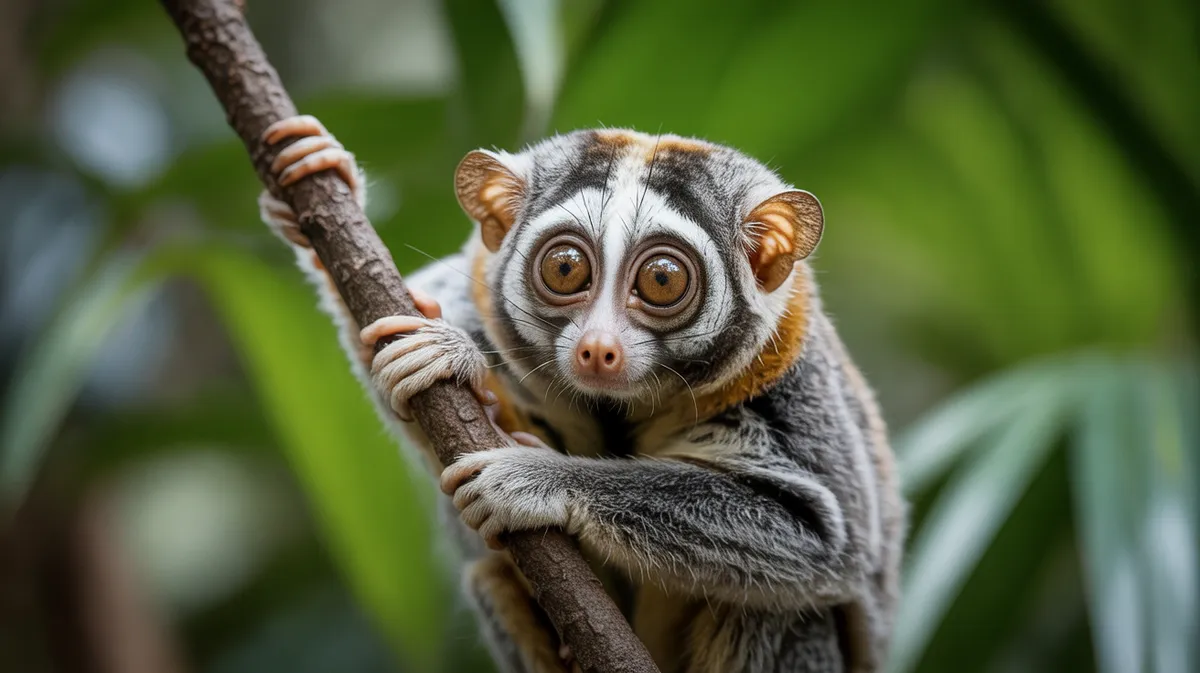
About the Slender loris
The slender loris is a small, nocturnal primate native to the forests of southern India and Sri Lanka. Characterized by its slender limbs, large forward-facing eyes, and elongated fingers, it is exceptionally well-adapted for an arboreal lifestyle, moving gracefully through dense foliage. Its soft, grayish or reddish fur, coupled with its slow, deliberate movements, help it remain camouflaged from predators. Slender lorises are known for their gentle and secretive nature, rarely descending from the trees during their nightly foraging expeditions.
Fascinating facts
Nocturnal Lifestyle
Slender lorises are strictly nocturnal, using their large eyes to navigate and hunt at night.
Insect Specialist
Although omnivorous, they primarily feed on insects, especially moths and beetles, using their long fingers to extract prey from tree bark and crevices.
Arboreal Acrobats
They are highly agile in the trees, rarely coming down to the ground and using their flexible joints to move silently among branches.
Detailed description
The slender loris (Loris tardigradus) is a small, nocturnal strepsirrhine primate distinguished by its delicate build, elongated limbs, and exceptionally large, forward-facing eyes adapted for enhanced night vision. Adults typically measure 18–26 cm in head-body length and weigh between 85–350 grams, with the red slender loris (L. tardigradus) being slightly smaller and more gracile than the gray slender loris (L. lydekkerianus). Their soft fur varies from reddish-brown to grayish hues, providing camouflage amid the dense foliage of their arboreal habitats. The hands and feet are highly specialized, with opposable thumbs and a reduced index finger, allowing for a powerful grip on branches and precise manipulation of prey. Slender lorises exhibit slow, deliberate locomotion, often 'bridging' gaps by stretching between branches, a strategy that minimizes detection by predators. Primarily insectivorous, they also consume small vertebrates, fruits, flowers, and gum exudates. Social structure is generally solitary or loosely organized, with individuals maintaining overlapping home ranges and communicating through scent marking and vocalizations. Reproduction is characterized by a low birth rate, with females giving birth to one or two offspring after a gestation period of approximately 166–174 days. Unique among primates, slender lorises possess a toxic bite, derived from secretions in their brachial glands, which they spread on their fur and use in defense. Their lifespan in the wild is estimated at 12–15 years, though this may be reduced by habitat loss and predation.
Did you know?
Despite their endearing appearance, slender lorises secrete a substance from their elbows that can cause irritation or allergic reactions in predators.
Research & sources
Wikipedia summary
The slender lorises (Loris) are a genus of loris native to India and Sri Lanka. The genus comprises two species, the red slender loris found in Sri Lanka and the gray slender loris from Sri Lanka and India. Slender lorises spend most of their life in trees, traveling along the tops of branches with slow and precise movements. They are found in tropical rainforests, scrub forests, semi-deciduous forests, and swamps. The primates have lifespans of approximately 15 years and are nocturnal. Slender lorises generally feed on insects, reptiles, plant shoots, and fruit.
Behaviour & social structure
Slender lorises are strictly nocturnal, emerging at dusk to forage and returning to their daytime sleeping sites before dawn. Their foraging behavior is characterized by slow, stealthy movements, allowing them to approach insect prey undetected. They use their acute sense of smell and vision to locate prey, often capturing insects such as beetles, moths, and crickets with swift, precise hand movements. Occasionally, they supplement their diet with small reptiles, bird eggs, and plant matter. Social interactions are limited; individuals are generally solitary but may form sleeping groups, especially females with offspring or subadults. Communication involves a repertoire of high-pitched whistles, clicks, and growls, as well as scent marking using urine and glandular secretions. Territorial disputes are rare but can involve vocal displays and, occasionally, physical confrontations. Grooming is an important social activity, particularly between mothers and young.
Reproduction & life cycle
Slender lorises exhibit a polygynous mating system, with males competing for access to receptive females. Breeding can occur year-round but often peaks during the rainy season when food is abundant. After a gestation period of about 5.5–6 months (166–174 days), females give birth to one or, rarely, two infants. Newborns are altricial, with closed eyes and limited mobility, and are carried by the mother clinging to her belly or left in nests while she forages. Maternal care is intensive, with weaning occurring at around 6–7 months of age. Sexual maturity is reached at approximately 10–12 months for females and slightly later for males. Interbirth intervals are typically long, reflecting the species' slow reproductive rate.
Adaptations & survival
The slender loris exhibits several key adaptations for an arboreal, nocturnal lifestyle. Its large eyes provide excellent night vision, while a reflective tapetum lucidum enhances light sensitivity. The hands and feet are highly prehensile, with a reduced index finger and opposable thumbs for grasping narrow branches. The slow, deliberate locomotion, known as 'cryptic movement,' helps avoid detection by predators and prey. The species' brachial gland produces a secretion that, when mixed with saliva, delivers a mild toxin via their bite, deterring predators and possibly providing antimicrobial protection. Their flexible joints and elongated limbs enable them to bridge gaps and maneuver through dense vegetation with minimal noise.
Cultural significance
In South Asian folklore, slender lorises have been associated with mystical powers and are sometimes believed to possess medicinal properties, leading to their exploitation in traditional medicine. In some regions, they are considered omens or are featured in local myths as creatures with supernatural abilities due to their nocturnal habits and unusual appearance. However, there is also a growing recognition of their ecological importance and a shift toward conservation-oriented attitudes in local communities.
Recent research
Recent research has focused on the slender loris's unique toxic bite, with studies identifying the chemical composition of brachial gland secretions and their potential role in defense and social communication. Advances in radio telemetry and camera trapping have improved understanding of their home range, habitat use, and population densities. Genetic studies are clarifying the taxonomy and evolutionary relationships within the genus Loris, revealing significant genetic divergence between populations. Ongoing conservation research emphasizes habitat connectivity, community-based protection, and the impact of environmental change on loris populations.
Videos
Habitat
Tropical and subtropical forests


Conservation
The Slender loris is currently classified as Endangered on the IUCN Red List.
Threats & challenges
Major threats to slender lorises include habitat loss and fragmentation due to deforestation, agricultural expansion, and urbanization. Illegal capture for the pet trade and use in traditional medicine further exacerbate population declines. Road mortality and electrocution from power lines are additional anthropogenic threats. The species is highly sensitive to habitat disturbance, requiring contiguous, undisturbed forest for survival. Population trends are generally declining, with some subpopulations considered critically endangered. Conservation challenges include enforcing legal protections, habitat restoration, and mitigating human-wildlife conflict.
Taxonomy
Scientific name
Loris tardigradus
- Kingdom
- Animalia
- Phylum
- Chordata
- Class
- Mammalia
- Order
- Primates
- Family
- Lorisidae
- Genus
- Loris
- Species
- tardigradus
Where to see a slender loris
3 zoos and aquariums in 2 countries are recorded as keeping this species.
 Newquay Zoo🇬🇧 Newquay, United Kingdom
 London Zoo🇬🇧 London, United Kingdom
 Memphis Zoo🇺🇸 Memphis, United States
Community notes
Share your observations about the Slender loris.
No community notes yet. Be the first!
Discover more wildlife
More fascinating animals from the encyclopedia.