
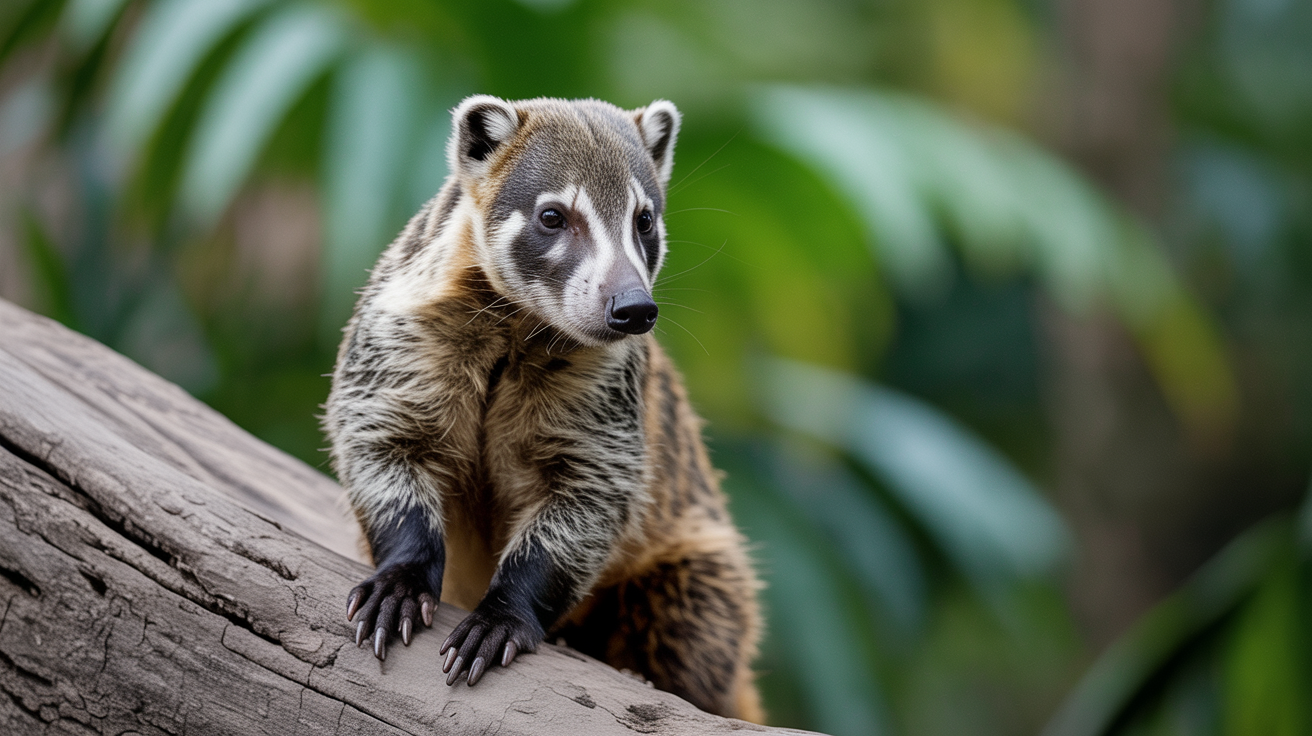
About the South American Coati
The South American coati, also known as the ring-tailed coati, is a diurnal, highly social mammal native to South America. Recognizable by its elongated, flexible snout and distinctive ringed tail, the coati is an agile climber and forager. Coatis live in groups called bands, typically consisting of females and their young, while adult males tend to be solitary. They are opportunistic omnivores, consuming a diverse diet ranging from fruits and insects to small vertebrates. Their adaptability allows them to thrive in a variety of forested habitats, from lowland rainforests to dry woodlands.
Fascinating facts
Flexible Snouts
Coatis have highly flexible, elongated snouts that help them root out insects, eggs, and other food hidden in crevices or under debris.
Tree Dwellers
They are skilled climbers and often rest, forage, or even build nests in trees to avoid ground predators.
Social Structure
Female coatis and their young live in large groups called bands, sometimes numbering up to 30 individuals, while adult males are generally solitary.
Detailed description
The South American coati (Nasua nasua) is a medium-sized procyonid mammal distinguished by its elongated, highly flexible snout, which is used to probe for food in crevices and leaf litter. Adults typically weigh between 2 and 7.2 kg (4.4–15.9 lb) and measure 85–113 cm (33–44 in) in total length, with the tail accounting for nearly half of this measurement. Their fur color varies from reddish-brown to grayish, with a paler underside and a tail marked by faint or prominent dark rings. Unlike its northern relative, the white-nosed coati, N. nasua has a uniformly brown or blackish snout. The species exhibits pronounced sexual dimorphism, with males being up to 20% larger than females. Coatis are diurnal and highly social, forming female-led groups called bands that can number up to 30 individuals, while adult males are typically solitary outside the breeding season. They are agile climbers and spend significant time both on the ground and in trees, using their strong limbs and semi-prehensile tails for balance. Their keen sense of smell and dexterous forepaws aid in foraging for a diverse diet. Vocalizations and tail postures are important for communication within groups. The South American coati occupies a wide range of habitats, from lowland rainforests and gallery forests to dry woodlands and scrub, and is found from northern Argentina and Uruguay through much of Brazil, Paraguay, Bolivia, and into western Colombia and Ecuador.
Did you know?
Coatis have double-jointed ankles that can rotate beyond 180 degrees, enabling them to descend trees headfirst.
Research & sources
Wikipedia summary
The South American coati, also known as the ring-tailed coati or brown-nosed coati, is a coati species and a member of the raccoon family (Procyonidae), found in the tropical and subtropical parts of South America. An adult generally weighs from 2–7.2 kg (4.4–15.9 lb) and is 85–113 cm (33–44 in) long, with half of that being its tail. Its color is highly variable and the rings on the tail may be only somewhat visible, but its most distinguishing characteristic is that it lacks the largely white snout of its northern relative, the white-nosed coati.
Behaviour & social structure
South American coatis are primarily diurnal, with most activity occurring in the early morning and late afternoon. Foraging is a group activity for females and juveniles, who move through the understory and forest floor in search of fruits, invertebrates, small vertebrates, eggs, and occasionally carrion. Their foraging technique involves using their mobile snouts and strong claws to dig, overturn debris, and probe into holes. Social interactions within bands are complex, involving grooming, play, and vocal communication such as chirps, grunts, and alarm barks. Dominance hierarchies are established among females, often based on age and size. Adult males are generally excluded from bands except during the breeding season and are more solitary, with larger home ranges. Coatis sleep in trees or dense vegetation, often using different sleeping sites each night to avoid predators. When threatened, they may climb trees or use coordinated alarm calls and tail-raising to alert the group.
Reproduction & life cycle
Breeding in South American coatis is seasonal and typically synchronized with the onset of the rainy season, which varies geographically but often occurs between October and February. During this period, solitary adult males join female bands temporarily for mating. After a gestation period of approximately 74–77 days, females leave the group to give birth in secluded nests built in trees or dense vegetation. Litters usually consist of 2–7 young. The mother cares for the altricial offspring alone for the first 5–6 weeks, after which she rejoins the band with her young. Weaning occurs at around 4 months, but juveniles remain with the band for up to two years. Sexual maturity is reached at about 2 years for females and 3 years for males.
Adaptations & survival
South American coatis possess several adaptations for their omnivorous and arboreal lifestyle. Their elongated, flexible snout is highly sensitive and can move in multiple directions, allowing them to locate hidden prey and food items. Their strong, curved claws and robust forelimbs are well-suited for digging and climbing, while their semi-prehensile tails provide balance in trees. Coatis have acute senses of smell and hearing, aiding in foraging and predator detection. Social living in bands provides protection against predators and increases foraging efficiency. Their omnivorous diet and behavioral flexibility enable them to exploit a wide range of food resources and habitats, contributing to their ecological success.
Cultural significance
Coatis feature in the folklore and traditional knowledge of several indigenous South American cultures, often symbolizing cleverness and resourcefulness. In some regions, their meat is consumed, and their skins have been used for various purposes. Coatis are occasionally kept as pets, although this is discouraged due to their complex social and behavioral needs. In ecotourism areas, coatis are sometimes habituated to humans, which can lead to conflicts and health risks for both animals and people.
Recent research
Recent research on South American coatis has focused on their social structure, communication, and ecological roles as seed dispersers and predators of invertebrates and small vertebrates. Genetic studies have clarified the relationships among coati species and subspecies, revealing significant regional variation. Ongoing studies are examining the impacts of habitat fragmentation on coati movement, genetic diversity, and disease transmission. Camera trap surveys and GPS telemetry are increasingly used to monitor their populations and behavior in the wild.
Videos
Habitat
Tropical and subtropical forests
 Various Continental Regions
Grassland
Open areas dominated by grasses rather than trees, supporting numerous herbivores and their predators.
 Elevated Terrain
Mountain
High-altitude environments with varying climates and specialized wildlife adapted to rugged terrain and thin air.
 Tropical Regions
Rainforest
Dense, wet forests with the highest biodiversity on Earth, containing more than half of the world's plant and animal species.
 Global
Forest
Wooded areas with significant tree cover and diverse plant and animal communities.
Conservation
The South American Coati is currently classified as Least Concern on the IUCN Red List.
Threats & challenges
While the South American coati is currently classified as Least Concern by the IUCN, local populations face threats from habitat loss due to deforestation, agricultural expansion, and urbanization. They are sometimes hunted for their meat or captured for the pet trade, and may be killed as crop pests. Road mortality is an increasing concern in fragmented landscapes. Coatis are also susceptible to diseases transmitted by domestic animals. Despite these pressures, their adaptability and broad diet have allowed them to persist in many disturbed environments, although long-term population trends in heavily altered habitats remain uncertain.
Taxonomy
Scientific name
Nasua nasua
- Kingdom
- Animalia
- Phylum
- Chordata
- Class
- Mammalia
- Order
- Carnivora
- Family
- Procyonidae
- Genus
- Nasua
- Species
- nasua
Where to see a south american coati
8 zoos and aquariums in 5 countries are recorded as keeping this species.
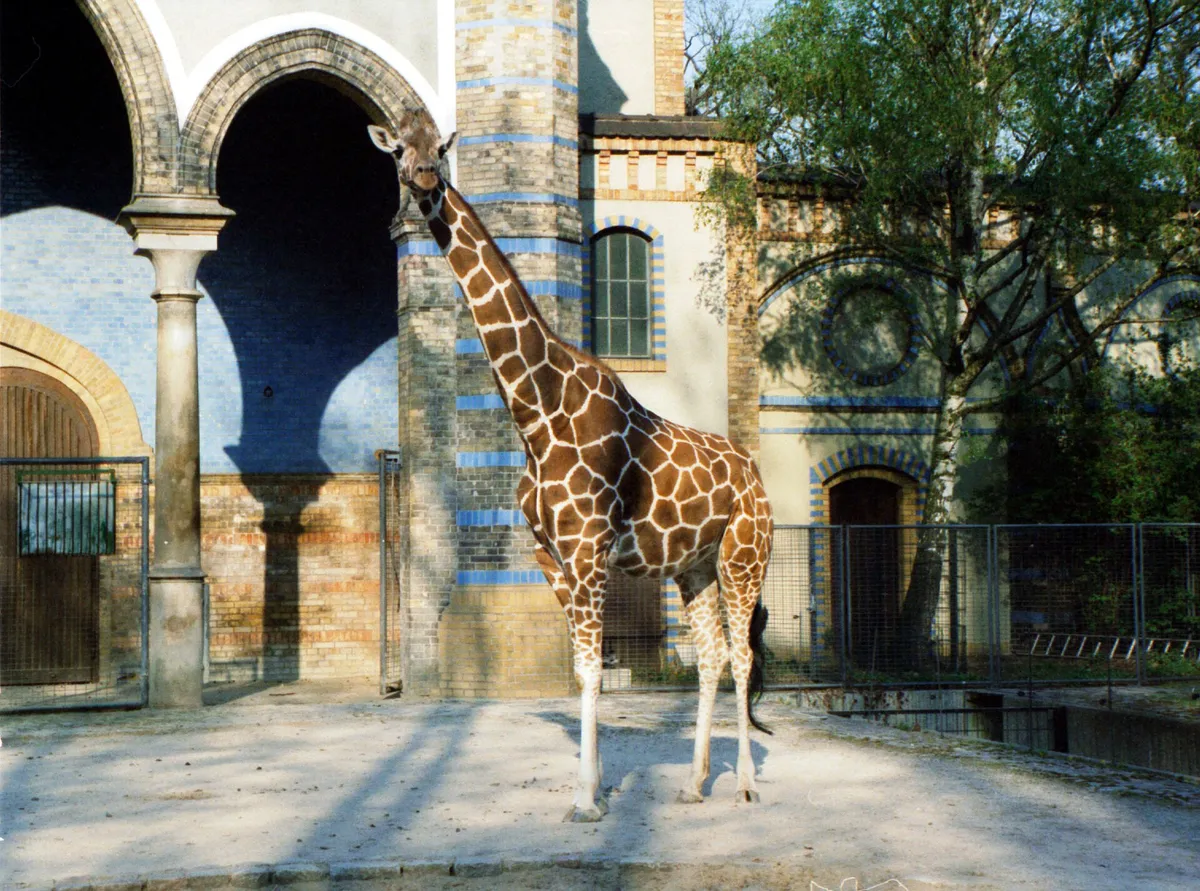 Berlin Zoo🇩🇪 Berlin, Germany
 Detroit Zoo🇺🇸 Royal Oak, United States
 Paignton Zoo🇬🇧 Paignton, United Kingdom
 Śląski Ogród Zoologiczny🇵🇱 Chorzów, Poland
 London Zoo🇬🇧 London, United Kingdom
Community notes
Share your observations about the South American Coati.
No community notes yet. Be the first!
Discover more wildlife
More fascinating animals from the encyclopedia.