
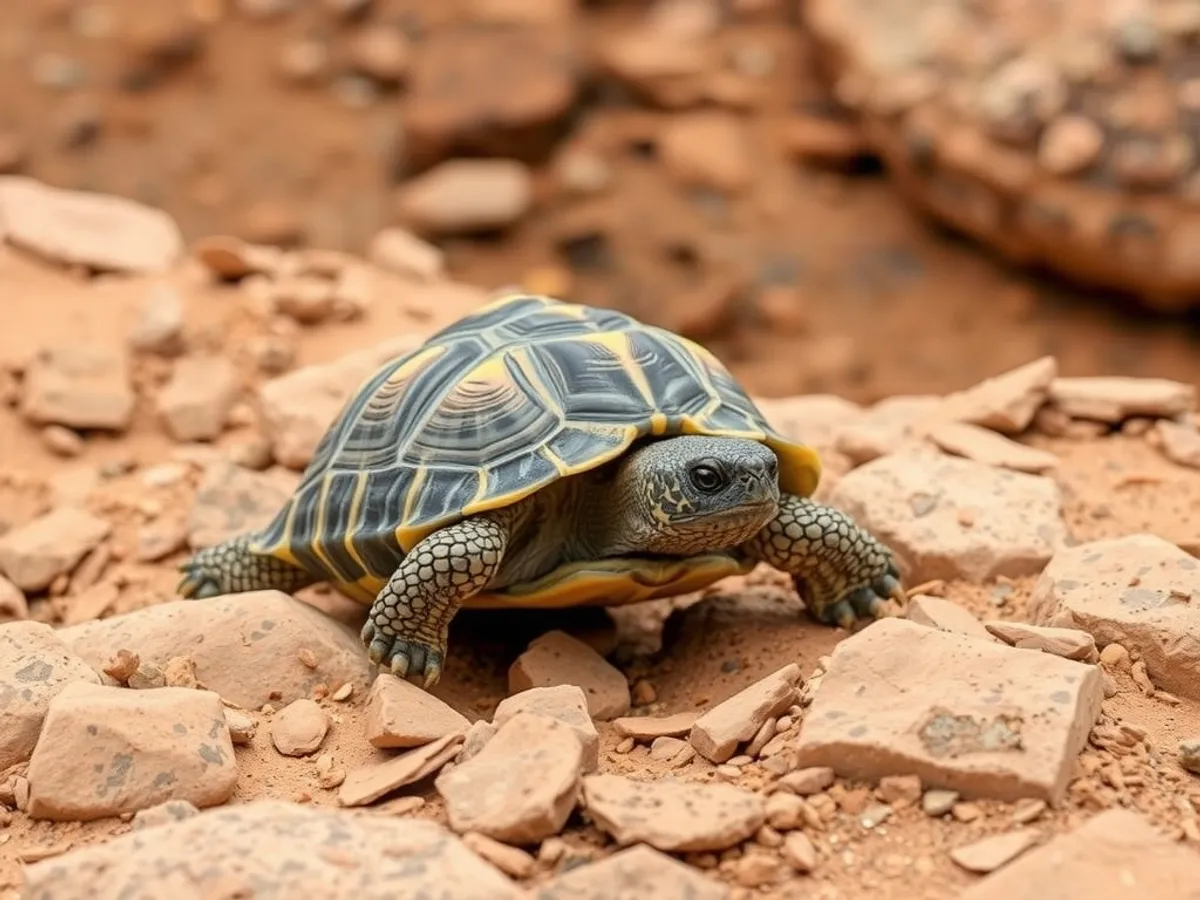
About the Speckled Padloper Tortoise
The speckled padloper (Chersobius signatus) of Namaqualand and the western Cape is the smallest tortoise in the world: males mature at around 6 to 8 centimetres and adults weigh roughly 95 to 165 grams, small enough to sit in a matchbox. Everything about it is fitted to granite. The shell is unusually flattened and slightly flexible, and the animal wedges itself into narrow rock crevices for the night and during the fierce heat of the day, which is both an escape from predators and a way to avoid lethal temperatures on the exposed outcrops it lives among. Unlike most tortoises it is nimble and climbs rocks readily, using the shell's low profile to squeeze into cracks a bird cannot follow. Its diet is the small succulents and annual plants that flush after the winter rains, and it is active mainly in the cooler morning and evening. Reproduction is correspondingly minimal: a female lays a single, relatively large egg at a time, perhaps a few times in a good season, so any losses are replaced slowly. The species is confined to a narrow strip of Succulent Karoo, and it is under pressure from collection for the pet trade, from overgrazing that removes its food plants, and from introduced predators, and it is listed as Endangered.
Fascinating facts
World's Smallest Tortoise
Adult Speckled Padloper Tortoises typically grow only 6–8 cm long, making them the smallest tortoise species globally.
Rocky Home
Their speckled shells mimic the appearance of the quartzite rocks in their habitat, providing excellent camouflage from predators.
Water Conservation
They obtain most of their moisture from dew and the succulent plants they eat, an adaptation to their arid environment.
Detailed description
The Speckled Padloper Tortoise (Chersobius signatus, formerly Homopus signatus) is the smallest tortoise species in the world, with adult males typically reaching a carapace length of 6–8 cm and females up to 10 cm, and weighing between 95–165 grams. Its carapace is highly domed and adorned with numerous black or dark brown speckles on a yellow to orange-brown background, providing effective camouflage among the quartzite and granite outcrops of its native habitat. The plastron is pale with variable dark markings. The limbs are short and robust, with five toes on the forelimbs (a distinguishing feature among padlopers), and the head is small and wedge-shaped, aiding in maneuvering through narrow rock crevices. The skin is granular and matches the shell in coloration, further enhancing concealment. This species is diurnal, emerging in the early morning and late afternoon to bask and forage, while avoiding the midday heat. It is primarily herbivorous, feeding on a variety of small succulents, forbs, and grasses endemic to the Succulent Karoo biome. The Speckled Padloper is solitary and highly territorial, with individuals maintaining small, overlapping home ranges. Reproduction is oviparous, with females laying one or occasionally two eggs per clutch, typically in the spring or early summer. The species is highly adapted to arid conditions, with physiological and behavioral mechanisms to minimize water loss and withstand extreme temperature fluctuations.
Did you know?
Despite its tiny size, the Speckled Padloper Tortoise can climb steep, rocky surfaces with surprising agility.
Research & sources
Wikipedia summary
Chersobius signatus is the world's smallest species of tortoise. The species is commonly known as the speckled tortoise and also known locally as the speckled padloper and internationally as the speckled Cape tortoise. A member of the genus Chersobius, it is endemic to South Africa.
Behaviour & social structure
Speckled Padlopers are secretive and elusive, spending much of their time hidden in rock crevices to avoid predators and desiccation. They are most active during cool, moist conditions, particularly after rainfall, when food is more abundant. Foraging is slow and deliberate, with individuals selecting specific plant species, often favoring endemic succulents and small annuals. Social interactions are limited, as adults are generally solitary, but males may display aggressive behaviors such as ramming or biting during the breeding season to establish dominance or secure mates. Daily routines include basking in the morning to raise body temperature, followed by short foraging excursions, and retreating to shelter during the hottest part of the day. Defensive behaviors include withdrawing tightly into their shells and wedging themselves into crevices, making extraction by predators extremely difficult.
Reproduction & life cycle
Breeding occurs during the South African spring and early summer (September to December), coinciding with increased rainfall and food availability. Courtship involves males following and occasionally biting females, with copulation occurring in sheltered locations. Females lay a single, hard-shelled egg per clutch, though two eggs are possible in rare cases. Eggs are deposited in shallow nests dug in sandy soil or under rocks. Incubation lasts approximately 100–120 days, depending on ambient temperature and humidity. Hatchlings are exceptionally small, measuring about 25–30 mm in carapace length and weighing 6–8 grams. There is no parental care post-oviposition; hatchlings are independent from birth and must immediately seek shelter and food.
Adaptations & survival
The Speckled Padloper exhibits several remarkable adaptations for survival in arid, rocky environments. Its diminutive size and flattened, domed shell allow it to access narrow rock fissures for protection from predators and extreme temperatures. The cryptic speckled coloration provides camouflage against lichen-covered rocks. Physiologically, it has a low metabolic rate and is capable of tolerating dehydration; it can absorb water from dew and succulent plants. Behavioral adaptations include crevice-dwelling, activity restricted to cooler periods, and selective feeding on drought-resistant flora. The species' reproductive strategy—producing few, well-protected eggs—reflects adaptation to an unpredictable environment where juvenile survival is challenging.
Cultural significance
While the Speckled Padloper does not have significant roles in traditional folklore or mythology, it is emblematic of the unique biodiversity of South Africa's arid regions. Conservation organizations use its image to promote awareness of the fragile Succulent Karoo ecosystem. Locally, it is sometimes referred to as the 'padloper' (Afrikaans for 'path-walker'), reflecting its terrestrial habits. Its rarity and diminutive size have made it a subject of fascination among herpetologists and wildlife enthusiasts, but also a target for illegal collectors.
Recent research
Recent research has focused on the species' microhabitat preferences, thermoregulatory behavior, and dietary specialization, revealing a strong dependence on endemic plant species and specific rock formations for survival. Genetic studies have clarified its taxonomic status within the genus Chersobius, distinguishing it from closely related padloper species. Health assessments of wild populations have highlighted the impact of environmental stressors and the species' vulnerability to respiratory and nutritional disorders in captivity. Ongoing conservation research includes habitat restoration, anti-poaching initiatives, and the development of captive breeding protocols, though successful long-term captive maintenance remains elusive due to the species' specialized needs.
Videos
Habitat
Rocky outcrops in arid and semi-arid regions


Conservation
The Speckled Padloper Tortoise is currently classified as Vulnerable on the IUCN Red List.
Threats & challenges
The primary threats to the Speckled Padloper Tortoise are habitat destruction and fragmentation due to agricultural expansion, mining, and urban development in the Succulent Karoo. Illegal collection for the international pet trade has also severely impacted wild populations, as the species does not thrive in captivity and has specialized dietary and habitat requirements. Road mortality and predation by introduced species (such as domestic dogs and pigs) further exacerbate population declines. Climate change poses a long-term threat by altering rainfall patterns and increasing the frequency of droughts. The species is listed as Vulnerable by the IUCN, with populations continuing to decline despite legal protections and conservation measures.
Taxonomy
Scientific name
Homopus signatus
- Kingdom
- Animalia
- Phylum
- Chordata
- Class
- Reptilia
- Order
- Testudines
- Family
- Testudinidae
- Genus
- Homopus
- Species
- signatus
Community notes
Share your observations about the Speckled Padloper Tortoise.
No community notes yet. Be the first!
Discover more wildlife
More fascinating animals from the encyclopedia.