
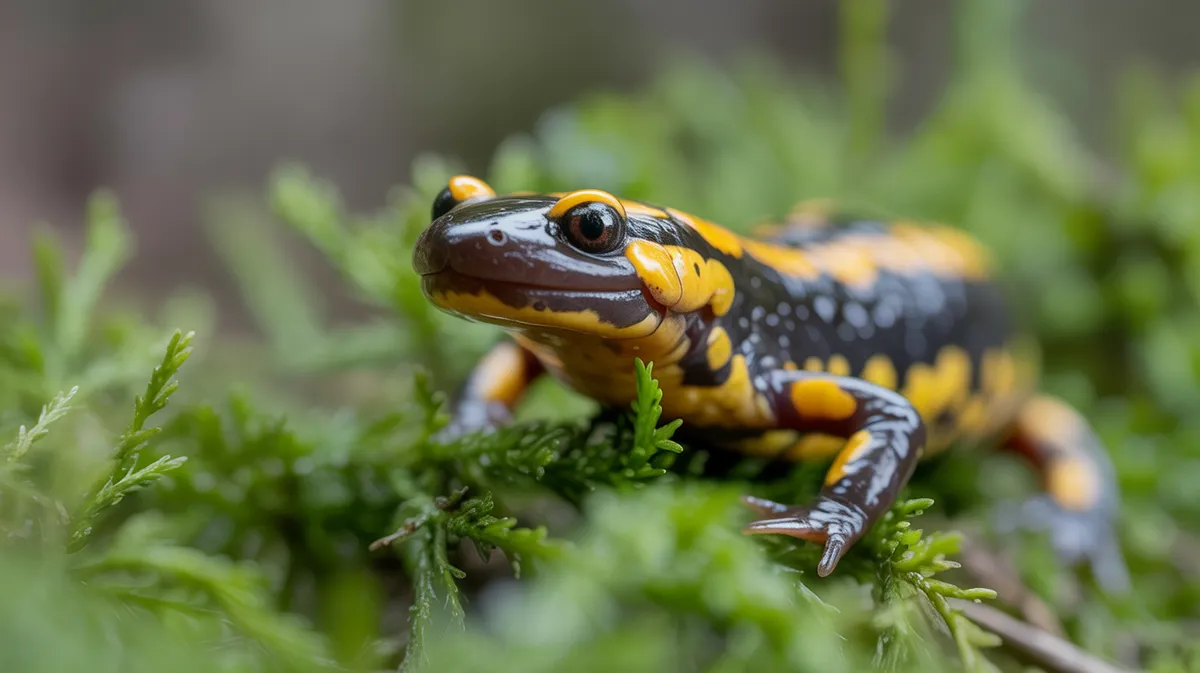
About the Spectacled Salamander
The Spectacled Salamander is a small, secretive amphibian native to the Apennine Mountains of Italy. Named for the distinctive light-colored markings around its eyes that resemble spectacles, this salamander is primarily nocturnal and prefers moist, shaded environments. It is well-adapted to life on the forest floor, spending much of its time hidden under rocks, logs, and leaf litter. Due to its limited range and specialized habitat requirements, the Spectacled Salamander is considered a species of conservation concern.
Fascinating facts
Spectacle Markings
The light, spectacle-shaped markings around its eyes give the Spectacled Salamander its common name and help distinguish it from other salamanders.
Forest Dweller
This salamander relies on moist, undisturbed deciduous forests and is rarely seen outside these habitats.
Land-Based Lifecycle
Unlike many other amphibians, the Spectacled Salamander's young hatch as miniature adults and do not go through an aquatic larval stage.
Detailed description
The Spectacled Salamander (Salamandrina perspicillata) is a small, slender amphibian, typically measuring 7–12 cm in total length, with females generally larger than males. Its most distinctive feature is the pale, cream-colored marking encircling each eye, giving the appearance of 'spectacles' and aiding in species recognition. The dorsal coloration is dark brown to black, providing camouflage among leaf litter, while the ventral side is marked with striking black and white marbling and vivid red or orange patches on the limbs and underside of the tail, which serve as aposematic signals to deter predators. The skin is moist and finely granular, facilitating cutaneous respiration, which is vital as the species often inhabits humid microhabitats. The limbs are relatively short, with four digits on the forelimbs and five on the hindlimbs, adapted for terrestrial locomotion. The tail is cylindrical and tapers to a point, used in defensive displays. Spectacled Salamanders are primarily terrestrial outside the breeding season, showing a strong preference for undisturbed, shaded deciduous forests with abundant ground cover. Their secretive, nocturnal lifestyle helps minimize predation and desiccation. This species is endemic to the northern and central Apennine Mountains of Italy, with a fragmented distribution due to habitat specificity. Notably, S. perspicillata is morphologically and genetically distinct from its southern relative, S. terdigitata.
Did you know?
The Spectacled Salamander is one of just two species in its genus, both of which are found only in Italy.
Research & sources
Wikipedia summary
The spectacled salamander is a species of salamander in the family Salamandridae.
Behaviour & social structure
Spectacled Salamanders are nocturnal and crepuscular, emerging at dusk or after rainfall to forage. They are solitary outside the breeding season, exhibiting territoriality, especially among males. Their diet consists mainly of small invertebrates such as insects, spiders, worms, and mollusks, which they locate using chemosensory cues. Prey is captured with a rapid extension of the sticky tongue. When threatened, they display the unken reflex: arching the body and curling the tail to expose the brightly colored ventral surfaces as a warning to potential predators. During the day, they remain hidden under rocks, logs, or deep leaf litter to avoid dehydration and predation. Activity peaks in spring and autumn, with reduced movement during the hot, dry summer and cold winter months, when they may enter a state of torpor.
Reproduction & life cycle
Breeding occurs primarily from March to May, triggered by increased rainfall and humidity. Males establish small territories near slow-moving streams or springs and attract females through pheromonal cues. Courtship involves a complex sequence of tactile and chemical signals, including tail undulations and body contact. Fertilization is internal; the male deposits a spermatophore, which the female picks up with her cloaca. Females lay 30–60 eggs singly or in small clusters, attaching them to submerged vegetation or stones in shallow water. Embryonic development lasts 30–45 days, depending on temperature. Larvae are fully aquatic, with external gills and a diet of small aquatic invertebrates. Metamorphosis occurs after 2–3 months, at which point juveniles leave the water and adopt a terrestrial lifestyle. Parental care is absent after egg deposition.
Adaptations & survival
S. perspicillata exhibits several adaptations for a terrestrial, secretive lifestyle. Its cryptic dorsal coloration provides camouflage, while the aposematic ventral markings warn predators of its unpalatability, likely due to skin toxins. The granular skin enhances cutaneous respiration and moisture retention, crucial for survival in humid microhabitats. Behavioral adaptations include nocturnality and the use of refuges to avoid desiccation and predation. The species' reproductive strategy—laying eggs in clean, well-oxygenated streams—reduces competition and predation on larvae. The unken reflex is a specialized anti-predator display shared with other newts and salamanders.
Cultural significance
The Spectacled Salamander holds a modest place in local folklore, often regarded as a symbol of forest health and purity due to its sensitivity to environmental changes. In some Italian regions, salamanders are associated with rain and fertility, and their presence is seen as an indicator of unspoiled natural habitats. There are no known traditional uses or significant roles in mythology specific to this species, but salamanders in general have featured in European legends as creatures immune to fire or as omens of good fortune.
Recent research
Recent molecular studies have clarified the taxonomic distinction between S. perspicillata and S. terdigitata, revealing significant genetic divergence and supporting their status as separate species. Ongoing research focuses on the species' microhabitat preferences, population genetics, and responses to environmental stressors, including climate change and habitat fragmentation. Conservation efforts are increasingly informed by ecological niche modeling and long-term monitoring of population trends. Studies on the chemical composition of skin secretions have identified unique peptides with potential antimicrobial properties, contributing to broader research on amphibian skin defenses.
Videos
Habitat
Moist deciduous forests, often near streams or springs
 Elevated Terrain
Mountain
High-altitude environments with varying climates and specialized wildlife adapted to rugged terrain and thin air.
 Global
Forest
Wooded areas with significant tree cover and diverse plant and animal communities.
 Global
Freshwater
Lakes, rivers, and wetlands with diverse aquatic ecosystems.
Conservation
The Spectacled Salamander is currently classified as Near Threatened on the IUCN Red List.
Threats & challenges
Major threats to the Spectacled Salamander include habitat loss and fragmentation due to deforestation, agricultural expansion, and infrastructure development. Pollution of streams and springs, particularly from pesticides and fertilizers, poses a risk to both eggs and larvae. Climate change, with increased frequency of droughts and temperature extremes, threatens the moist microhabitats essential for survival. The species is also vulnerable to the introduction of invasive predators and pathogens, such as the chytrid fungus (Batrachochytrium dendrobatidis). Although currently listed as 'Least Concern' by the IUCN, local populations are declining, and the species is considered Near Threatened in some regional assessments.
Taxonomy
Scientific name
Salamandrina perspicillata
- Kingdom
- Animalia
- Phylum
- Chordata
- Class
- Amphibia
- Order
- Urodela
- Family
- Salamandridae
- Genus
- Salamandrina
- Species
- perspicillata
Community notes
Share your observations about the Spectacled Salamander.
No community notes yet. Be the first!
Discover more wildlife
More fascinating animals from the encyclopedia.