
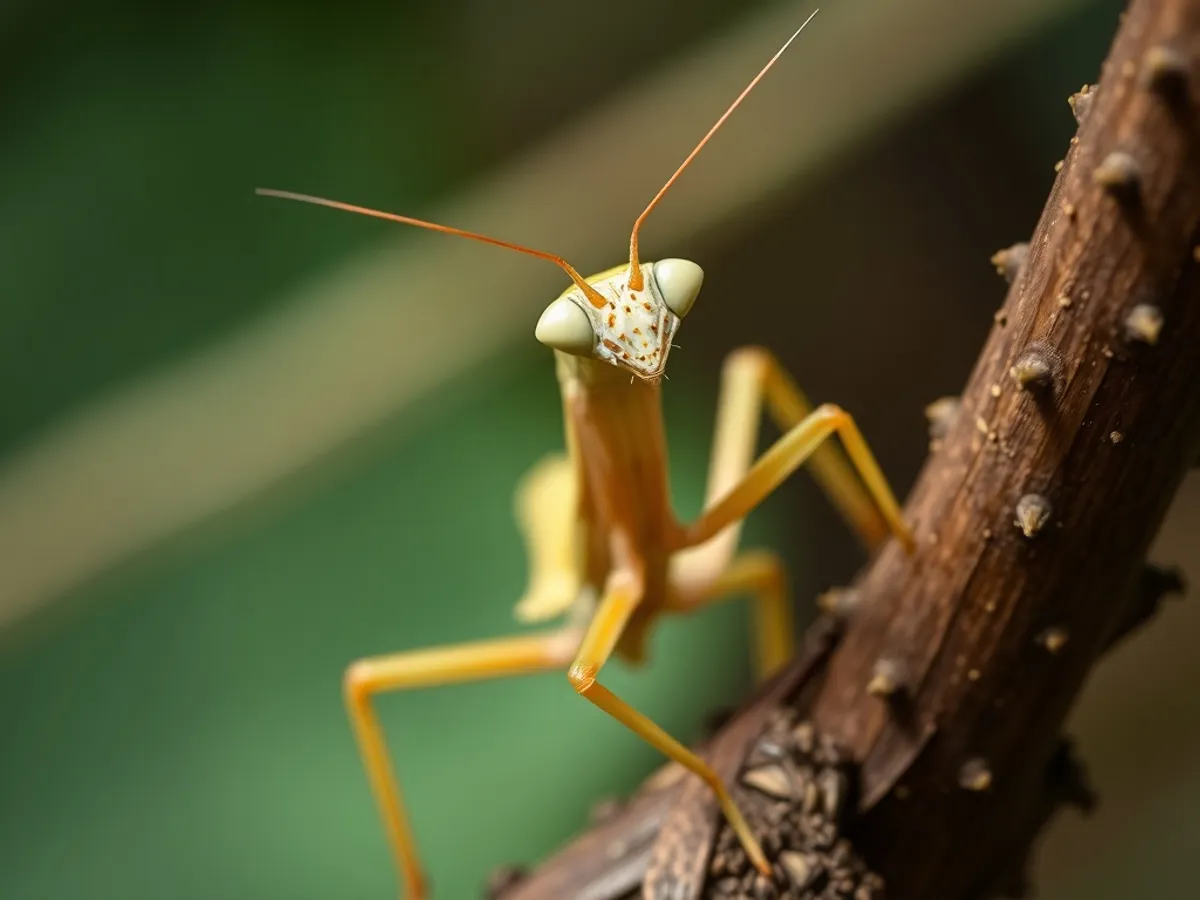
About the Spiny flower mantis
The Spiny flower mantis is a strikingly colorful praying mantis species native to sub-Saharan Africa. It is renowned for its elaborate body patterns, bright coloration, and distinctive spiny projections on its thorax. This small mantis mimics flowers both in appearance and behavior, enabling it to ambush pollinating insects with remarkable efficiency. Its defensive displays include flashing vibrant eyespots on its wings to startle predators. Adapted to warm, vegetated habitats, it is a favorite among insect enthusiasts for its beauty and fascinating behaviors.
Fascinating facts
Master of Disguise
The Spiny flower mantis expertly mimics flowers, blending in with petals and attracting pollinators for ambush predation.
Eye-catching Defense
When threatened, it displays bold, spiral-shaped eyespots on its wings to startle and deter predators.
Ant Mimicry in Youth
Nymphs of this species mimic ants in both appearance and movement, providing them with extra protection from predators.
Detailed description
The Spiny flower mantis (Pseudocreobotra wahlbergii) is a small, visually striking mantid species, typically measuring 25–38 mm in length, with females being larger and more robust than males. Its body is adorned with intricate patterns of white, green, yellow, and pink, which provide both camouflage and warning coloration. The thorax features prominent, sharp spines, while the forewings display a distinctive, circular eyespot surrounded by concentric bands—used in deimatic (startle) displays. The raptorial forelegs are lined with spines for grasping prey, and the head is highly mobile, allowing for a wide field of vision. This species is a master of aggressive mimicry, closely resembling flowers to lure pollinators such as bees, flies, and butterflies. P. wahlbergii is primarily solitary and highly territorial, with individuals displaying threat postures to ward off rivals. Its lifecycle includes egg, nymph, and adult stages, with nymphs resembling miniature adults but lacking wings. The species is sexually dimorphic, with males possessing longer antennae and being more agile fliers. Adapted to warm, vegetated environments, the Spiny flower mantis is both predator and prey, relying on its cryptic appearance and rapid reflexes for survival.
Did you know?
Despite their delicate appearance, Spiny flower mantises are fierce predators capable of capturing prey much larger than themselves.
Research & sources
Behaviour & social structure
Spiny flower mantises are ambush predators, remaining motionless among flowers or foliage while waiting for prey to approach. Their hunting strategy involves swaying gently to mimic the movement of flowers in the breeze, enhancing their camouflage. When prey comes within reach, they strike with lightning-fast precision, using their spined forelegs to grasp and immobilize insects. They are diurnal, most active during daylight hours when pollinators are abundant. Social interactions are limited, with encounters between individuals often resulting in displays of threat or cannibalism, especially during mating. Defensive behaviors include raising the forelegs and wings to expose the eyespots, accompanied by a rocking or jerking motion to deter predators. Cannibalism is not uncommon, particularly among nymphs and during mating, with females sometimes consuming males.
Reproduction & life cycle
Breeding typically occurs during the wet season, when food resources are plentiful. Courtship involves cautious approaches by males, who display submissive behaviors to avoid being mistaken for prey. Mating can last several hours, and post-copulatory sexual cannibalism by females is documented, though not universal. Females lay oothecae (egg cases) containing 20–50 eggs, attaching them to plant stems or leaves. Incubation lasts 3–6 weeks, depending on temperature and humidity. Nymphs emerge as miniature, wingless versions of adults and undergo 6–8 molts before reaching maturity. There is no parental care; nymphs are independent from hatching and highly vulnerable to predation and cannibalism. Generation time is typically one year in the wild, with overlapping generations in favorable conditions.
Adaptations & survival
Pseudocreobotra wahlbergii exhibits several remarkable adaptations. Its flower mimicry is both morphological and behavioral, with coloration and body shape closely resembling local blossoms, and swaying movements enhancing the illusion. The eyespot on each forewing is a key anti-predator adaptation, startling birds and small mammals. The spines on the thorax and legs provide physical defense and aid in prey capture. Its compound eyes offer excellent vision, crucial for detecting prey and predators. Rapid reflexes and the ability to leap or fly short distances aid in escape. The species' small size and cryptic coloration reduce detection by both predators and prey. Sexual dimorphism, with larger, more fecund females and agile, mobile males, reflects evolutionary pressures for reproductive success.
Cultural significance
While not prominent in traditional African folklore, the Spiny flower mantis has gained popularity in the global pet trade and among entomologists for its beauty and unique behaviors. It is often featured in educational programs and documentaries highlighting insect mimicry and predation. In some cultures, mantids are symbols of patience, stillness, and precision, though P. wahlbergii itself is not specifically referenced in mythology or traditional medicine.
Recent research
Recent research has focused on the evolutionary ecology of flower mimicry in Pseudocreobotra wahlbergii, examining how visual and behavioral adaptations enhance predatory efficiency and predator avoidance. Studies using high-speed videography have documented the mantis's rapid strike mechanics and deimatic display effectiveness. Molecular phylogenetics has clarified the relationships within the Hymenopodidae family, confirming the distinctiveness of the genus Pseudocreobotra. Ongoing research includes the impact of environmental changes on phenotypic plasticity and the role of sexual selection in shaping sexual dimorphism. The species is also used as a model organism in studies of insect vision and camouflage.
Sources
Revision of the flower mantis genus Pseudocreobotra Saussure (Mantodea: Hymenopodidae)
S. R. Roy (1999)
scientificFlower mantids: Diversity, mimicry, and predatory strategies in Pseudocreobotra wahlbergii
Svenson, G.J. & Marshall, S.A. (2015)
scientificVideos
Habitat
Tropical and subtropical forests, savannas, and gardens
 Africa
Savanna
Grasslands with scattered trees, characterized by seasonal rainfall and home to diverse grazing animals and predators.
 Various Continental Regions
Grassland
Open areas dominated by grasses rather than trees, supporting numerous herbivores and their predators.
 Global
Forest
Wooded areas with significant tree cover and diverse plant and animal communities.
Conservation
The Spiny flower mantis is currently classified as Least Concern on the IUCN Red List.
Threats & challenges
Currently classified as 'Least Concern,' the Spiny flower mantis faces localized threats from habitat loss due to agricultural expansion, pesticide use, and urbanization. Overcollection for the pet trade is a minor concern but not yet a significant threat to wild populations. Climate change may alter the distribution of suitable habitats, potentially impacting future populations. Natural predators include birds, reptiles, and larger arthropods. Population trends are stable, but ongoing habitat degradation could pose future risks, especially in fragmented landscapes.
Taxonomy
Scientific name
Pseudocreobotra wahlbergii
- Kingdom
- Animalia
- Phylum
- Arthropoda
- Class
- Insecta
- Order
- Mantodea
- Family
- Hymenopodidae
- Genus
- Pseudocreobotra
- Species
- wahlbergii
Community notes
Share your observations about the Spiny flower mantis.
No community notes yet. Be the first!
Discover more wildlife
More fascinating animals from the encyclopedia.