
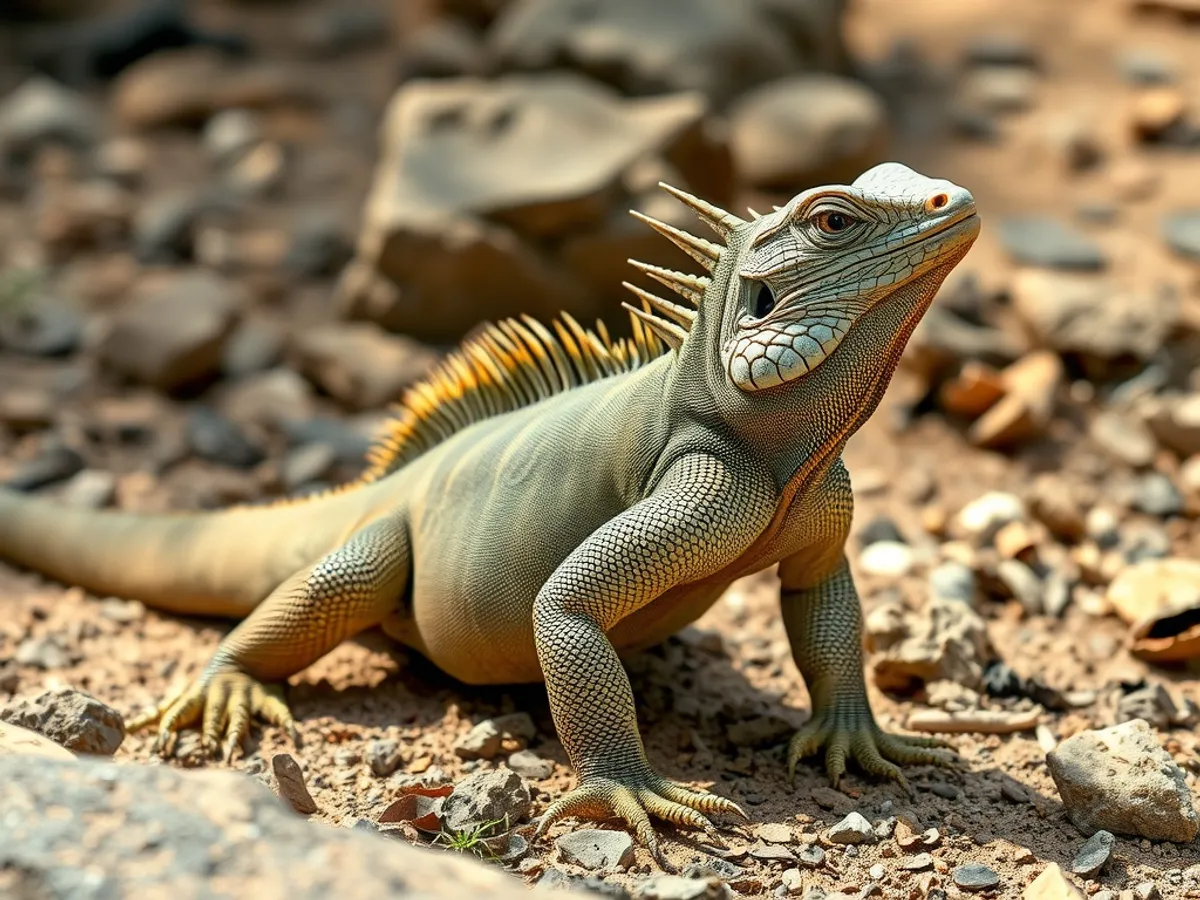
About the Spiny-tailed iguana
The Spiny-tailed iguana is a robust, medium-to-large lizard native to Central America and Mexico, known for the prominent spines running along its tail and back. Its scales are rough and keeled, providing protection from predators and aiding in climbing. This species is highly adaptable and often found in rocky areas, forests, and even urban environments, where it can bask on walls and rooftops. Spiny-tailed iguanas are diurnal and have a diverse diet, making them resilient in varied habitats. Their alertness and speed make them difficult to catch, both for predators and humans.
Fascinating facts
Tail Defense
Their tails are covered in sharp, spiny scales that they use to whip predators, deterring attacks.
Speedy Escape
Spiny-tailed iguanas can run up to 34 km/h (21 mph), making them one of the fastest lizards.
Flexible Diet
They consume fruits, flowers, insects, and small vertebrates, adapting their diet to seasonal availability.
Detailed description
The Spiny-tailed iguana (Ctenosaura pectinata) is a robust, medium-to-large lizard with adults typically reaching total lengths of 35–100 cm (14–39 in), though some males may exceed 1 meter. Its most distinctive anatomical feature is the series of sharply keeled, spiny scales running along the dorsal surface of the tail, which serve both as a deterrent to predators and as a defensive weapon during intraspecific conflicts. The body is laterally compressed, aiding in rapid movement through rocky crevices and dense vegetation. Coloration is variable, ranging from gray to olive or brown, often with darker banding or mottling, and juveniles may display brighter green hues for camouflage. The head is angular with strong jaws and a pronounced dewlap, which is used in social displays. Ctenosaura pectinata possesses well-developed limbs and long toes with sharp claws, facilitating climbing and basking on vertical surfaces. The species is diurnal and highly alert, with keen vision and rapid reflexes, making it difficult to approach. Its skin is covered in tough, overlapping scales that reduce water loss and provide protection from abrasions. Sexual dimorphism is present, with males being larger and bearing more prominent crests and spines.
Did you know?
Despite their fierce appearance, Spiny-tailed iguanas are important seed dispersers, playing a key ecological role in their native habitats.
Research & sources
Wikipedia summary
Ctenosaura is a lizard genus commonly known as spinytail iguanas or ctenosaurs. The genus is part of the large lizard family Iguanidae and is native to Mexico and Central America. The name is derived from two Greek words: κτενός, meaning "comb", and σαύρα, meaning "lizard".
Behaviour & social structure
Spiny-tailed iguanas are primarily diurnal, emerging in the morning to bask and regulate their body temperature before foraging. They are opportunistic omnivores, feeding on a wide variety of plant material (leaves, flowers, fruits, seeds) as well as insects, small vertebrates, and carrion. Juveniles are more insectivorous, while adults shift towards a predominantly herbivorous diet. These iguanas are highly territorial, especially males, who use head-bobbing, dewlap extension, and tail-whipping displays to assert dominance and defend territories. Social structure is loosely organized, with overlapping home ranges but clear dominance hierarchies. When threatened, they retreat rapidly into rock crevices or burrows, using their spiny tails to block entrances and deter predators. They are known for their speed and agility, capable of sprinting short distances on all fours. In urban areas, they adapt well, often basking on walls and rooftops and exploiting human food sources.
Reproduction & life cycle
Breeding occurs primarily in the dry season, with courtship involving elaborate visual displays by males, including head-bobbing and chasing. Females lay a single clutch per year, typically between March and June, consisting of 10–30 eggs deposited in sunny, well-drained soil or sand. Incubation lasts approximately 80–90 days, depending on temperature and humidity. Hatchlings emerge in late summer to early autumn and are independent from birth, receiving no parental care. Sexual maturity is reached at 2–3 years of age. Females may select communal nesting sites, and egg predation by mammals and birds is a significant source of mortality.
Adaptations & survival
Ctenosaura pectinata exhibits several key adaptations: the spiny tail provides both a physical defense and a tool for intraspecific combat; cryptic coloration aids in camouflage among rocks and vegetation; and the tough, keeled scales reduce water loss and injury. Their laterally compressed bodies and strong limbs allow for rapid movement through narrow crevices, while sharp claws facilitate climbing. Behavioral plasticity enables them to exploit a wide range of habitats, including disturbed and urban environments. Their omnivorous diet allows them to survive seasonal fluctuations in food availability. Rapid sprinting and acute vision help them evade predators, and their ability to bask efficiently aids in thermoregulation.
Cultural significance
Spiny-tailed iguanas have been part of local folklore and traditional diets in parts of Mexico, where they are sometimes referred to as 'garrobos.' In pre-Columbian times, iguanas were depicted in art and mythology, symbolizing agility and resilience. Today, they are occasionally kept as pets and are valued for their role in controlling insect populations. In some regions, they are featured in ecotourism and educational programs, highlighting their ecological importance.
Recent research
Recent research has focused on the species' adaptability to urban environments, dietary flexibility, and the impact of climate change on reproductive timing. Genetic studies have clarified relationships within the Ctenosaura genus and revealed previously unrecognized cryptic diversity. Ongoing studies are examining the effects of habitat fragmentation on gene flow and population structure. Behavioral research has documented complex social interactions and communication, including the use of visual signals and tail displays. Conservation genetics is an emerging field for this species, particularly in areas where hybridization with other Ctenosaura is occurring.
Videos
Habitat
Dry forests, rocky areas, and scrublands
 Arid Regions
Desert
Arid lands with minimal rainfall, extreme temperatures, and specialized wildlife adapted to harsh conditions.
 Various Continental Regions
Grassland
Open areas dominated by grasses rather than trees, supporting numerous herbivores and their predators.
 Elevated Terrain
Mountain
High-altitude environments with varying climates and specialized wildlife adapted to rugged terrain and thin air.
 Global
Forest
Wooded areas with significant tree cover and diverse plant and animal communities.
Conservation
The Spiny-tailed iguana is currently classified as Least Concern on the IUCN Red List.
Threats & challenges
While currently listed as Least Concern by the IUCN, Spiny-tailed iguanas face localized threats from habitat loss due to agriculture, urbanization, and deforestation. They are sometimes hunted for food or captured for the pet trade. Road mortality and predation by introduced species (such as domestic cats and dogs) also pose risks. In some areas, hybridization with related Ctenosaura species may impact genetic integrity. Despite these challenges, their adaptability and generalist diet have allowed populations to remain stable in many regions, though ongoing monitoring is recommended.
Taxonomy
Scientific name
Ctenosaura pectinata
- Kingdom
- Animalia
- Phylum
- Chordata
- Class
- Reptilia
- Order
- Squamata
- Family
- Iguanidae
- Genus
- Ctenosaura
- Species
- pectinata
Community notes
Share your observations about the Spiny-tailed iguana.
No community notes yet. Be the first!
Discover more wildlife
More fascinating animals from the encyclopedia.