
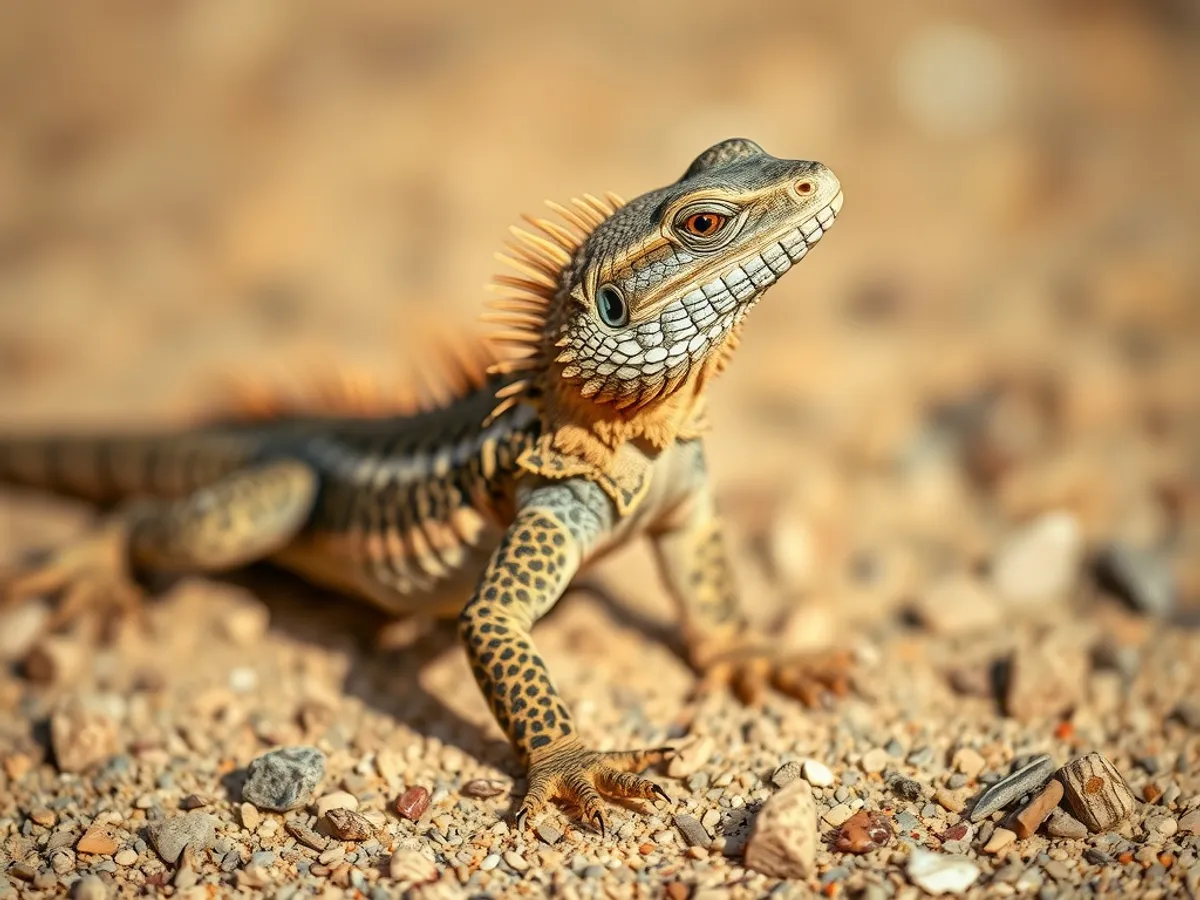
About the Spiny-tailed Lizard
The Spiny-tailed Lizard, commonly known as Uromastyx, is a genus of robust, desert-dwelling lizards found across North Africa, the Middle East, and parts of South Asia. They are easily recognized by their thick, spiny tails, which they use for defense against predators. Uromastyx are primarily terrestrial and are well-adapted to hot, arid environments, often basking in the sun and retreating to burrows during extreme temperatures. Their diet is predominantly herbivorous, feeding on a variety of leaves, flowers, and seeds. These lizards are popular in the pet trade due to their docile nature and unique appearance.
Fascinating facts
Desert Specialists
Uromastyx are highly adapted for desert life, with the ability to survive high temperatures and little water.
Spiny Defense
Their thick, spiny tails are swung at predators as a powerful deterrent.
Plant Eaters
Unlike many other lizards, Uromastyx are almost entirely herbivorous, eating flowers, leaves, and seeds.
Detailed description
Spiny-tailed lizards (Uromastyx spp.) are medium to large agamid lizards, with adults ranging from 25 to 90 cm in total length depending on the species, and weights up to 2 kg in the largest forms (e.g., Uromastyx aegyptia). Their most distinctive feature is the robust, muscular tail armed with whorls of spiny, keratinized scales, which serves as a formidable defensive weapon. Uromastyx possess a broad, flattened body with strong limbs and blunt claws adapted for digging complex burrow systems, which provide refuge from extreme desert temperatures and predators. Their heads are short and triangular, with powerful jaw muscles suited for crushing tough plant material. Coloration varies widely among species and populations, ranging from dull browns and grays to vivid yellows, oranges, and blues, often with intricate patterns that provide camouflage or play a role in thermoregulation and social signaling. Uromastyx are diurnal and exhibit pronounced basking behavior, relying on external heat sources to regulate their body temperature. They are primarily herbivorous, feeding on a diverse array of desert vegetation, but some species may opportunistically consume insects or other invertebrates, especially juveniles. Social structure is generally solitary or loosely territorial, with individuals defending burrow entrances and basking sites. Reproduction is oviparous, with females laying clutches of 5–40 eggs, depending on species and environmental conditions. Uromastyx exhibit a suite of physiological and behavioral adaptations to arid environments, including highly efficient kidneys, water-conserving behaviors, and the ability to tolerate extreme heat.
Did you know?
Despite living in harsh desert conditions, Uromastyx rarely drink water, obtaining almost all the moisture they need from their plant-based diet.
Research & sources
Wikipedia summary
Uromastyx is a genus of lizards in the family Agamidae. The genus is native to Africa and the Middle East. Member species are commonly called spiny-tailed lizards, uromastyces, mastigures, or dabb lizards.
Behaviour & social structure
Uromastyx are primarily solitary and territorial, with adults maintaining and defending burrow systems against conspecifics, especially during the breeding season. Daily activity centers around basking in the early morning and late afternoon to optimize body temperature, followed by foraging for edible vegetation. Feeding involves cropping leaves, flowers, seeds, and occasionally fruits; juveniles may supplement their diet with insects for additional protein. These lizards are vigilant and quick to retreat into their burrows at the first sign of danger, often blocking the entrance with their spiny tails. Social interactions are limited outside of the breeding season, but males may engage in ritualized combat involving tail lashing and posturing to establish dominance. Communication is primarily visual, involving body inflation, head bobbing, and color changes, particularly in males during courtship or territorial disputes. Uromastyx exhibit seasonal activity patterns, with periods of dormancy (aestivation or brumation) during the coldest or driest months, depending on geographic location.
Reproduction & life cycle
Breeding in Uromastyx typically coincides with the onset of warmer temperatures and increased food availability, often in spring or early summer. Males become more brightly colored and actively seek out females, engaging in courtship displays that include head bobbing, tail waving, and body inflation. Copulation is brief, after which females develop eggs over a period of 4–6 weeks. Clutch size varies by species and female size, ranging from 5 to 40 eggs. Eggs are laid in deep burrows or excavated chambers, where stable temperatures and humidity promote successful incubation. Incubation lasts 8–10 weeks at optimal temperatures (30–35°C). There is no parental care post-oviposition; hatchlings are fully independent and must immediately fend for themselves. Sexual maturity is reached at 3–5 years, depending on species and environmental conditions.
Adaptations & survival
Uromastyx have evolved a range of adaptations for desert survival. Their spiny tails deter predators and can be wielded with considerable force. Burrowing behavior allows them to escape extreme heat and predation, while their flattened bodies facilitate movement in tight spaces. Their herbivorous diet is supported by a highly specialized digestive system, including an enlarged colon for water reabsorption and fermentation of tough plant fibers. Uromastyx can derive most of their water from food, minimizing the need for free-standing water. Their kidneys produce highly concentrated uric acid, further reducing water loss. Coloration not only provides camouflage but also aids in thermoregulation, with some species darkening to absorb heat or lightening to reflect sunlight. Behavioral adaptations include basking to raise body temperature and seasonal dormancy to survive periods of extreme drought or cold.
Cultural significance
Uromastyx have held cultural significance in various societies across North Africa and the Middle East. In Islamic tradition, the 'dabb' lizard is mentioned in hadith literature, and its meat is considered halal by some scholars. Historically, Uromastyx have been used as a food source and in traditional medicine, believed to possess curative properties. Their striking appearance has also made them popular in the exotic pet trade, contributing to their symbolic value as hardy desert survivors. In some regions, they feature in folklore as symbols of resilience and adaptation.
Recent research
Recent research on Uromastyx has focused on their physiological adaptations to arid environments, including studies of renal function, water conservation, and thermoregulation. Genetic analyses have clarified species boundaries and revealed cryptic diversity within the genus, leading to the description of new species and subspecies. Conservation studies have assessed the impact of overharvesting and habitat fragmentation, informing management strategies and CITES listings. Behavioral research has documented complex social interactions, including dominance hierarchies and visual communication. Ongoing studies are investigating the effects of climate change on distribution and reproductive success, as well as the potential for captive breeding and reintroduction programs.
Videos
Habitat
Desert


Conservation
The Spiny-tailed Lizard is currently classified as Least Concern on the IUCN Red List.
Threats & challenges
Major threats to Uromastyx populations include habitat loss due to agricultural expansion, overgrazing by livestock, and urban development. Many species are also heavily collected for the international pet trade and, in some regions, for traditional food and medicine. Overharvesting, particularly of larger species such as Uromastyx aegyptia, has led to significant population declines in parts of their range. Climate change poses additional risks by altering habitat suitability and food availability. While some species remain common and are listed as Least Concern, others are considered Vulnerable or Endangered by the IUCN, with fragmented populations and declining trends. Conservation challenges include enforcing trade regulations, protecting critical habitats, and raising awareness among local communities.
Taxonomy
Scientific name
Uromastyx spp.
- Kingdom
- Animalia
- Phylum
- Chordata
- Class
- Reptilia
- Order
- Squamata
- Family
- Agamidae
- Genus
- Uromastyx
- Species
- spp.
Community notes
Share your observations about the Spiny-tailed Lizard.
No community notes yet. Be the first!
Discover more wildlife
More fascinating animals from the encyclopedia.