
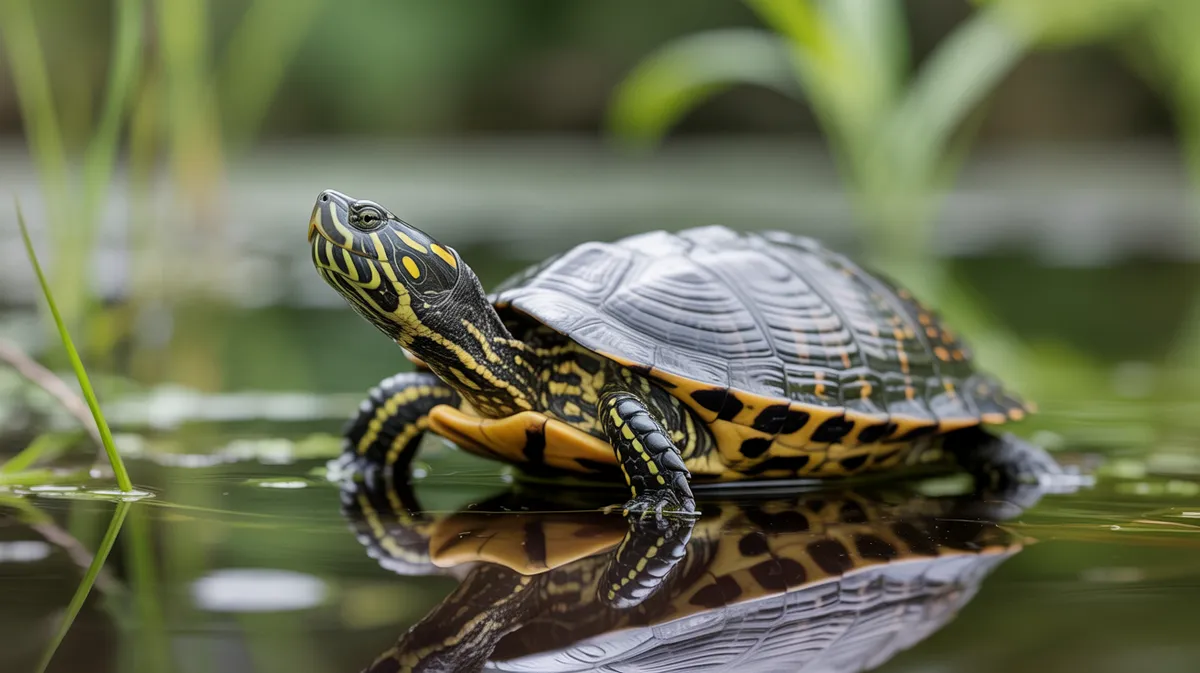
About the Spotted Turtle
The Spotted Turtle is a small, semi-aquatic turtle native to eastern North America, easily recognized by the bright yellow spots scattered across its dark, smooth shell. These turtles prefer shallow, clean freshwater habitats like marshes, bogs, swamps, and wet meadows. They are shy and elusive, often basking on logs or rocks but quickly slipping into the water when disturbed. The species has experienced significant population declines due to habitat destruction, illegal collection, and pollution.
Fascinating facts
Distinctive Spots
Each Spotted Turtle has a unique pattern of yellow spots on its shell and head, which can be used to identify individuals.
Habitat Specialist
Spotted Turtles require clean, shallow, vegetated wetlands and are extremely sensitive to environmental changes and pollution.
Diverse Diet
Their omnivorous diet includes insects, snails, worms, aquatic vegetation, algae, and occasionally small fish or amphibian eggs.
Detailed description
The Spotted Turtle (Clemmys guttata) is a small, semi-aquatic turtle distinguished by its smooth, domed carapace, which measures 8–12 cm (3.1–4.7 in) in length and is typically black or bluish-black adorned with variable numbers of bright yellow spots. The plastron is yellow to orange with large black blotches. The head, neck, and limbs also bear yellow spots, with the number and arrangement of spots unique to each individual, potentially aiding in identification. Males can be differentiated from females by their concave plastron, longer and thicker tails, and darker facial coloration and irises, while females have a flat plastron, shorter tails, and lighter, often orange or yellow, facial markings. Juveniles resemble females in coloration and develop male characteristics at maturity. Spotted Turtles have webbed feet adapted for swimming but are equally adept at terrestrial locomotion, allowing them to move between aquatic and upland habitats. Their skin is smooth and dark, providing camouflage among aquatic vegetation and muddy substrates. The species is known for its secretive and cautious nature, often basking in sunlight on logs or mats of vegetation but quickly retreating to water when threatened. Spotted Turtles are long-lived, with individuals in the wild known to reach ages of 25–50 years, and some captive specimens exceeding 60 years. Their small size, distinctive coloration, and ecological requirements make them a unique representative of North American wetland turtle fauna.
Did you know?
Unlike many turtles, Spotted Turtles are excellent climbers and can sometimes be found perched in low shrubs or on tangled vegetation above water.
Research & sources
Wikipedia summary
The spotted turtle, the only species of the genus Clemmys, is a small, semi-aquatic turtle that reaches a carapace length of 8–12 cm (3.1–4.7 in) upon adulthood. Their broad, smooth, low dark-colored upper shell, or carapace, ranges in its exact colour from black to a bluish black with a number of tiny yellow round spots. The spotting patterning extends from the head, to the neck and out onto the limbs. Sexually mature males have a concave plastron and a long, thick tail. By contrast, sexually mature females possess a flat plastron and have a tail that is noticeably shorter and thinner than that of mature males. Mature males also have a dark iris and face; females typically have a yellow or orange iris and a similarly coloured face that is distinctly lighter than the males'. Juveniles appear female-like in this regard, and at maturity males begin to develop darker features.
Behaviour & social structure
Spotted Turtles are diurnal, with peak activity in the spring and early summer, particularly during warm, sunny days. They are most active in the morning and late afternoon, spending midday hours basking or resting in shaded aquatic vegetation. During hot summer months or periods of drought, they may aestivate by burrowing into mud or leaf litter to avoid desiccation. Their diet is omnivorous, consisting of aquatic invertebrates (such as snails, worms, and insects), small crustaceans, tadpoles, carrion, and a variety of plant material including algae and aquatic vegetation. Spotted Turtles forage both in water and on land, using their keen sense of smell and tactile cues to locate prey. Social interactions are generally limited outside of the breeding season, though multiple individuals may be observed basking together. Aggressive encounters, especially among males during the mating season, can include biting and chasing. Home ranges are relatively small, typically less than 2 hectares (5 acres), but individuals may travel considerable distances overland to reach new wetlands or nesting sites.
Reproduction & life cycle
Breeding occurs primarily in spring, from March to May, following emergence from winter hibernation. Courtship involves males circling females, nipping at their limbs and shell, and displaying their brightly spotted heads. Copulation usually takes place in shallow water. Females lay 1–2 clutches per year, each containing 3–7 elliptical, leathery eggs, typically in June or July. Nest sites are selected in open, sunny areas with loose, well-drained soil, often some distance from water. Incubation lasts 70–83 days, depending on temperature, with hatchlings emerging in late summer or early fall. Sex determination is temperature-dependent, with warmer nest temperatures favoring females. Females exhibit no parental care after oviposition; hatchlings are independent from birth and must find their way to suitable aquatic habitats. Sexual maturity is reached at 8–15 years, with females generally maturing later than males.
Adaptations & survival
Spotted Turtles possess several adaptations for their semi-aquatic lifestyle. Their streamlined, low-domed carapace reduces drag in water, while partially webbed feet enhance swimming efficiency. The dark coloration and yellow spotting provide disruptive camouflage among dappled sunlight and aquatic vegetation. Their ability to aestivate during hot or dry periods allows them to survive in fluctuating wetland environments. Temperature-dependent sex determination is an evolutionary adaptation that may help balance sex ratios in variable climates. The species' generalist diet and flexible habitat use enable it to exploit a range of wetland types, though it remains sensitive to habitat quality and fragmentation. Their long lifespan and delayed maturity are typical of many turtle species, reflecting a life history strategy adapted to environments with variable juvenile survival.
Cultural significance
While the Spotted Turtle does not have widespread cultural or mythological significance, it has become a symbol of wetland conservation in eastern North America. Its striking appearance and rarity have made it a flagship species for environmental education and advocacy. In some indigenous North American traditions, turtles in general are revered as symbols of longevity, wisdom, and the earth, though specific references to Clemmys guttata are rare. The species is occasionally featured in local folklore and nature literature, highlighting its role as an indicator of healthy wetland ecosystems.
Recent research
Recent research on Spotted Turtles has focused on population genetics, movement ecology, and the impacts of habitat fragmentation. Genetic studies have revealed significant population structuring, underscoring the importance of maintaining habitat corridors. Radio telemetry and mark-recapture studies have provided detailed insights into home range size, seasonal movements, and habitat preferences. Conservation research has emphasized the need for landscape-scale wetland protection and the effectiveness of head-starting (captive rearing and release) as a management tool. Ongoing studies are investigating the effects of climate change on sex ratios and reproductive success, as well as the potential for disease transmission from invasive species. The species is also used as a model organism for studying the impacts of environmental contaminants on reptilian development and health.
Videos
Habitat
Shallow freshwater wetlands, marshes, bogs, and woodland ponds


Conservation
The Spotted Turtle is currently classified as Endangered on the IUCN Red List.
Threats & challenges
The Spotted Turtle faces numerous threats, most notably habitat loss and fragmentation due to wetland drainage, urbanization, and agricultural expansion. Road mortality is a significant source of adult deaths, especially during seasonal migrations to nesting sites. Illegal collection for the pet trade has severely impacted some populations, as the species' small size and attractive appearance make it highly sought after. Pollution, invasive species, and climate change further degrade habitat quality and reduce reproductive success. Populations are often small, isolated, and vulnerable to local extirpation. The IUCN lists the species as Endangered, with ongoing declines across much of its range. Conservation challenges include protecting and restoring wetland habitats, mitigating road impacts, enforcing anti-poaching regulations, and maintaining genetic diversity through habitat connectivity.
Taxonomy
Scientific name
Clemmys guttata
- Kingdom
- Animalia
- Phylum
- Chordata
- Class
- Reptilia
- Order
- Testudines
- Family
- Emydidae
- Genus
- Clemmys
- Species
- guttata
Where to see a spotted turtle
4 zoos and aquariums in 1 country are recorded as keeping this species.
 North Carolina Zoo🇺🇸 Asheboro, United States
- 🦁The Maryland Zoo in Baltimore🇺🇸 Baltimore, United States
 Oakland Zoo🇺🇸 United States
- 🦁Peoria Zoo🇺🇸 United States
Community notes
Share your observations about the Spotted Turtle.
No community notes yet. Be the first!
Discover more wildlife
More fascinating animals from the encyclopedia.