
About the Stag Beetle
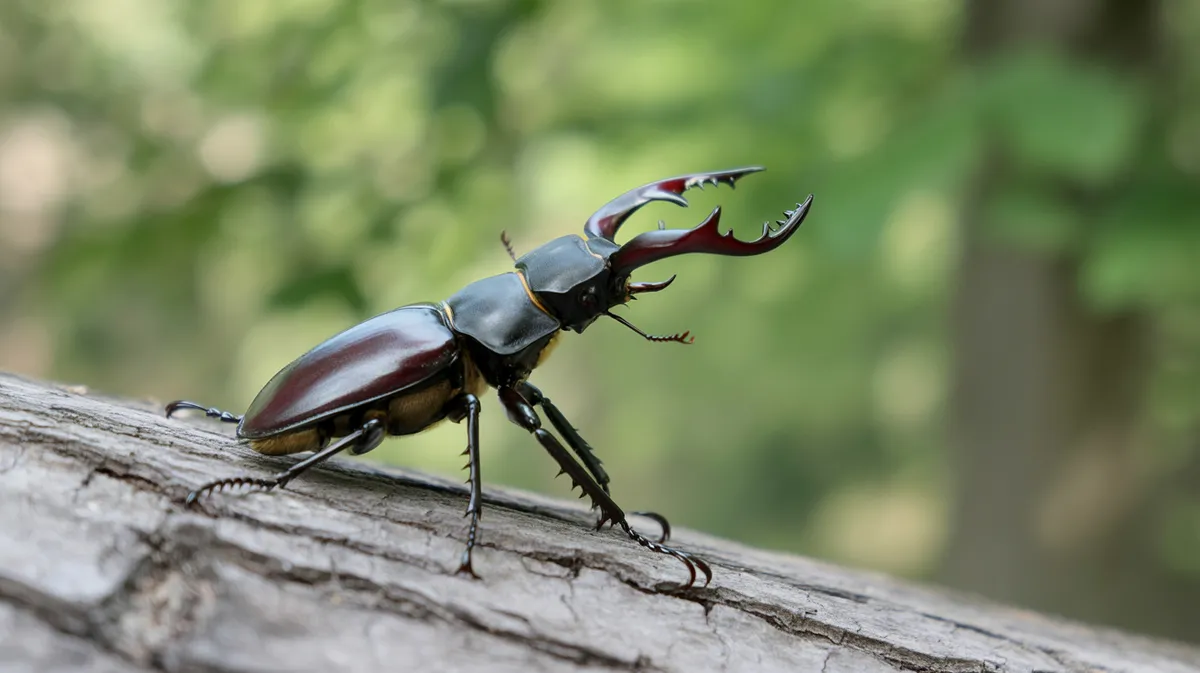
The European stag beetle (Lucanus cervus) is the continent's largest terrestrial beetle, males reaching around 75 millimetres, most of it mandible. Those antler-like jaws are the classic example of a weapon that has been optimised for display and grappling rather than for damage. Measurements show that a male's enormous mandibles actually bite with relatively little force for their size, because the leverage is terrible; instead a male uses them like a pair of tongs, clamping around a rival's body, lifting him bodily off the branch and dropping him. Contests are usually settled by size alone without any contact. Females have small, unimpressive jaws that bite far harder. The adult beetle is the brief, showy end of a very slow life: larvae live for three to seven years inside decaying, white-rotted wood, usually the buried stumps and roots of broadleaf trees, chewing through it with the help of gut microbes, and they must reach a critical mass before pupating. Adults live only a few weeks, drinking tree sap and juice from damaged fruit, and males fly at dusk on warm summer evenings with the body hanging almost vertically beneath the wings, a laboured, unmistakable silhouette. The species is declining across northern Europe because tidy forestry and gardening remove exactly what the larvae need: dead wood left in the ground.
Fascinating facts
Antler-Like Jaws
The male stag beetle’s mandibles resemble a stag’s antlers and are used to grapple with rivals during mating disputes.
Woodland Dwellers
Stag beetle larvae depend on decaying wood, making old forests and woodlands vital for their survival.
Short Adult Life
After spending years as larvae, adult stag beetles typically live for only a few weeks, just long enough to mate.
Detailed description
The stag beetle (Lucanus cervus) is Europe's largest terrestrial beetle, with males reaching lengths of 35–75 mm (1.4–3 in), including their prominent mandibles, while females are generally smaller (30–50 mm) and have shorter, more robust jaws. The male's antler-like mandibles, which can be nearly as long as the rest of the body, are used primarily for ritualized combat with other males over access to females and territory. The body is robust and heavily sclerotized, with a shiny, dark chestnut-brown to black coloration. The elytra (wing covers) are smooth and protect the delicate hindwings, which are used for flight. Stag beetles are sexually dimorphic, with males exhibiting larger mandibles and a more elongated head. The larvae are creamy-white, C-shaped grubs that can reach up to 110 mm (4.3 in) in length and spend 3–7 years developing underground, feeding on decaying wood. Adults emerge from the soil in late spring to early summer, living only a few weeks, during which they focus on reproduction. Despite their fearsome appearance, adult stag beetles are harmless to humans and rarely bite. Their life cycle is closely tied to old-growth woodlands, where dead and decaying wood is abundant, making them important decomposers in forest ecosystems.
Did you know?
Stag beetles can fly, and males are often seen on warm summer evenings searching for females, despite their large size and heavy mandibles.
Research & sources
Wikipedia summary
Stag beetles comprise the family Lucanidae. It has about 1,200 species of beetles in four subfamilies. Some species grow to over 12 centimetres, but most to about 5 cm (2 in).
Behaviour & social structure
Stag beetles are primarily crepuscular, with peak activity at dusk and during warm, humid evenings. Males are often seen flying clumsily in search of mates, sometimes traveling considerable distances. They are not aggressive towards humans but may engage in elaborate combat displays with rival males, using their mandibles to wrestle and attempt to flip opponents off logs or branches. Adults feed little, subsisting on tree sap, overripe fruit, or nectar, while larvae are xylophagous, feeding exclusively on decaying hardwoods such as oak, beech, and ash. Stag beetles are solitary outside of the breeding season, and adults are generally short-lived, with most dying within a few weeks of emergence. Larvae play a crucial ecological role by breaking down lignin and cellulose, facilitating nutrient cycling in forest soils.
Reproduction & life cycle
The breeding season for Lucanus cervus typically occurs from late May to August, depending on climate and latitude. Males locate females by scent and engage in combat with rivals for access to receptive females. Courtship involves the male gently stroking the female with his antennae and forelegs. After mating, the female seeks out suitable decaying wood in which to lay her eggs, often burrowing into the substrate to deposit 20–40 eggs over several weeks. The eggs hatch after 2–4 weeks, and the larvae remain underground for several years, passing through three larval instars. Pupation occurs in an earthen cell, and the adult beetle may remain underground for several months before emerging the following summer. There is no parental care after egg-laying.
Adaptations & survival
Stag beetles exhibit several notable adaptations. The male's oversized mandibles are a classic example of sexual selection, evolved for intraspecific combat rather than feeding. Their robust exoskeleton provides protection from predators and environmental hazards. Larvae possess powerful jaws for chewing tough, decaying wood and symbiotic gut microbes that aid in digesting lignocellulose. Adults have well-developed wings for dispersal, though their flight is slow and cumbersome. Their dark coloration offers camouflage against the forest floor, and their crepuscular habits reduce predation risk from diurnal birds. The ability to detect pheromones and volatile compounds helps males locate females and suitable habitats.
Cultural significance
Stag beetles have long held a place in European folklore and mythology, often associated with thunder and lightning due to their impressive mandibles and summer emergence. In some regions, they were believed to bring good luck or to possess magical properties. The beetle's image appears in art, jewelry, and heraldry. In Japan and other parts of Asia, related species are popular as pets and in beetle-fighting contests. Stag beetles are also used as flagship species in conservation campaigns to promote the preservation of ancient woodlands.
Recent research
Recent research on Lucanus cervus has focused on the genetic diversity of fragmented populations, the biomechanics of male mandible combat, and the role of gut microbiota in larval wood digestion. Studies using radio telemetry and mark-recapture techniques have improved understanding of adult dispersal and habitat use. Conservation genetics is increasingly important for managing isolated populations. Ongoing citizen science projects, such as the UK Stag Beetle Survey, have contributed valuable data on distribution and population trends. Additionally, research into the effects of climate change on phenology and larval development is ongoing.
Videos
Habitat
Deciduous woodlands and forests


Conservation
The Stag Beetle is currently classified as Near Threatened on the IUCN Red List.
Threats & challenges
The primary threats to stag beetle populations are habitat loss, fragmentation, and the removal of deadwood from forests and urban parks. Modern forestry practices, urbanization, and the tidying of green spaces have significantly reduced the availability of suitable breeding sites. Road mortality is also a concern, as adults often cross roads during dispersal flights. Climate change may alter the timing of emergence and larval development, potentially disrupting reproductive success. Conservation efforts focus on preserving old-growth woodlands, promoting deadwood retention, and raising public awareness. Population trends are declining in many parts of Europe, leading to their Near Threatened status on the IUCN Red List.
Taxonomy
Scientific name
Lucanus cervus
- Kingdom
- Animalia
- Phylum
- Arthropoda
- Class
- Insecta
- Order
- Coleoptera
- Family
- Lucanidae
- Genus
- Lucanus
- Species
- cervus
Community notes
Share your observations about the Stag Beetle.
No community notes yet. Be the first!
Discover more wildlife
More fascinating animals from the encyclopedia.