
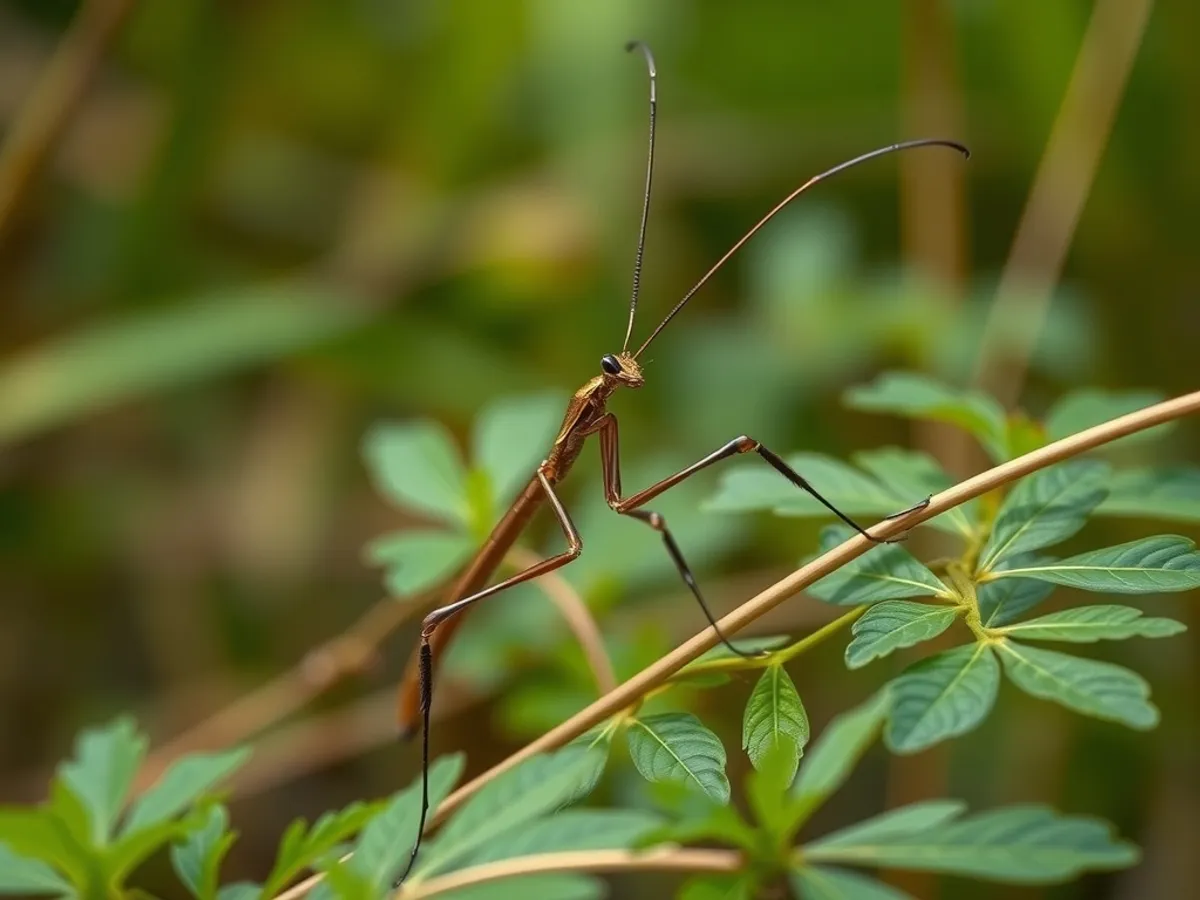
About the Stick Insect
Stick insects (order Phasmatodea) are the most committed plant mimics among animals, and the mimicry extends far beyond shape. A disturbed stick insect will rock rhythmically back and forth, matching the sway of a twig in a breeze, and can hold a rigid, cataleptic pose for hours, dropping to the leaf litter if that fails. But the strangest adaptation belongs to the eggs. Phasmid eggs look like seeds, hard-shelled and often sculpted, and many carry a fatty knob called a capitulum which is a near-perfect functional copy of the elaiosome that plants use to bribe ants into moving their seeds. Ants pick up the eggs, carry them into the nest, eat the capitulum and discard the intact egg in the refuse chamber, where it sits protected from fire, drought and predators until it hatches, whereupon the nymph, in many species an ant mimic itself, walks out. A 2018 study went further and showed that phasmid eggs eaten by birds can survive passage through the gut and hatch from the droppings, offering these flightless insects a plant-like means of long-distance dispersal. Parthenogenesis is common, and some species have no males at all. The order includes the longest insects on Earth, with Phryganistria chinensis measured at over 60 centimetres with legs extended.
Fascinating facts
Master of Disguise
Stick insects have evolved to blend in perfectly with their natural surroundings, making them exceptionally difficult for predators to spot.
Unique Reproduction
Many stick insect species can reproduce via parthenogenesis, allowing females to produce offspring without mating.
Leg Regeneration
If a stick insect loses a limb, it can often regenerate the lost leg during its subsequent molts.
Detailed description
Stick insects (order Phasmatodea) are a diverse group of primarily nocturnal, herbivorous insects renowned for their extraordinary morphological adaptations that enable them to mimic twigs, branches, or leaves. Adult phasmids typically possess elongated, cylindrical bodies, with some species (e.g., Phryganistria chinensis) reaching lengths of up to 64 cm, making them the longest insects in the world. Their coloration and body texture often closely resemble their host plants, and some species can even change color slightly in response to environmental conditions. The legs are long and slender, with tarsi adapted for grasping vegetation. Many species have reduced or absent wings, though some, particularly in the suborder Euphasmatodea, possess fully developed wings and can perform short gliding flights. Stick insects have compound eyes and long, filamentous antennae that aid in navigation and foraging. Their life cycle includes egg, nymph, and adult stages, with nymphs resembling miniature adults and undergoing multiple molts. Some species exhibit parthenogenesis, allowing females to reproduce in the absence of males, which is especially common in isolated or disturbed habitats. Defensive adaptations include startle displays, the secretion of noxious chemicals, and, in some cases, the ability to shed limbs (autotomy) to escape predation. The order is distributed globally, with the greatest diversity in tropical and subtropical forests, but representatives are also found in temperate regions.
Did you know?
Stick insects can remain motionless for hours or gently sway to mimic the movement of twigs in the wind, making them nearly invisible to predators.
Research & sources
Wikipedia summary
The Phasmatodea are an order of insects whose members are variously known as stick insects, stick bugs, walkingsticks, stick animals, or bug sticks. They are also occasionally referred to as Devil's darning needles, although this name is shared by both dragonflies and crane flies. They can be generally referred to as phasmatodeans, phasmids, or ghost insects, with phasmids in the family Phylliidae called leaf insects, leaf-bugs, walking leaves, or bug leaves. The group's name is derived from the Ancient Greek φάσμα phasma, meaning an apparition or phantom, referring to their resemblance to vegetation while in fact being animals. Their natural camouflage makes them difficult for predators to detect; still, many species have one of several secondary lines of defense in the form of startle displays, spines or toxic secretions. Stick insects from the genera Phryganistria, Ctenomorpha, and Phobaeticus include the world's longest insects.
Behaviour & social structure
Stick insects are primarily solitary and exhibit cryptic behavior, remaining motionless for extended periods to avoid detection by predators. They are mostly nocturnal feeders, emerging at dusk to consume a variety of leaves, including those of bramble, oak, eucalyptus, and other woody plants. Their movement is slow and deliberate, often accompanied by a rocking motion that mimics the swaying of twigs in the wind, further enhancing their camouflage. When threatened, some species display deimatic behavior, such as sudden wing-flashing to reveal bright colors or eyespots, or dropping to the ground and remaining motionless (thanatosis). Social interactions are minimal, with aggregation occurring mainly during mating periods or in high-density populations. Communication is largely limited to chemical cues, and there is little evidence of complex social structures.
Reproduction & life cycle
Phasmatodea exhibit diverse reproductive strategies. Most species are oviparous, with females depositing eggs singly or in clusters, often dropping them to the ground or attaching them to vegetation. The eggs are typically hard-shelled and resemble plant seeds, providing additional camouflage. Incubation periods vary widely, from several months to over a year, depending on species and environmental conditions. Parthenogenesis is widespread, particularly in genera such as Carausius and Clitarchus, allowing populations to persist even in the absence of males. Mating, when it occurs, can last for several hours to days, with males often remaining attached to females to guard against rival suitors. There is no parental care post-oviposition; nymphs are independent upon hatching and undergo multiple molts before reaching maturity, a process that can take several months.
Adaptations & survival
Stick insects are masters of crypsis, with body shapes, colors, and surface textures that closely mimic their environment. Some species possess lobed legs or flattened bodies that enhance their resemblance to leaves or bark. Many can autotomize (shed) limbs to escape predators, with subsequent regeneration during molts. Chemical defenses are common; glands located on the thorax or abdomen can secrete irritating or foul-smelling substances when threatened. Some phasmids have spines or sharp projections for physical defense. Behavioral adaptations include catalepsy (remaining rigid and motionless), swaying to mimic vegetation, and, in winged species, sudden displays of bright underwings to startle predators. Eggs are often camouflaged or mimic seeds, reducing predation by ants and other invertebrates.
Cultural significance
Stick insects have fascinated humans for centuries due to their remarkable camouflage and unusual appearance. In some cultures, they are symbols of patience, stillness, and invisibility. They are popular in the exotic pet trade and are frequently used in educational settings to demonstrate adaptation and mimicry. In traditional medicine, certain species have been used in folk remedies in Southeast Asia, though such uses are rare. Their unique appearance has inspired art, literature, and even robotics, where their locomotion and camouflage strategies are studied for biomimetic applications.
Recent research
Recent research on Phasmatodea has focused on their evolutionary relationships, with molecular phylogenetics revealing complex patterns of divergence and convergent evolution in camouflage traits. Studies on parthenogenesis have provided insights into the genetic mechanisms underlying asexual reproduction and its ecological advantages. Investigations into their chemical defenses have identified novel compounds with potential applications in pest management and pharmaceuticals. Ongoing fieldwork continues to discover new species, particularly in understudied tropical regions, highlighting the need for further taxonomic and ecological research. Additionally, the biomechanics of stick insect locomotion and limb regeneration are active areas of study with implications for regenerative medicine and robotics.
Sources
Phasmatodea: Biology of the Stick and Leaf Insects
Paul D. Brock & Daniel E. Marshall (2019)
scientificPhylogenomics of stick and leaf insects (Phasmatodea) illuminates the evolution of plant mimicry
Simon T. Bradler et al. (2021)
scientificVideos
Habitat
Forests and woodlands
 Various Continental Regions
Grassland
Open areas dominated by grasses rather than trees, supporting numerous herbivores and their predators.
 Tropical Regions
Rainforest
Dense, wet forests with the highest biodiversity on Earth, containing more than half of the world's plant and animal species.
 Global
Forest
Wooded areas with significant tree cover and diverse plant and animal communities.
Conservation
The Stick Insect is currently classified as Least Concern on the IUCN Red List.
Threats & challenges
While most stick insect species are classified as Least Concern, localized populations may be threatened by habitat loss due to deforestation, agricultural expansion, and urbanization. Some species are targeted by the pet trade, which can impact wild populations if not managed sustainably. Invasive predators, such as rats and birds introduced to island habitats, have also contributed to declines in certain species. Climate change poses a potential threat by altering the distribution of suitable habitats and host plants. Despite these challenges, many phasmid populations remain stable, though ongoing monitoring is needed for rare or endemic species.
Taxonomy
Scientific name
Phasmatodea (order)
- Kingdom
- Animalia
- Phylum
- Arthropoda
- Class
- Insecta
- Order
- Phasmatodea
- Family
- Phasmatidae
- Genus
- Varies (e.g., Phasmatodes, Carausius, Extatosoma)
- Species
- Varies by species
Community notes
Share your observations about the Stick Insect.
No community notes yet. Be the first!
Discover more wildlife
More fascinating animals from the encyclopedia.