
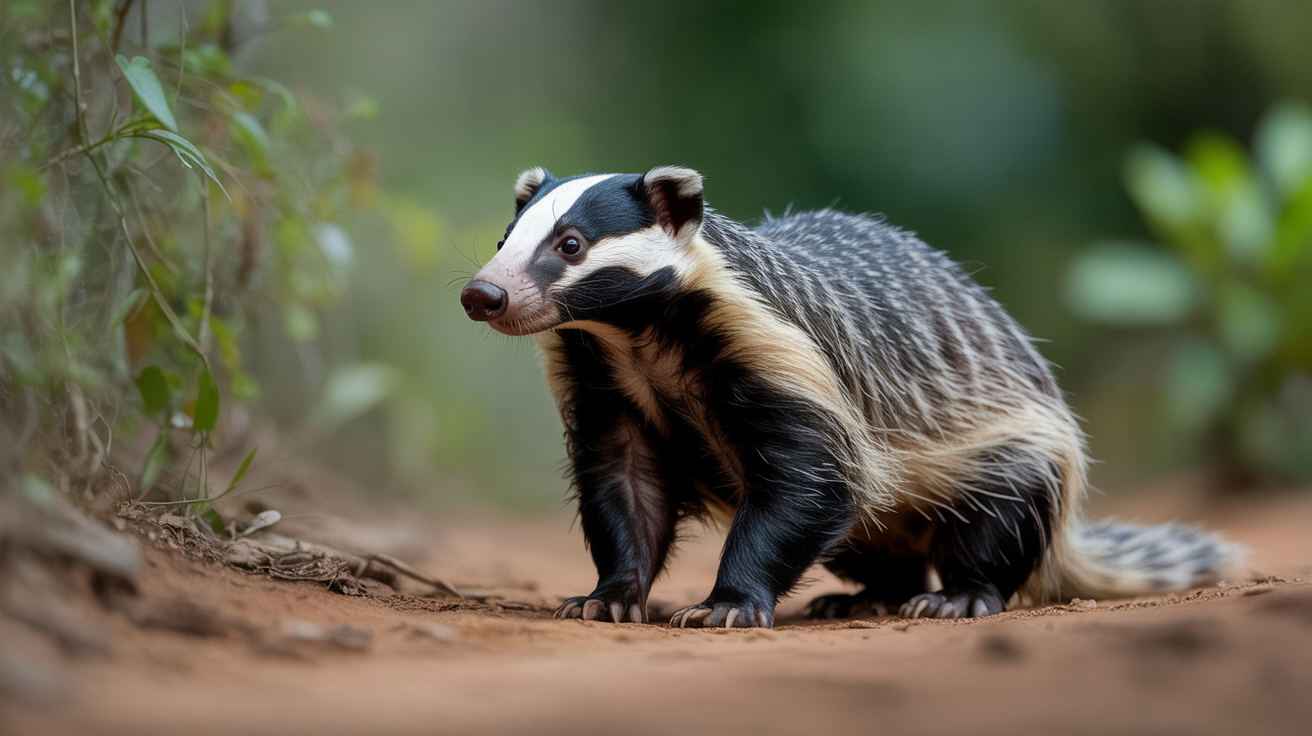
About the Sunda Stink Badger
The Sunda Stink Badger, also known as the Javan stink badger, is a small, nocturnal mammal native to Southeast Asia, particularly the islands of Java, Sumatra, Borneo, and nearby smaller islands. It is characterized by its compact body, short legs, and a distinctive white stripe running along its back. Famous for its potent anal gland secretions, the Sunda Stink Badger uses this foul-smelling spray as a defense mechanism against predators. Despite its name and appearance, it is more closely related to skunks than true badgers.
Fascinating facts
Nocturnal Lifestyle
Sunda Stink Badgers are mostly active at night, foraging for insects, small animals, and plant material under the cover of darkness.
Powerful Defense
When threatened, this badger can release a pungent, oily spray from its anal glands that deters most predators.
Skunk Relative
Although it resembles a badger, genetic studies reveal it is more closely related to skunks than to true badgers.
Detailed description
The Sunda stink badger (Mydaus javanensis) is a small, robust mammal measuring 37–51 cm in body length, with a short tail of 3–7 cm and weighing between 1.3 to 3.6 kg. Its fur is coarse and predominantly dark brown or black, with a distinctive white or yellowish dorsal stripe that varies in width and length among individuals. The head is broad with a blunt snout, small rounded ears, and relatively small eyes, reflecting its nocturnal lifestyle. It possesses powerful forelimbs with long, curved claws adapted for digging. The anal glands are highly developed, capable of ejecting a noxious, oily secretion up to several meters as a defense against predators. Sunda stink badgers are primarily terrestrial and exhibit a solitary, secretive nature, emerging at dusk to forage. They are omnivorous, feeding on invertebrates, small vertebrates, roots, tubers, and fruits. Their senses of smell and hearing are acute, compensating for poor eyesight. The species is adapted to a range of habitats, from lowland rainforests to montane forests up to 2,400 meters, and can sometimes be found in agricultural or disturbed areas.
Did you know?
Despite being called a 'badger,' the Sunda Stink Badger is not a true badger and belongs to a separate family more closely related to skunks.
Research & sources
Wikipedia summary
The Sunda stink badger, also called the Javan stink badger, teledu, Malay stink badger, Malay badger, Indonesian stink badger and Sunda skunk, is a mammal native to Indonesia and Malaysia. Despite the common name, stink badgers are not closely related to true badgers, and are, instead, Old World relatives of the skunks. Coincidentally, its local name sigung in Sundanese is a false cognate to skunk which is of Algonquian origin.
Behaviour & social structure
Sunda stink badgers are strictly nocturnal, spending daylight hours in self-dug burrows or natural crevices. They are solitary outside of the breeding season, maintaining home ranges that may overlap minimally with others. Foraging is primarily done by rooting through leaf litter and soil with their snouts and foreclaws, searching for earthworms, insects, larvae, and occasionally small vertebrates or carrion. They are opportunistic feeders, supplementing their diet with fruits, roots, and tubers. When threatened, they exhibit a characteristic warning posture—stamping their feet, raising the tail, and orienting the anal glands toward the threat before discharging their spray. Communication is mainly through scent marking and occasional vocalizations such as grunts or hisses. Territorial disputes are rare but may involve aggressive displays.
Reproduction & life cycle
Breeding in Sunda stink badgers is believed to occur year-round, with some evidence of seasonal peaks depending on local climate and resource availability. Courtship involves scent marking and vocalizations, with males actively seeking receptive females. After mating, the gestation period is estimated at 60–80 days. Females give birth to litters of 1–3 altricial young in well-concealed burrows. The young are born blind and nearly hairless, relying entirely on maternal care. Weaning occurs at around 2–3 months, after which juveniles gradually become independent. Parental care is provided solely by the female, who is highly protective and may relocate the young if the nest is disturbed.
Adaptations & survival
The Sunda stink badger's most notable adaptation is its highly developed anal scent glands, which produce a sulfurous, oily secretion containing thiols and other volatile compounds for chemical defense. Its strong forelimbs and claws are specialized for digging both for food and for constructing burrows. The thick, coarse fur provides protection from undergrowth and potential predators. Nocturnality reduces competition and predation risk, while acute olfactory and auditory senses aid in foraging and predator detection. The species' omnivorous diet and tolerance for disturbed habitats confer ecological flexibility, allowing survival in both primary forests and human-modified landscapes.
Cultural significance
In local cultures, the Sunda stink badger is known as 'teledu' or 'sigung.' Its potent odor has led to its use in folklore as a symbol of defense and resilience. In some Indonesian and Malaysian communities, the animal is sometimes associated with traditional medicine, where its fat or scent glands are believed to have curative properties, though such practices are rare. The animal's name in Sundanese, 'sigung,' is a linguistic coincidence and not etymologically related to the Algonquian 'skunk.' Overall, it is more often regarded with aversion due to its smell rather than as a significant cultural figure.
Recent research
Recent molecular phylogenetic studies have confirmed that stink badgers (genus Mydaus) are more closely related to skunks (family Mephitidae) than to true badgers (family Mustelidae), resolving a long-standing taxonomic ambiguity. Ongoing research focuses on their ecological role as insectivores and soil aerators, as well as their adaptability to habitat disturbance. Camera trap and radio telemetry studies in Borneo and Sumatra have begun to elucidate their home range sizes, activity patterns, and habitat preferences. There is increasing interest in their chemical defense mechanisms, with studies analyzing the composition and efficacy of their anal gland secretions. Conservationists are calling for more field surveys to assess population status and inform management strategies.
Videos
Habitat
Montane and lowland forests


Conservation
The Sunda Stink Badger is currently classified as Least Concern on the IUCN Red List.
Threats & challenges
Although currently listed as Least Concern by the IUCN, the Sunda stink badger faces localized threats from habitat loss due to deforestation, agricultural expansion, and infrastructure development. Road mortality and incidental trapping occur in some regions. In certain areas, they may be hunted for meat or traditional medicine, though this is not widespread. The species' ability to tolerate secondary habitats has buffered it from more severe declines, but continued habitat fragmentation could isolate populations and reduce genetic diversity. There is limited data on population trends, and the species is considered understudied, highlighting a need for more comprehensive ecological and population assessments.
Taxonomy
Scientific name
Mydaus javanensis
- Kingdom
- Animalia
- Phylum
- Chordata
- Class
- Mammalia
- Order
- Carnivora
- Family
- Mephitidae
- Genus
- Mydaus
- Species
- javanensis
Community notes
Share your observations about the Sunda Stink Badger.
No community notes yet. Be the first!
Discover more wildlife
More fascinating animals from the encyclopedia.