
About the Three-toed Box Turtle
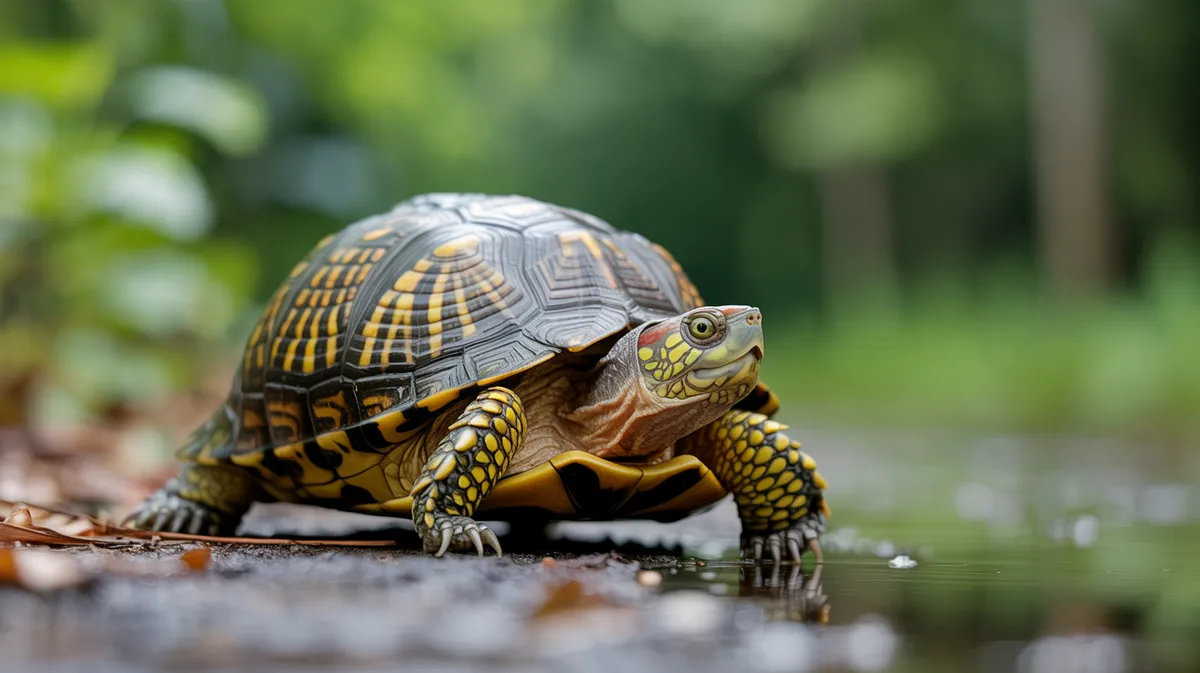
The Three-toed Box Turtle is a subspecies of the Eastern Box Turtle, distinguished by its three toes on each hind foot, rather than the usual four. This medium-sized terrestrial turtle has a domed, hinged shell that allows it to close itself tightly for protection against predators. Its carapace is usually olive or brown with faint yellow or orange markings, and its skin can display yellow, orange, or red spots, especially on the head and legs. Native to the central United States, the Three-toed Box Turtle inhabits moist woodlands, meadows, and thickets, often near streams or ponds. It is a long-lived species, with individuals sometimes reaching several decades in age.
Fascinating facts
Unique Toes
Unlike other box turtles, the Three-toed Box Turtle typically has only three toes on each hind foot, a key feature for identification.
Moist Habitat
This turtle prefers moist environments such as woodlands and forest edges, but it can occasionally be found in grasslands or near wetlands.
Omnivorous Diet
Its diet is varied and includes earthworms, insects, snails, berries, fungi, and sometimes carrion, making it a true omnivore.
Detailed description
The Three-toed Box Turtle (Terrapene carolina triunguis) is a medium-sized, terrestrial turtle, typically measuring 11–15 cm (4.3–6 in) in carapace length. Its most distinctive anatomical feature is the presence of three toes on each hind foot, a trait that differentiates it from other subspecies of the Eastern Box Turtle. The carapace is high-domed and hinged, allowing the turtle to close itself tightly against predators and desiccation. Carapace coloration varies from olive to brown, often with faint yellow or orange radiating lines or blotches, while the plastron is usually yellowish with dark markings. The skin is generally brown or gray, but males often display brighter yellow, orange, or red spots, especially on the head and forelimbs. Sexual dimorphism is evident: males tend to have red eyes, a concave plastron, and longer, thicker tails, while females have brown eyes and a flat plastron. The species is primarily terrestrial but is known to enter shallow water during hot, dry periods. Three-toed Box Turtles are long-lived, with lifespans commonly exceeding 30 years in the wild and some individuals documented at over 50 years. They possess a keen sense of smell and vision, aiding in foraging and navigation. Their hinged plastron is a unique adaptation among North American turtles, providing exceptional protection from predators.
Did you know?
Some Three-toed Box Turtles have been documented to live over 50 years in the wild, making them one of the longest-lived reptiles in North America.
Research & sources
Behaviour & social structure
Three-toed Box Turtles are generally solitary, exhibiting territorial behavior, especially among males during the breeding season. They are crepuscular, most active during early morning and late afternoon, and may aestivate during extreme heat or drought by burrowing into leaf litter or soil. Their omnivorous diet includes earthworms, insects, snails, slugs, berries, fungi, flowers, and occasionally carrion. Foraging is primarily visual and olfactory, with turtles using their strong jaws to crush invertebrates and tough plant material. They are known to travel considerable distances (up to several hundred meters) in search of food, mates, or suitable nesting sites, often displaying strong site fidelity to home ranges. During cooler months, they hibernate in shallow burrows, usually from October to April, depending on latitude and local climate. Social interactions are limited, though males may engage in combat or courtship displays involving circling, biting, and shell butting.
Reproduction & life cycle
Breeding occurs from late spring to early summer (April–July), with courtship involving persistent following, biting, and shell-nudging by males. Females can store viable sperm for up to four years, allowing for delayed fertilization. Nesting typically takes place in late spring or early summer, with females excavating flask-shaped nests in soft, moist soil, often in open or partially shaded areas. Clutch size ranges from 2 to 8 eggs, with an average of 3–5. Incubation lasts 70–90 days, and the temperature of the nest determines the sex of the hatchlings (temperature-dependent sex determination). Hatchlings emerge in late summer or early fall and are fully independent, receiving no parental care. Juvenile survival rates are low due to predation and environmental hazards.
Adaptations & survival
The Three-toed Box Turtle's hinged plastron is a key adaptation, enabling it to close its shell tightly and protect soft tissues from predators and environmental extremes. Its cryptic coloration provides camouflage in leaf litter and underbrush. The species exhibits behavioral thermoregulation, seeking shade or water during heat and burrowing during cold or drought. Its omnivorous diet and ability to exploit a wide range of food sources confer ecological flexibility. The capacity for sperm storage in females enhances reproductive success in variable environments. Strong homing instincts help individuals return to established home ranges, which may aid in resource tracking and predator avoidance.
Cultural significance
Box turtles, including the Three-toed subspecies, have featured in Native American folklore and symbolism, often representing longevity, patience, and resilience. In some traditions, turtles are seen as earth-bearers or creators. The species has been collected for the pet trade and occasionally used in traditional medicine, though such uses are discouraged due to conservation concerns. Public education and outreach programs increasingly highlight the turtle's ecological role and the importance of habitat conservation.
Recent research
Recent research has focused on the effects of habitat fragmentation and road mortality on population genetics and viability. Studies using radio telemetry have revealed detailed movement patterns and home range sizes, informing conservation management. Investigations into temperature-dependent sex determination are ongoing, particularly in the context of climate change. Genetic analyses have clarified subspecies boundaries and hybridization zones with other Terrapene carolina subspecies. Conservation initiatives are exploring head-starting programs for hatchlings and habitat restoration to support population recovery.
Videos
Habitat
Moist woodlands and forest edges
 Various Continental Regions
Grassland
Open areas dominated by grasses rather than trees, supporting numerous herbivores and their predators.
 Global
Forest
Wooded areas with significant tree cover and diverse plant and animal communities.
 Global
Freshwater
Lakes, rivers, and wetlands with diverse aquatic ecosystems.
Conservation
The Three-toed Box Turtle is currently classified as Vulnerable on the IUCN Red List.
Threats & challenges
Major threats to Three-toed Box Turtles include habitat loss and fragmentation due to agriculture, urbanization, and road construction. Road mortality is a significant cause of adult deaths, especially during seasonal migrations. Collection for the pet trade, both legal and illegal, has severely impacted wild populations. Pesticide and herbicide use reduces prey availability and can cause direct toxicity. Predation by raccoons, skunks, and domestic animals, as well as nest predation, further reduces recruitment. Climate change poses emerging risks by altering habitat suitability and disrupting hibernation and nesting cycles. Population trends are declining, and the species is listed as Vulnerable in several states and by the IUCN, with some local populations considered at risk of extirpation.
Taxonomy
Scientific name
Terrapene carolina triunguis
- Kingdom
- Animalia
- Phylum
- Chordata
- Class
- Reptilia
- Order
- Testudines
- Family
- Emydidae
- Genus
- Terrapene
- Species
- triunguis
Where to see a three-toed box turtle
4 zoos and aquariums in 1 country are recorded as keeping this species.
- 🦁The Maryland Zoo in Baltimore🇺🇸 Baltimore, United States
 Oakland Zoo🇺🇸 United States
- 🦁Topeka Zoo🇺🇸 Topeka, United States
 Zoo Montana🇺🇸 Billings, United States
Community notes
Share your observations about the Three-toed Box Turtle.
No community notes yet. Be the first!
Discover more wildlife
More fascinating animals from the encyclopedia.