
About the Western Capercaillie
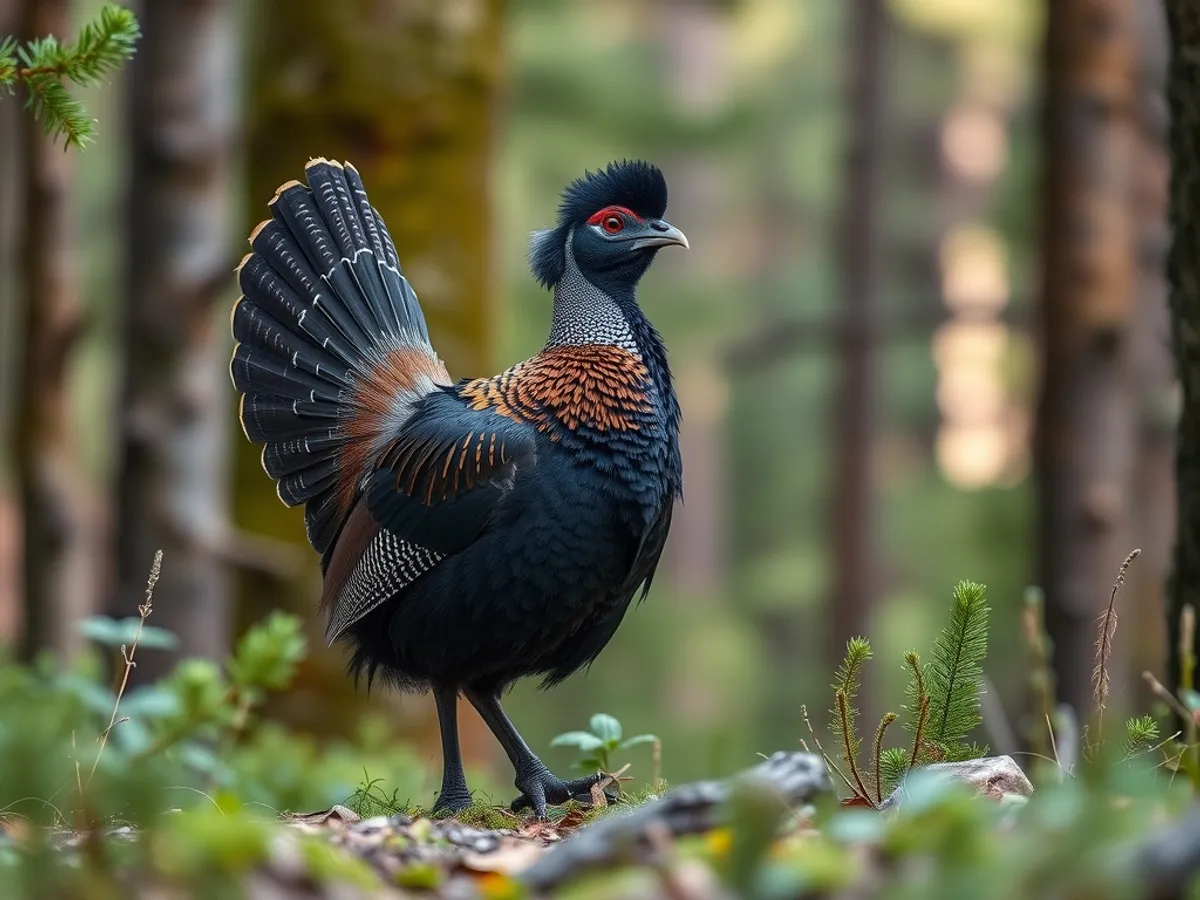
The western capercaillie (Tetrao urogallus) is the largest grouse in the world, and the difference between the sexes is extreme: a cock can weigh twice as much as a hen, up to 6.5 kilograms, and is nearly black with a metallic green breast and a scarlet wattle over each eye. Cocks display at leks, and the song is a bizarre sequence of clicks that accelerate into a sound like a cork being pulled from a bottle, followed by a wheezing, scraping flourish. During that final phase the bird becomes temporarily deaf: a fold of tissue in the ear canal is pushed across by the movement of the jaw, and the bird cannot hear. Hunters have exploited this for centuries, creeping forward only during the wheeze and freezing between phrases, and it is the origin of the German name Auerhahn and of the old reputation of the "deaf grouse". In winter the capercaillie eats almost nothing but conifer needles, chiefly pine, a diet so poor that it survives on it only by having enormously enlarged caeca in which bacteria ferment the material; it also swallows grit to grind the needles. Individual cocks occasionally become "rogues", attacking cars, dogs and people. The Scottish population, reintroduced after an earlier extinction, has fallen below about 600 birds and is in serious trouble.
Fascinating facts
Sexual Dimorphism
Western Capercaillie males are almost twice as large as females, with males reaching up to 6.5 kg while females rarely exceed 2.5 kg.
Courtship Leks
Males gather in special areas called 'leks' each spring, performing elaborate displays to attract potential mates.
Winter Diet
In winter, the capercaillie feeds primarily on pine needles, which it can digest thanks to a specialized digestive system.
Detailed description
The Western Capercaillie (Tetrao urogallus) is a large, sexually dimorphic grouse species, with males reaching up to 100 cm in length and weighing between 3.5 and 6.5 kg, while females are notably smaller, averaging 2 to 2.5 kg and about 60 cm in length. Males exhibit striking plumage: dark, iridescent green-black on the breast, brown wings, and a prominent white shoulder patch, while females are mottled brown and grey, providing camouflage. The species is adapted to life in mature, old-growth coniferous and mixed forests, particularly those with a dense understory of bilberry (Vaccinium myrtillus) and other ericaceous shrubs. Capercaillies are primarily ground-dwelling but are capable of strong, explosive flight when startled. Their robust legs and feet are feathered for insulation and equipped with pectinate toes in winter, aiding movement on snow. The species is most famous for its elaborate male courtship display, or 'lekking,' where males compete for females at traditional display sites. Capercaillies are generally solitary outside the breeding season, though females may form small groups with their chicks. Their diet shifts seasonally: in winter, they consume mainly pine needles and buds, while in summer, they feed on leaves, berries, insects, and other invertebrates. The Western Capercaillie is a key indicator species for forest ecosystem health, as it requires large, undisturbed tracts of mature woodland.
Did you know?
Despite their large size and apparent clumsiness, Western Capercaillies are capable of swift and powerful flight when threatened.
Research & sources
Wikipedia summary
The western capercaillie, also known as the Eurasian capercaillie, wood grouse, heather cock, cock-of-the-woods, or simply capercaillie, is a heavy member of the grouse family and the largest of all extant grouse species. The heaviest-known specimen, recorded in captivity, had a weight of 7.2 kilograms. Found across Europe and the Palearctic, this primarily-ground-dwelling forest grouse is renowned for its courtship display. The bird shows extreme sexual dimorphism, with males nearly twice the size of females. The global population is listed as "least concern" under the IUCN, although the populations of central Europe are declining and fragmented, or possibly extirpated.
Behaviour & social structure
Western Capercaillies are crepuscular, being most active at dawn and dusk. Males are territorial during the breeding season, defending display sites with aggressive posturing, vocalizations, and physical confrontations. Outside of lekking, both sexes are generally solitary, though hens with broods may form loose family groups. Feeding behavior is highly seasonal: in winter, birds feed almost exclusively on conifer needles, especially Scots pine (Pinus sylvestris), using their large crops to digest this fibrous diet. In spring and summer, they forage for berries, green plant material, seeds, and insects, which are especially important for the protein needs of growing chicks. Capercaillies are wary and rely on camouflage and stillness to avoid predators, but will flush noisily if approached closely. Roosting occurs in trees or on the ground, depending on weather and predation risk. Social interactions outside the breeding season are minimal, with individuals maintaining large home ranges.
Reproduction & life cycle
Breeding occurs from late March to early June, varying with latitude and altitude. Males gather at traditional leks, where they perform elaborate displays to attract females. The display includes tail fanning, neck stretching, wing drooping, and a series of unique vocalizations—clicks, pops, and wheezing notes. After mating, females leave the lek to nest alone, selecting well-concealed sites on the ground, often under dense vegetation. Clutch size ranges from 6 to 12 eggs, which are incubated solely by the female for 26–28 days. Chicks are precocial and leave the nest within 24 hours of hatching, following the mother and feeding on insects and plant material. The female provides all parental care, leading the brood and protecting them from predators. Fledging occurs at 3–4 weeks, but young remain with the mother until autumn.
Adaptations & survival
The Western Capercaillie exhibits several adaptations to its forest environment. Its cryptic plumage provides effective camouflage against the forest floor. Feathered legs and toes offer insulation against cold and facilitate movement on snow. The digestive system is highly specialized: an enlarged crop and caeca allow efficient breakdown of tough, fibrous plant material, especially conifer needles in winter. Seasonal changes in gut microbiota enhance digestion of different diets. Males' elaborate displays are evolutionary adaptations for sexual selection, with vocalizations and visual signals optimized for transmission in dense forest habitats. Chicks are adapted for rapid growth and early mobility, crucial for survival in predator-rich environments.
Cultural significance
The Western Capercaillie has deep cultural roots in northern and eastern Europe, featuring prominently in folklore, art, and hunting traditions. Its dramatic courtship display has inspired numerous legends and is a symbol of wilderness in countries like Scotland, Sweden, and Russia. The species has historically been hunted for sport and food, and its feathers and meat were once considered delicacies. In some regions, the capercaillie is regarded as a flagship species for forest conservation and is used in ecotourism and environmental education.
Recent research
Recent research has focused on the genetic diversity and population structure of fragmented populations, revealing low gene flow between isolated groups. Studies on lekking behavior have provided insights into sexual selection and the impacts of human disturbance. Advances in telemetry and GPS tracking have improved understanding of habitat use, seasonal movements, and home range requirements. Conservation research is exploring habitat restoration, predator management, and the effectiveness of reintroduction programs, particularly in areas where the species has been extirpated. Ongoing studies are also examining the effects of climate change on breeding phenology and food availability.
Videos
Habitat
Boreal and temperate coniferous forests


Conservation
The Western Capercaillie is currently classified as Least Concern on the IUCN Red List.
Threats & challenges
Major threats include habitat loss and fragmentation due to forestry practices, urbanization, and infrastructure development, which reduce the extent and quality of suitable old-growth forests. Disturbance from recreational activities, especially during the breeding season, can lead to lek abandonment and reduced reproductive success. Increased predation from generalist predators (e.g., red foxes, martens) is exacerbated by habitat fragmentation. Climate change poses additional risks by altering forest composition and snow cover patterns. Populations in Central and Western Europe are particularly vulnerable, with some local extinctions reported. Conservation challenges include the need for large, contiguous tracts of mature forest and effective management of human disturbance.
Taxonomy
Scientific name
Tetrao urogallus
- Kingdom
- Animalia
- Phylum
- Chordata
- Class
- Aves
- Order
- Galliformes
- Family
- Phasianidae
- Genus
- Tetrao
- Species
- urogallus
Community notes
Share your observations about the Western Capercaillie.
No community notes yet. Be the first!
Discover more wildlife
More fascinating animals from the encyclopedia.