
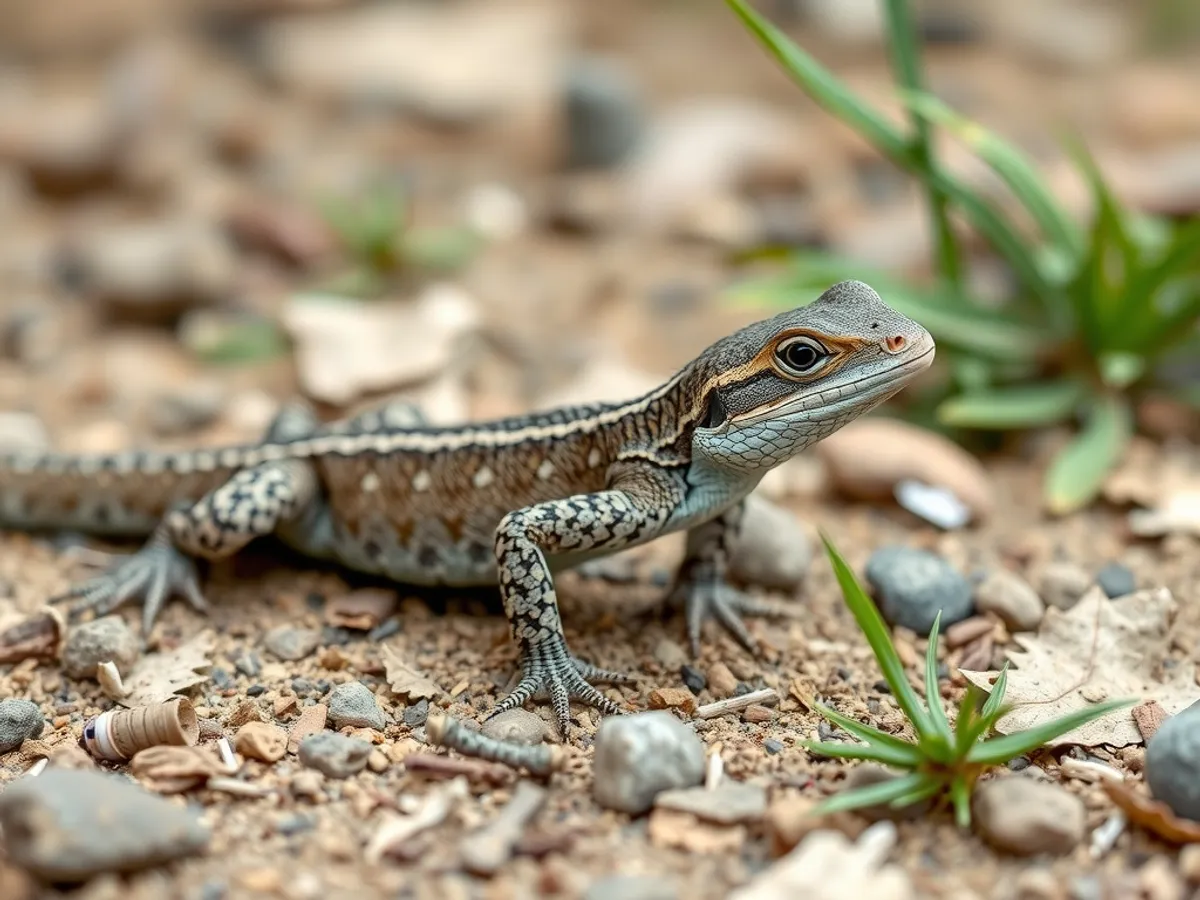
About the Western Fence Lizard
The Western Fence Lizard, often called the 'blue-belly' lizard, is a medium-sized reptile native to the western United States. Recognizable by its rough, spiny scales and distinctive blue coloration on its throat and belly, it thrives in a variety of environments, including grasslands, woodlands, and suburban areas. These lizards are diurnal and spend much of their time basking in the sun on fences, rocks, and logs. They play an important ecological role by controlling insect populations and are notable for their resistance to Lyme disease transmission.
Fascinating facts
Blue Bellies
Male Western Fence Lizards have bright blue patches on their bellies and throats, especially vivid during the breeding season.
Sun Basking
They are often seen basking in sunny spots, which helps them regulate their body temperature and stay active.
Tick Defense
Their blood contains a protein that kills the Lyme disease bacterium in ticks, reducing the risk of transmission to humans.
Detailed description
The Western Fence Lizard (Sceloporus occidentalis) is a medium-sized phrynosomatid lizard, typically measuring 5.7 to 8.9 cm (2.25 to 3.5 inches) in snout-to-vent length, with total lengths reaching up to 21 cm (8.3 inches) including the tail. Its body is robust and covered in keeled, spiny scales that provide protection from predators and facilitate water retention. The dorsal coloration ranges from gray to brown or black, often with subtle crossbands, while the ventral surface of adult males displays vivid blue patches on the throat and belly, a feature less pronounced in females and juveniles. This species is diurnal and highly active, frequently observed basking on exposed surfaces such as rocks, logs, and fences to regulate its body temperature. Western Fence Lizards are primarily insectivorous, preying on a diverse array of arthropods, including ants, beetles, spiders, and caterpillars. They exhibit territorial behavior, with males defending prime basking and foraging sites through visual displays such as push-ups, head-bobbing, and tail-waving. Reproduction occurs in spring and early summer, with females laying clutches of 3 to 17 eggs in moist, protected soil. Hatchlings emerge after an incubation period of about 60 days, receiving no parental care. Notably, S. occidentalis plays an important ecological role by reducing the prevalence of Lyme disease; its blood contains a protein that kills the Borrelia burgdorferi spirochete carried by feeding ticks, interrupting the transmission cycle.
Did you know?
Ticks that feed on Western Fence Lizards lose the bacteria that cause Lyme disease, making areas with these lizards safer for humans.
Research & sources
Wikipedia summary
The western fence lizard is a species of lizard native to Arizona, New Mexico, and California, as well as Idaho, Nevada, Oregon, Utah, Washington, and Northern Mexico. The species is widely found in its native range and is considered common, often being seen in yards, or as the name implies, on fences. As the ventral abdomen of an adult is characteristically blue, it is also known as the blue-belly. Two western fence lizards have been reported with duplicated or forked tails, presumably following an autotomy.
Behaviour & social structure
Western Fence Lizards are solitary and territorial, especially during the breeding season. Males establish and defend territories using conspicuous visual displays, including rapid push-ups, lateral flattening to expose blue belly patches, and tail arching. These displays serve both to deter rival males and attract females. The species is primarily ground-dwelling but is adept at climbing and often perches on elevated surfaces for basking and vigilance. Activity peaks during warm daylight hours, with lizards retreating to crevices or burrows at night or during extreme heat. Their foraging strategy is a combination of sit-and-wait and active hunting, with quick dashes to capture prey. When threatened, they may employ caudal autotomy (tail shedding) to escape predators, and the tail can regenerate over time. Social interactions are generally limited outside of the breeding season, and individuals maintain defined home ranges.
Reproduction & life cycle
Breeding in Sceloporus occidentalis typically begins in early spring (March to June), triggered by rising temperatures and increased daylight. Males engage in courtship displays to attract females, which may include head-bobbing and the exhibition of blue ventral patches. After mating, females lay one to three clutches per season, each containing 3 to 17 eggs, depending on female size and environmental conditions. Eggs are deposited in shallow nests dug in loose, moist soil, often under rocks or logs. Incubation lasts approximately 50 to 65 days, with hatchlings emerging in late summer. There is no parental care; juveniles are independent from birth. Sexual maturity is typically reached within one to two years.
Adaptations & survival
Western Fence Lizards possess several adaptations for survival in diverse habitats. Their rough, spiny scales reduce water loss and offer protection from predators. The blue ventral coloration in males is a sexually selected trait used in intraspecific communication. Behavioral thermoregulation, such as basking and seeking shade, allows them to maintain optimal body temperatures for activity and digestion. Caudal autotomy provides an effective escape mechanism from predation. Their immune system includes a unique complement protein that neutralizes Borrelia burgdorferi, reducing Lyme disease transmission. Additionally, their broad diet and tolerance for disturbed habitats enable them to thrive in both natural and suburban environments.
Cultural significance
The Western Fence Lizard is a familiar sight in much of the western United States and is often appreciated for its role in controlling insect pests. Its striking blue belly has made it a subject of local folklore and a popular species among amateur naturalists and educators. The species is sometimes featured in regional art and storytelling, symbolizing resilience and adaptability. There are no significant traditional medicinal or economic uses documented.
Recent research
Recent research has focused on the Western Fence Lizard's role in interrupting Lyme disease transmission, with studies demonstrating that the lizard's blood kills Borrelia burgdorferi in feeding ticks, reducing infection rates in tick populations. Genetic studies have revealed significant geographic variation and the presence of several subspecies across its range. Ongoing research examines the effects of urbanization and climate change on their distribution, behavior, and physiology. Studies on tail regeneration and autotomy have provided insights into vertebrate tissue regeneration. Additionally, behavioral ecology research has explored the evolutionary significance of blue coloration and its role in sexual selection and species recognition.
Sources
Sceloporus occidentalis (Western Fence Lizard): Natural History and Ecology
Stebbins, R.C. & McGinnis, S.M. (2012)
scientificSceloporus occidentalis: IUCN Red List of Threatened Species
Hollingsworth, B. & Hammerson, G.A. (2007)
conservationVideos
Habitat
Woodlands, grasslands, chaparral, and suburban areas
 Various Continental Regions
Grassland
Open areas dominated by grasses rather than trees, supporting numerous herbivores and their predators.
 Elevated Terrain
Mountain
High-altitude environments with varying climates and specialized wildlife adapted to rugged terrain and thin air.
 Global
Forest
Wooded areas with significant tree cover and diverse plant and animal communities.
Conservation
The Western Fence Lizard is currently classified as Least Concern on the IUCN Red List.
Threats & challenges
Currently, the Western Fence Lizard is classified as Least Concern by the IUCN due to its wide distribution and large, stable populations. However, localized threats include habitat loss from urban development, agricultural expansion, and road mortality. Pesticide use can reduce prey availability and directly impact lizard health. Climate change may alter habitat suitability and seasonal activity patterns. Despite these challenges, the species demonstrates considerable adaptability and resilience, with no significant population declines reported.
Taxonomy
Scientific name
Sceloporus occidentalis
- Kingdom
- Animalia
- Phylum
- Chordata
- Class
- Reptilia
- Order
- Squamata
- Family
- Phrynosomatidae
- Genus
- Sceloporus
- Species
- occidentalis
Community notes
Share your observations about the Western Fence Lizard.
No community notes yet. Be the first!
Discover more wildlife
More fascinating animals from the encyclopedia.