
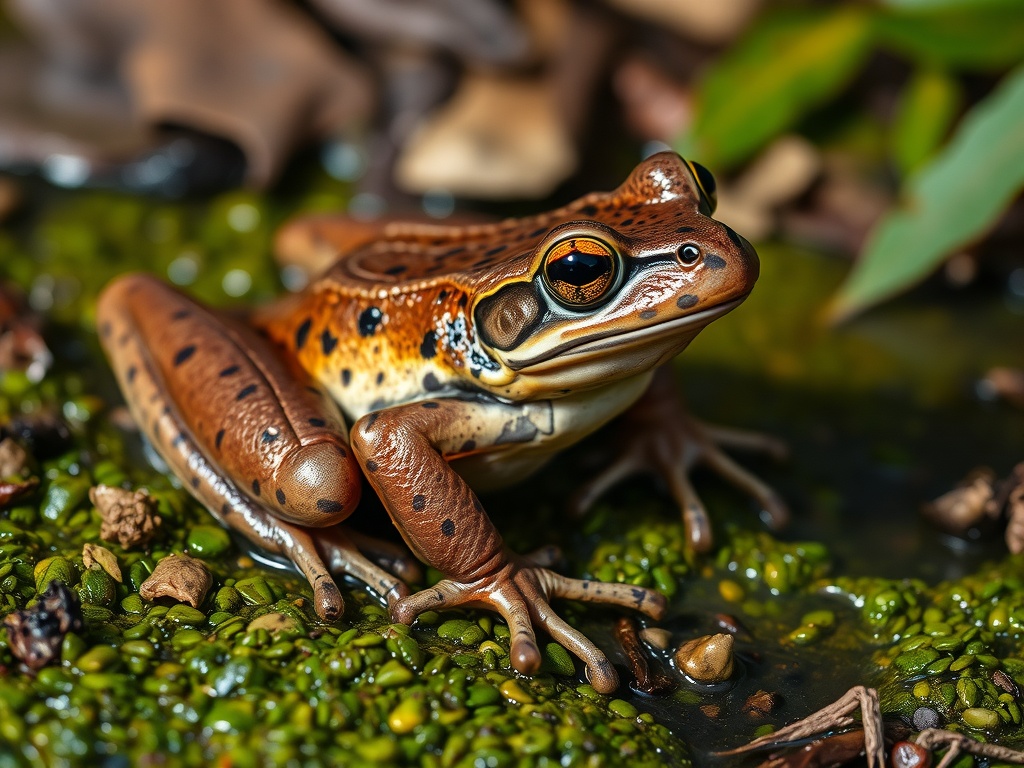
About the Wood Frog
The wood frog survives winter by freezing solid. As much as two-thirds of the water in its body turns to ice, its heart stops beating, it stops breathing, and measurable brain activity ceases — by any ordinary standard it is dead, and it stays that way for weeks or months. The trick is chemistry. As ice begins to form in the skin, the liver floods the bloodstream with glucose, which acts as an antifreeze, and it packs the inside of every cell so densely with sugar that the water within the cell cannot crystallise. Ice is therefore permitted to form, but only outside the cells — in the body cavity and beneath the skin — where it does no fatal damage. In spring the frog thaws from the inside out, the heart simply restarts on its own, and within hours it is hopping and calling. It is the northernmost frog in North America, found well above the Arctic Circle, and it does this every year of its life.
Fascinating facts
Freeze Tolerance
Wood Frogs can survive freezing of their blood and tissues, using glucose as a cryoprotectant to prevent cellular damage.
Unique Call
Their mating call sounds like a series of short, duck-like quacks, making them easy to identify during the breeding season.
Northern Range
The Wood Frog holds the record for the northernmost range of any North American amphibian, reaching as far as Alaska and the Arctic Circle.
Detailed description
The Wood Frog (Lithobates sylvaticus) is a small, medium-built amphibian, typically measuring 3.5–7.5 cm (1.4–3 in) in length, with females generally larger than males. Its most distinctive feature is a prominent dark brown or black 'mask' extending from the snout, through the eye, and over the tympanum, contrasting with a pale upper lip. Dorsal coloration varies widely from tan, rust, brown, to gray, aiding in camouflage among leaf litter, while the ventral surface is pale or whitish. The skin is smooth and moist, with subtle dorsolateral folds running from behind the eyes down the back. Wood Frogs possess long, powerful hind limbs adapted for jumping and swimming, and unwebbed front toes. They are primarily terrestrial outside the breeding season, often found far from water in moist woodlands, sphagnum bogs, or even tundra. Their eyes are large and positioned laterally, providing a broad field of vision to detect predators. During winter, Wood Frogs exhibit a remarkable physiological adaptation: they survive freezing by allowing up to 65% of their body water to crystallize, with high concentrations of glucose and urea acting as cryoprotectants to prevent cellular damage. This adaptation enables them to overwinter in shallow ground cover, leaf litter, or under logs, resuming activity rapidly after thawing in early spring.
Did you know?
Up to 70% of a Wood Frog's body water can turn to ice during winter, and its heart actually stops beating until it thaws in spring.
Research & sources
Wikipedia summary
Lithobates sylvaticus or Rana sylvatica, commonly known as the wood frog, is a frog species that has a broad distribution over North America, extending from the boreal forest of the north to the southern Appalachians, with several notable disjunct populations including lowland eastern North Carolina. The wood frog has garnered attention from biologists because of its freeze tolerance, relatively great degree of terrestrialism, interesting habitat associations, and relatively long-range movements.
Behaviour & social structure
Wood Frogs are primarily crepuscular, being most active at dawn and dusk, though they may be active during the day in cool, moist conditions. Outside the breeding season, they are solitary and highly terrestrial, foraging on the forest floor for a variety of invertebrates including insects, spiders, worms, and slugs. They use a sit-and-wait hunting strategy, relying on camouflage and sudden lunges to capture prey with their sticky tongues. During the brief breeding season, they congregate in large numbers in temporary pools, where males establish loose choruses and compete vocally for females. The species exhibits strong site fidelity, often returning to the same breeding pools each year. Wood Frogs are capable of long-distance migrations, sometimes traveling over 1 km between terrestrial and breeding habitats. They are generally non-aggressive, but males may engage in amplexus competition. When threatened, Wood Frogs may leap away or remain motionless, relying on their cryptic coloration.
Reproduction & life cycle
Breeding occurs in early spring, often within days of ice melt, making Wood Frogs among the first amphibians to breed in northern climates. Males arrive at vernal pools first and produce a series of short, duck-like 'quacks' to attract females. Amplexus (mating embrace) is axillary, with males clasping females behind the forelimbs. Females lay large, globular egg masses containing 500–2,000 eggs, which are attached to submerged vegetation. Embryonic development is rapid, with eggs hatching in 6–12 days depending on water temperature. Tadpoles are herbivorous, feeding on algae and detritus, and undergo metamorphosis in 40–90 days. There is no parental care after egg-laying; both adults and tadpoles are vulnerable to predation. Most individuals reach sexual maturity in 2–3 years, and the average lifespan in the wild is estimated at 3–5 years.
Adaptations & survival
The Wood Frog's most extraordinary adaptation is its freeze tolerance, allowing it to survive subzero temperatures by halting its heartbeat and ceasing respiration for weeks or months. This is achieved through the synthesis of glucose and urea, which protect cells from ice damage. Their coloration and patterning provide effective camouflage in leaf litter, reducing predation risk. Wood Frogs have evolved rapid development rates in their larval stage, an adaptation to ephemeral breeding pools that dry up quickly. Their ability to migrate long distances between terrestrial and aquatic habitats increases their resilience to habitat fragmentation. Additionally, their breeding synchrony and explosive breeding strategy help overwhelm predators and ensure reproductive success.
Cultural significance
The Wood Frog holds a unique place in northern folklore and indigenous knowledge, often symbolizing resilience and the arrival of spring. Its freeze tolerance has inspired scientific and popular interest, leading to its use as a model organism in cryobiology and climate adaptation research. In some Native American traditions, frogs are associated with transformation and renewal. The Wood Frog's early spring chorus is a familiar natural event in many North American forests, marking the seasonal transition and serving as an indicator of wetland health.
Recent research
Recent research on Wood Frogs has focused on the molecular and physiological mechanisms underlying freeze tolerance, with implications for organ preservation and cryomedicine. Studies have also examined the effects of climate change on breeding phenology, showing earlier breeding in response to warming temperatures. Genetic analyses have revealed significant population structure and local adaptation, particularly in isolated or edge populations. Ongoing research is investigating the impacts of road networks on gene flow and population viability, as well as the species' role in forest ecosystem nutrient cycling. The Wood Frog is increasingly used as a bioindicator species for monitoring environmental health and the effects of contaminants on amphibian populations.
Videos
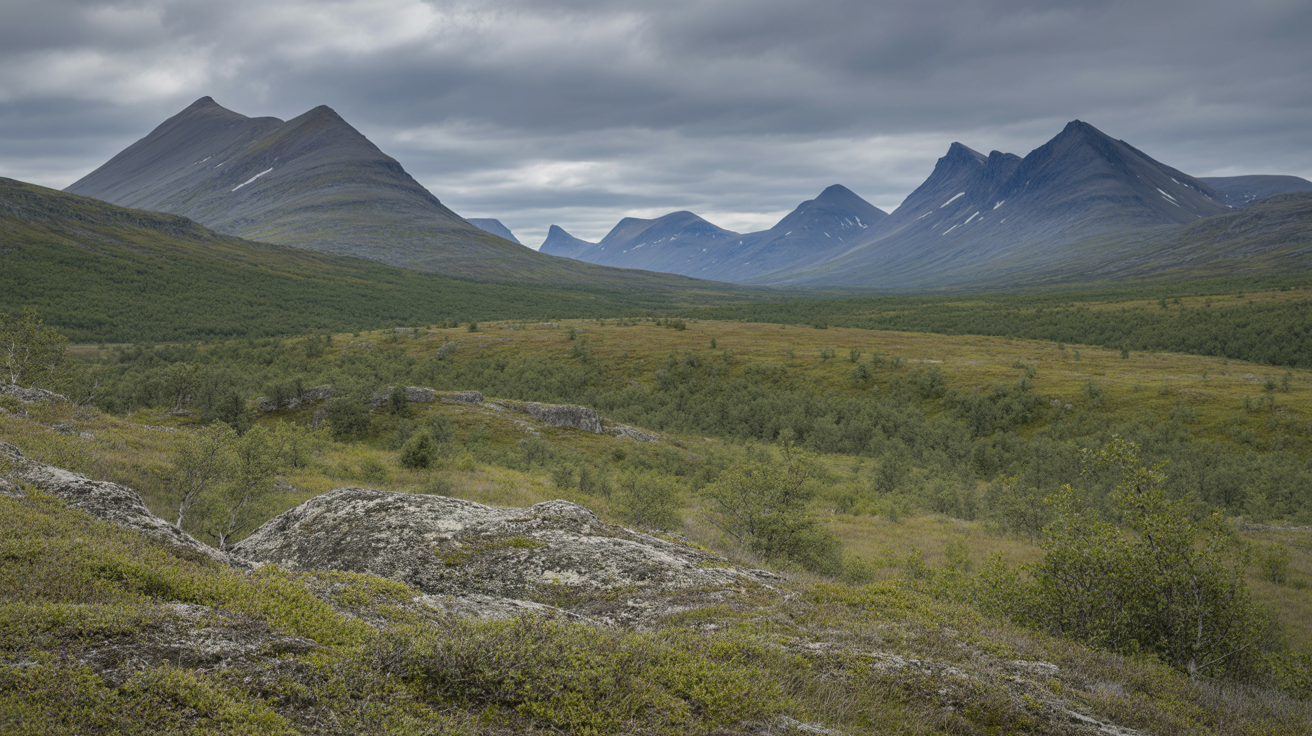
Habitat
Deciduous and mixed forests, wetlands, vernal pools, and tundra edges


Conservation
The Wood Frog is currently classified as Least Concern on the IUCN Red List.
Threats & challenges
Although currently listed as Least Concern, Wood Frogs face several threats. Habitat loss and fragmentation due to urbanization, agriculture, and road construction reduce available breeding and foraging sites. Vernal pool destruction is particularly detrimental, as these temporary wetlands are critical for reproduction. Road mortality during spring migrations can be significant. Climate change poses a long-term threat by altering precipitation patterns, shortening hydroperiods of breeding pools, and affecting overwintering survival. Exposure to pesticides, pollutants, and emerging infectious diseases such as chytridiomycosis (caused by Batrachochytrium dendrobatidis) are additional concerns. Despite these challenges, Wood Frogs remain widespread and abundant in much of their range, with some local declines noted.
Taxonomy
Scientific name
Rana sylvatica
- Kingdom
- Animalia
- Phylum
- Chordata
- Class
- Amphibia
- Order
- Anura
- Family
- Ranidae
- Genus
- Rana
- Species
- sylvatica
Community notes
Share your observations about the Wood Frog.
No community notes yet. Be the first!
Discover more wildlife
More fascinating animals from the encyclopedia.