
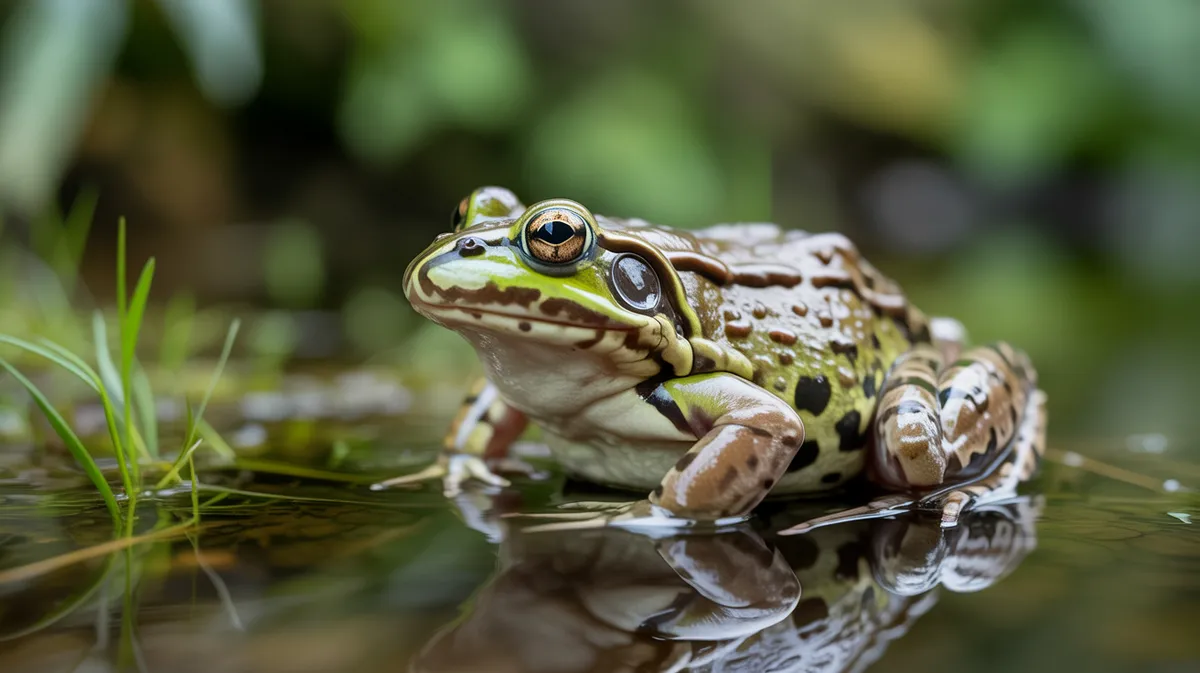
About the Wrinkled Frog
The Wrinkled Frog, scientifically known as Nyctibatrachus major, is a medium-sized amphibian native to the Western Ghats of southern India. It is characterized by its rough, wrinkled skin, which helps it blend into the leaf litter and rocky substrates of fast-flowing forest streams. These frogs are primarily nocturnal and are well adapted to their moist, shaded habitats. Their secretive lifestyle and camouflaged appearance make them difficult to spot in the wild.
Fascinating facts
Stream Dwellers
Wrinkled Frogs are highly adapted to life in and around fast-flowing streams, relying on their camouflage and toe pads to avoid being swept away.
Insect Eaters
Their diet mainly consists of small insects and other invertebrates found near water bodies.
Genetic Diversity
The genus Nyctibatrachus contains over 25 species, many of which are cryptic and have only recently been discovered due to their genetic diversity.
Detailed description
Nyctibatrachus major, commonly known as the Wrinkled Frog, is a robust, medium-sized amphibian, with adults typically ranging from 45 to 85 mm in snout-vent length. Its most distinctive feature is the highly wrinkled, glandular skin, which provides camouflage among the mossy rocks and leaf litter of its streamside habitat. The dorsal coloration varies from dark brown to grayish, often with lighter mottling, and the ventral side is usually lighter. The head is broad with a rounded snout, and the eyes are relatively large, aiding nocturnal vision. The limbs are muscular, with partially webbed toes adapted for gripping slippery substrates in fast-flowing streams. This species is primarily nocturnal and secretive, emerging at dusk to forage and breed. Its call is a series of low-pitched, pulsed notes, often delivered from concealed positions near water. The Wrinkled Frog is highly aquatic, rarely straying far from water, and is well adapted to the cool, humid microclimate of montane forests. Its life cycle is closely tied to perennial streams, where both adults and larvae are dependent on clean, oxygen-rich water.
Did you know?
Unlike many frogs, the Wrinkled Frog lays its eggs on land close to water, and the tadpoles wriggle into the stream after hatching.
Research & sources
Behaviour & social structure
Wrinkled Frogs are predominantly nocturnal and crepuscular, remaining hidden under rocks, logs, or dense leaf litter during the day to avoid desiccation and predation. At night, they become active, foraging along stream banks and in shallow water for a variety of invertebrates, including insects, arachnids, and small crustaceans. Their hunting strategy is primarily sit-and-wait, relying on their cryptic coloration and sudden lunges to capture prey. Social interactions are limited outside the breeding season, as individuals are largely solitary and territorial, especially males, which defend calling sites during the monsoon. Vocal communication is essential for mate attraction and territory establishment, with males producing advertisement calls that can be heard over the noise of running water. During the breeding season, aggregations may form at optimal oviposition sites, but direct physical interactions are infrequent.
Reproduction & life cycle
Breeding in Nyctibatrachus major is closely linked to the southwest monsoon (June–September), when increased stream flow and humidity create ideal conditions for reproduction. Males call from concealed positions near water to attract females. Amplexus is inguinal, and females lay clutches of 50–200 eggs on moist substrates above the waterline, such as rocks or vegetation. The eggs are gelatinous and unpigmented, and development is direct, with aquatic larvae (tadpoles) hatching and dropping into the stream below. The larval period can last 2–3 months, depending on water temperature and food availability. Parental care is minimal, though some observations suggest that males may remain near egg clutches to deter predators and fungal infections. Juvenile frogs reach sexual maturity in approximately 1–2 years.
Adaptations & survival
Nyctibatrachus major exhibits several key adaptations for its stream-dwelling lifestyle. The wrinkled, glandular skin not only aids in camouflage but also enhances cutaneous respiration, crucial in oxygen-rich but fast-flowing waters. Partially webbed toes and muscular limbs facilitate strong grip and agile movement on slippery substrates. The species' cryptic coloration and nocturnal habits reduce predation risk. Its reproductive strategy, involving egg deposition above water, minimizes egg loss from aquatic predators and flooding. The frog's low-frequency calls are adapted to transmit effectively over the ambient noise of running water, ensuring successful mate attraction.
Cultural significance
While Nyctibatrachus major does not have a prominent role in local folklore or traditional medicine, its presence is an indicator of healthy, unpolluted stream ecosystems in the Western Ghats. The species is sometimes referenced in environmental education as a flagship for amphibian conservation in India. Its unique appearance and ecological role have made it a subject of interest among herpetologists and conservationists, but it remains largely unknown to the general public.
Recent research
Recent research on Nyctibatrachus major has focused on its phylogenetic relationships within the Nyctibatrachidae family, revealing significant genetic divergence among populations, suggesting possible cryptic species. Studies have also examined its reproductive ecology, particularly the adaptation of egg-laying behavior to minimize predation and desiccation. Ongoing research is investigating the impacts of habitat fragmentation on genetic diversity and population connectivity. Conservation biologists are using environmental DNA (eDNA) techniques to monitor populations and assess the effectiveness of stream restoration projects. There is also growing interest in the species' skin microbiome, which may play a role in resistance to chytrid fungal infections.
Sources
Systematics and Phylogeny of Nyctibatrachus (Anura: Nyctibatrachidae) with Description of Twelve New Species from the Western Ghats, India
S.D. Biju et al. (2011)
scientificNyctibatrachus major: The IUCN Red List of Threatened Species 2022
IUCN SSC Amphibian Specialist Group
conservationSystematics and phylogeny of Nyctibatrachus (Anura: Nyctibatrachidae) with description of twelve new species from the Western Ghats, India
Biju, S.D., Van Bocxlaer, I., et al. (2011)
scientificNyctibatrachus major: The IUCN Red List of Threatened Species 2022
IUCN SSC Amphibian Specialist Group
conservationVideos
Habitat
Montane and evergreen forest streams
 Elevated Terrain
Mountain
High-altitude environments with varying climates and specialized wildlife adapted to rugged terrain and thin air.
 Global
Forest
Wooded areas with significant tree cover and diverse plant and animal communities.
 Global
Freshwater
Lakes, rivers, and wetlands with diverse aquatic ecosystems.
Conservation
The Wrinkled Frog is currently classified as Endangered on the IUCN Red List.
Threats & challenges
The Wrinkled Frog faces significant threats from habitat loss due to deforestation, agricultural expansion, and infrastructure development in the Western Ghats. Stream pollution from pesticides, fertilizers, and human waste degrades water quality, impacting both adults and larvae. Hydrological changes from damming and water extraction alter stream flow, reducing suitable breeding sites. Invasive species, such as predatory fish, also threaten tadpole survival. Climate change poses additional risks by altering rainfall patterns and stream dynamics. Population trends are declining, and the species is classified as Endangered by the IUCN. Conservation challenges include the need for habitat protection, stream restoration, and improved management of protected areas.
Taxonomy
Scientific name
Nyctibatrachus major
- Kingdom
- Animalia
- Phylum
- Chordata
- Class
- Amphibia
- Order
- Anura
- Family
- Nyctibatrachidae
- Genus
- Nyctibatrachus
- Species
- major
Community notes
Share your observations about the Wrinkled Frog.
No community notes yet. Be the first!
Discover more wildlife
More fascinating animals from the encyclopedia.