
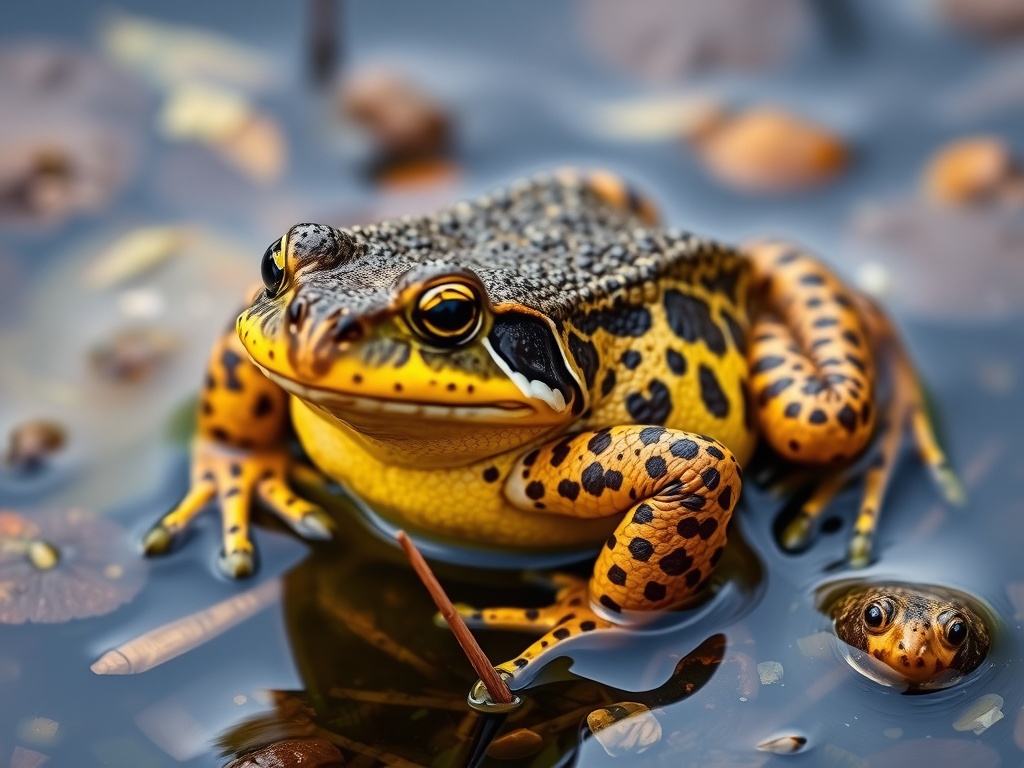
About the Yellow-bellied Toad
The Yellow-bellied Toad is a small amphibian known for its striking bright yellow or orange underside, which is marked with dark spots and serves as a warning to predators. Its dorsal side is usually gray or olive, providing excellent camouflage among rocks and leaf litter. This species is highly aquatic, often found in shallow ponds, marshes, and slow-moving streams throughout Central and Southern Europe. When threatened, it assumes a defensive posture called the 'unkenreflex,' arching its back and limbs to display its colorful belly as a deterrent. The Yellow-bellied Toad is also recognized for its distinct, melodic mating calls that resemble a high-pitched bell.
Fascinating facts
Warning Colors
The bright yellow or orange belly of the Yellow-bellied Toad warns predators of its skin toxins, a defense known as aposematism.
Bell-like Calls
Males produce a distinctive, melodious call that resembles a ringing bell, which is used to attract females during mating season.
Unkenreflex Display
When threatened, the toad arches its back and limbs to expose its vivid belly, startling predators and showcasing its toxic warning coloration.
Detailed description
The Yellow-bellied Toad (Bombina variegata) is a small, robust amphibian, typically measuring 35–55 mm in length, with females generally larger than males. Its dorsal surface is warty and colored in shades of gray, brown, or olive, often mottled with darker patches, providing effective camouflage in its terrestrial habitats. The ventral side is its most distinctive feature: a vivid yellow or orange background marked with irregular black or bluish spots, which serves as an aposematic signal to potential predators. The skin secretes mild toxins, including bombinins, which deter predation. The head is broad with protruding eyes and a short, rounded snout. Limbs are relatively short but strong, adapted for both swimming and walking. The species is semi-aquatic, spending significant time in shallow, ephemeral water bodies but also venturing onto moist terrestrial substrates. The tympanum (external ear) is not visible, and the toad relies heavily on vocalizations for communication, especially during the breeding season. Its lifespan in the wild is typically 8–10 years, though individuals in captivity may live longer. The species is known for its unique defensive posture, the 'unkenreflex,' in which it arches its back and limbs to display its bright belly when threatened.
Did you know?
Despite their small size, Yellow-bellied Toads can live up to 15 years in the wild, which is unusually long for such tiny amphibians.
Research & sources
Wikipedia summary
The yellow-bellied toad belongs to the order Anura, the archaeobatrachial family Bombinatoridae, and the genus of fire-bellied toads. The toad is distributed mainly across western Europe as well as a handful of countries in eastern Europe. While the population of the toad is steadily decreasing over time, its numbers are not critical enough to be considered threatened or extinct. Conservation efforts in Germany are taking place to remedy the declining population before it is too late.
Behaviour & social structure
Yellow-bellied Toads are primarily crepuscular, being most active during dawn and dusk, although activity patterns may shift with weather and season. They are opportunistic carnivores, feeding on a variety of small invertebrates such as insects, spiders, worms, and aquatic larvae. Foraging occurs both in water and on land, with prey detected visually and captured using a rapid tongue flick. Socially, they are generally solitary outside the breeding season, but may congregate in large numbers at suitable breeding sites. Territoriality is minimal, though males may compete for optimal calling positions. The species exhibits site fidelity, often returning to the same breeding pools annually. During dry periods, individuals may aestivate under logs, stones, or in burrows to avoid desiccation. The toads communicate through a series of melodious, bell-like calls produced by males to attract females and establish breeding territories.
Reproduction & life cycle
Breeding typically occurs from late April to August, depending on altitude and local climate. Males arrive first at breeding sites and emit characteristic calls to attract females. Amplexus is axillary, with the male grasping the female behind her forelimbs. Females lay 80–300 eggs per season, depositing them singly or in small clusters attached to submerged vegetation or detritus. Embryonic development is rapid, with eggs hatching within 3–10 days, depending on water temperature. Larval development (tadpoles) lasts 4–8 weeks, after which metamorphosis occurs, usually before temporary pools dry up. There is no parental care post-oviposition. Sexual maturity is typically reached at 2–4 years of age. The species' reproductive strategy is adapted to ephemeral aquatic habitats, with rapid development and flexible breeding timing.
Adaptations & survival
Bombina variegata exhibits several notable adaptations. Its bright ventral coloration and toxin-secreting skin are classic aposematic traits, warning predators of its unpalatability. The 'unkenreflex' display maximizes the visibility of these warning colors. The species' warty, cryptic dorsal skin aids in camouflage among leaf litter and rocks. Physiologically, the toad is tolerant of fluctuating water conditions, able to breed in temporary, low-oxygen pools where fish predators are absent. Its rapid larval development is an adaptation to the ephemeral nature of its breeding sites. Behavioral plasticity, including the ability to aestivate during droughts, enhances survival in variable climates. The toad's vocalizations are adapted for transmission over water surfaces, with males possessing a specialized vocal sac for sound amplification.
Cultural significance
While not as prominent in folklore as some amphibians, the Yellow-bellied Toad has been recognized in Central European rural traditions as a symbol of clean water and healthy wetlands. Its distinctive appearance and call have made it a subject of local nature education and conservation campaigns, particularly in Germany and Austria. In some regions, the species is featured in environmental awareness programs and is used as a flagship species for wetland restoration projects. There are no known traditional medicinal or culinary uses.
Recent research
Recent research has focused on the genetic diversity and population structure of Bombina variegata, revealing significant differentiation among isolated populations, which has implications for conservation management. Studies on hybrid zones with the closely related Bombina bombina (Fire-bellied Toad) have provided insights into speciation and reproductive isolation. Ongoing research is examining the effects of agrochemicals on larval development and the species' susceptibility to emerging amphibian pathogens. Acoustic communication and mate choice have also been subjects of behavioral studies, with findings indicating that call characteristics may be influenced by environmental factors and population density. Conservation genetics and landscape ecology are active areas of investigation, particularly in the context of habitat fragmentation.
Videos
Habitat
Freshwater ponds, marshes, and slow-moving streams
 Various Continental Regions
Grassland
Open areas dominated by grasses rather than trees, supporting numerous herbivores and their predators.
 Elevated Terrain
Mountain
High-altitude environments with varying climates and specialized wildlife adapted to rugged terrain and thin air.
 Global
Forest
Wooded areas with significant tree cover and diverse plant and animal communities.
 Global
Freshwater
Lakes, rivers, and wetlands with diverse aquatic ecosystems.
Conservation
The Yellow-bellied Toad is currently classified as Least Concern on the IUCN Red List.
Threats & challenges
Despite its current IUCN 'Least Concern' status, Bombina variegata faces several threats. Habitat loss and fragmentation, primarily due to agricultural intensification, urbanization, and drainage of wetlands, are major concerns. The species is sensitive to water pollution, especially from pesticides and fertilizers. Road mortality during seasonal migrations and the introduction of predatory fish to breeding sites further impact populations. Climate change poses additional risks by altering precipitation patterns and reducing the availability of suitable breeding habitats. Disease, particularly chytridiomycosis caused by the fungus Batrachochytrium dendrobatidis, has been detected in some populations, though its impact remains under study. Conservation challenges include maintaining habitat connectivity and restoring traditional land-use practices that favor the creation of temporary ponds.
Taxonomy
Scientific name
Bombina variegata
- Kingdom
- Animalia
- Phylum
- Chordata
- Class
- Amphibia
- Order
- Anura
- Family
- Bombinatoridae
- Genus
- Bombina
- Species
- variegata
Community notes
Share your observations about the Yellow-bellied Toad.
No community notes yet. Be the first!
Discover more wildlife
More fascinating animals from the encyclopedia.