
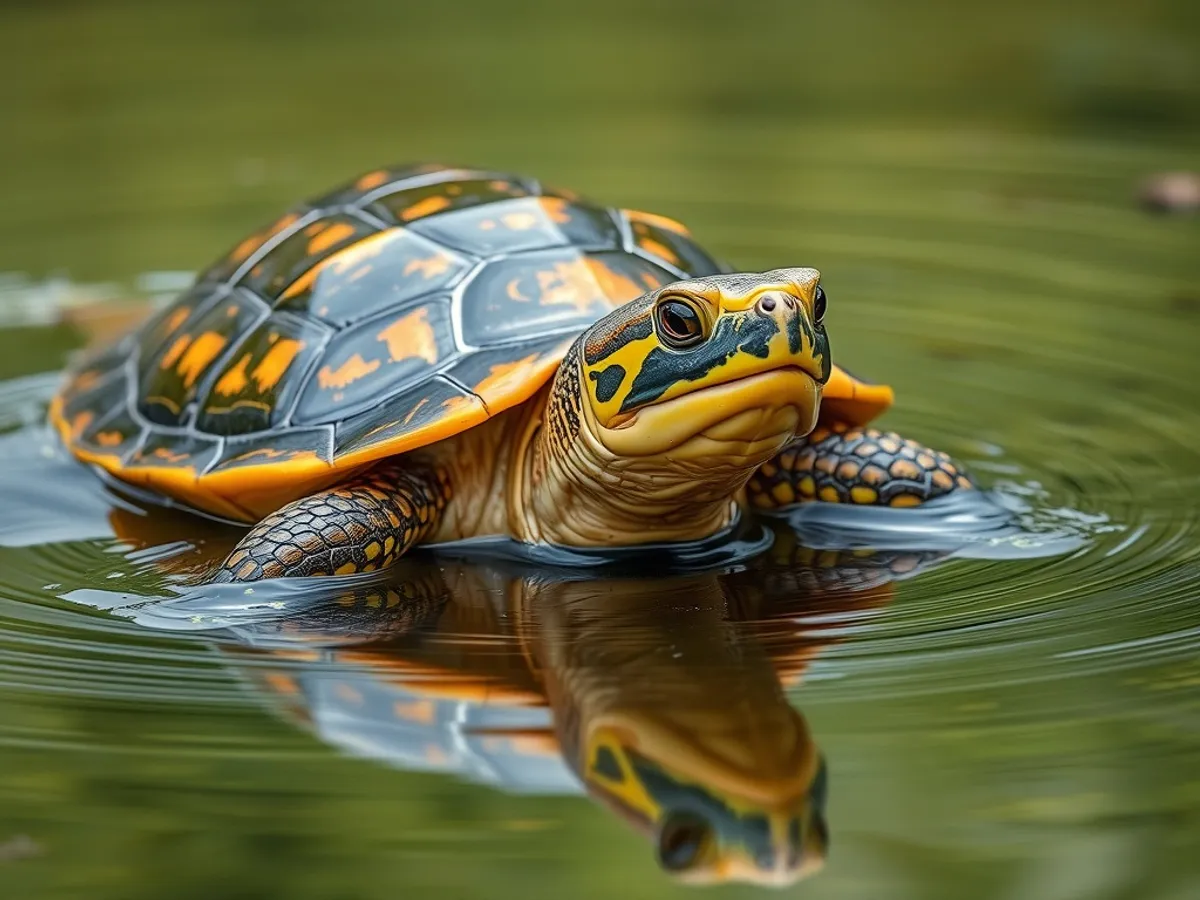
About the Yellow-Headed Amazon River Turtle
The Yellow-Headed Amazon River Turtle, also known as the Yellow-Spotted River Turtle, is a freshwater turtle native to the Amazon and Orinoco River basins in South America. It is easily recognized by the distinctive yellow spots on its head and neck, which contrast with its dark olive to black carapace. This semi-aquatic reptile spends much of its time in slow-moving rivers, lakes, and flooded forests, surfacing to bask on logs or sandbanks. Highly social, these turtles often gather in groups and play an important role in their ecosystem by dispersing seeds and controlling aquatic vegetation.
Fascinating facts
Distinctive Markings
The species is named for its bright yellow spots on the head and neck, which help with species recognition and may deter predators.
Nesting Habits
Females lay clutches of up to 35 eggs on sandy riverbanks, often timing their nesting with the dry season to ensure nest safety.
Ecosystem Role
By feeding on fruits and plants, these turtles help disperse seeds and maintain the health of riverine ecosystems.
Detailed description
The Yellow-Headed Amazon River Turtle (Podocnemis unifilis) is a large, semi-aquatic chelonian, with adults typically measuring 35–45 cm in carapace length and weighing between 6 and 10 kg, though some individuals can exceed these sizes. Its most distinguishing feature is the series of bright yellow or cream-colored spots on the sides and top of its head, which are especially prominent in juveniles and fade slightly with age. The carapace is broad, slightly domed, and ranges from olive to dark brown or black, while the plastron is lighter, often yellowish or cream. The limbs are strong and webbed, adapted for powerful swimming in slow-moving or flooded waters. Podocnemis unifilis is primarily diurnal, spending much of the day basking in groups on logs or banks to regulate body temperature. It is an omnivore, feeding on a wide variety of aquatic vegetation, fruits, seeds, insects, mollusks, and small fish, playing a vital role in seed dispersal and aquatic ecosystem balance. Socially, these turtles are known to form large aggregations, especially during basking and nesting seasons, and exhibit complex behaviors such as synchronized nesting. Reproduction is seasonal, with females laying clutches of 4–35 eggs in sandy riverbanks during the dry season. Hatchlings emerge at the onset of the rainy season, when rising water levels facilitate their return to aquatic habitats. This species exhibits remarkable adaptations to fluctuating riverine environments, including the ability to survive periods of low oxygen and variable water levels.
Did you know?
Despite their aquatic lifestyle, hatchlings instinctively head for water immediately after emerging from their nests to escape predators.
Research & sources
Behaviour & social structure
Podocnemis unifilis is highly gregarious, often observed basking in large groups, which may serve both thermoregulatory and anti-predator functions. It is primarily active during the day, with peak activity in the morning and late afternoon. Feeding occurs both in shallow and deeper waters, with individuals foraging for aquatic plants, fallen fruits, seeds, and animal matter. Juveniles tend to consume more animal protein, while adults shift towards a more herbivorous diet. The species demonstrates site fidelity to basking and nesting sites, returning to the same locations annually. Social interactions include visual signaling, such as head bobbing and limb movements, especially during courtship. During the dry season, turtles may aestivate in mud or under debris if water levels drop significantly.
Reproduction & life cycle
Breeding occurs during the early dry season (typically July to September, varying by region), when males court females through tactile and visual displays. Females excavate nests in sandy or soft soil on exposed riverbanks, often at night, and lay 4–35 eggs per clutch, with clutch size correlating to female body size. Incubation lasts approximately 66–159 days, depending on temperature and humidity, with sex determination being temperature-dependent (higher temperatures favoring females). There is no parental care post-oviposition; hatchlings emerge synchronously, often after heavy rains, and instinctively move toward water. Nesting sites are vulnerable to predation by mammals, birds, and humans, and to flooding.
Adaptations & survival
Podocnemis unifilis exhibits several adaptations for life in dynamic riverine environments. Its streamlined, flattened carapace reduces drag in water, while strong, webbed limbs facilitate efficient swimming and maneuvering in currents. The species can tolerate hypoxic (low-oxygen) conditions by reducing metabolic rates and utilizing cutaneous respiration. Its omnivorous diet allows flexibility in resource-scarce periods. Temperature-dependent sex determination enables population-level adaptation to environmental changes. The ability to synchronize nesting with seasonal hydrological cycles ensures hatchling survival. Social basking may enhance thermoregulation and reduce predation risk.
Cultural significance
Podocnemis unifilis holds cultural importance for many indigenous and riverine communities in the Amazon and Orinoco basins, where it is traditionally harvested for food and used in local festivals. Turtle eggs and meat are considered delicacies in some regions, especially during religious holidays. The species features in local folklore and is sometimes associated with fertility and riverine abundance. Recent conservation efforts have included educational campaigns to promote sustainable use and highlight the turtle’s ecological role.
Recent research
Recent studies have focused on the species’ population genetics, revealing significant genetic structuring across its range, which has implications for conservation management. Research on temperature-dependent sex determination is ongoing, particularly regarding the impacts of climate change on sex ratios. Satellite telemetry has provided new insights into movement patterns and habitat use, informing protected area design. Community-based nest protection programs have been evaluated for their effectiveness in increasing hatchling survival. Ongoing research is assessing the impact of mercury contamination from gold mining on turtle health.
Sources
Podocnemis unifilis (Yellow-spotted River Turtle): Ecology, Conservation, and Management
Rhodin, A.G.J., et al. (Turtle Taxonomy Working Group) (2021)
scientificPodocnemis unifilis: The IUCN Red List of Threatened Species 2023
IUCN SSC Tortoise and Freshwater Turtle Specialist Group
conservationPodocnemis unifilis (Yellow-spotted River Turtle): Natural History, Ecology, and Conservation
R. C. Vogt & J. P. Gallego-García (2022)
scientificPodocnemis unifilis: The IUCN Red List of Threatened Species 2021
IUCN SSC Tortoise and Freshwater Turtle Specialist Group
conservationVideos
Habitat
Freshwater rivers, lakes, and flooded forests
 Tropical Regions
Rainforest
Dense, wet forests with the highest biodiversity on Earth, containing more than half of the world's plant and animal species.
 Global
Forest
Wooded areas with significant tree cover and diverse plant and animal communities.
 Global
Freshwater
Lakes, rivers, and wetlands with diverse aquatic ecosystems.
Conservation
The Yellow-Headed Amazon River Turtle is currently classified as Vulnerable on the IUCN Red List.
Threats & challenges
Major threats include overharvesting of eggs, juveniles, and adults for human consumption and the pet trade, as well as habitat loss due to deforestation, dam construction, and river pollution. Nest predation by invasive species and increased flooding from climate change also pose significant risks. The species is listed as Vulnerable by the IUCN, with populations declining in many areas. Conservation challenges include enforcing protective legislation, managing sustainable harvests, and mitigating habitat fragmentation. Community-based conservation programs and nest protection initiatives have shown promise in some regions.
Taxonomy
Scientific name
Podocnemis unifilis
- Kingdom
- Animalia
- Phylum
- Chordata
- Class
- Reptilia
- Order
- Testudines
- Family
- Podocnemididae
- Genus
- Podocnemis
- Species
- unifilis
Where to see a yellow-headed amazon river turtle
6 zoos and aquariums in 1 country are recorded as keeping this species.
 Dallas World Aquarium🇺🇸 Dallas, United States
 Santa Barbara Zoological Gardens🇺🇸 Santa Barbara, United States
 Honolulu Zoo🇺🇸 Honolulu, United States
 National Zoological Park🇺🇸 Washington, United States
- 🦁Topeka Zoo🇺🇸 Topeka, United States
Community notes
Share your observations about the Yellow-Headed Amazon River Turtle.
No community notes yet. Be the first!
Discover more wildlife
More fascinating animals from the encyclopedia.