
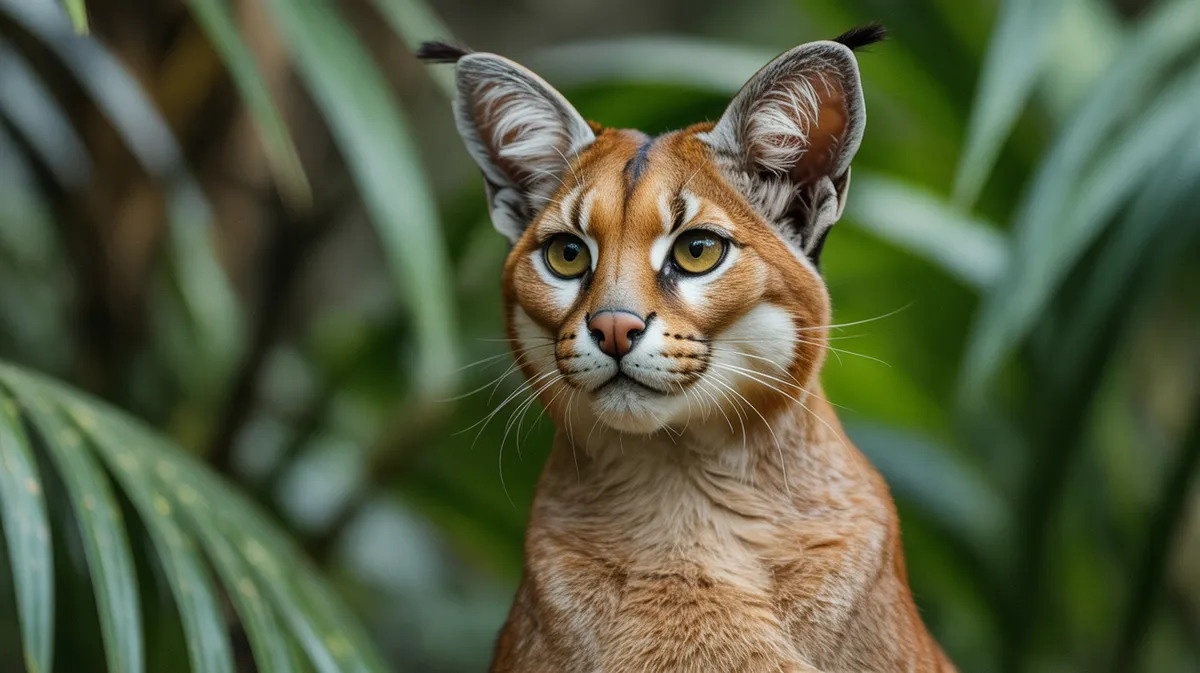
About the African Golden Cat
The African Golden Cat is a medium-sized, elusive wild cat native to the rainforests of Central and West Africa. It has a robust build, with a short tail and rounded ears, and its fur color ranges from golden or reddish-brown to silvery-grey, often marked with faint spots or stripes. This solitary and primarily nocturnal feline is seldom seen in the wild due to its secretive nature and dense forest habitat. African Golden Cats are skilled hunters, preying on a variety of small to medium-sized mammals, birds, and reptiles.
Fascinating facts
Forest Specialist
African Golden Cats are strictly associated with dense tropical forests and rarely venture into open areas or savannas.
Secretive Hunter
They are primarily nocturnal and crepuscular, making them extremely difficult to observe in the wild.
Color Variability
Their fur coloration varies widely, from reddish and golden to greyish, and may even change as the cat ages or depending on the region.
Detailed description
The African golden cat (Caracal aurata) is a medium-sized felid, robustly built, with a head-body length ranging from 61 to 101 cm and a relatively short tail measuring 16 to 46 cm. Adults typically weigh between 7 and 16 kg, with males generally larger than females. The coat coloration is highly variable, spanning from reddish-brown and golden to greyish or even silvery, often with faint spots or stripes on the flanks, legs, and belly; some individuals are almost entirely unmarked, while others display prominent patterning. The fur is dense and soft, providing insulation in the humid, cool understory of African rainforests. The face is rounded with small, rounded ears, and the eyes are large, adapted for low-light vision. The African golden cat is highly elusive and predominantly nocturnal, although some diurnal activity has been recorded, especially in undisturbed habitats. It is an agile climber but spends most of its time on the forest floor, where it stalks prey. Solitary by nature, individuals maintain large, overlapping territories marked by scent. The species is rarely seen due to its secretive habits and preference for dense, primary rainforest, though it can also be found in secondary forests, forest-savanna mosaics, and occasionally in montane bamboo forests up to 3,600 meters elevation.
Did you know?
Despite their range, African Golden Cats are so rarely seen that most of what scientists know about them comes from camera traps and local folklore.
Research & sources
Wikipedia summary
The African golden cat is a wild cat endemic to the rainforests of West and Central Africa. It is threatened due to deforestation and bushmeat hunting and listed as Vulnerable on the IUCN Red List. It is a close relative of both the caracal and the serval. Previously, it was placed in the genus Profelis. Its body size ranges from 61 to 101 cm with a 16 to 46 cm long tail.
Behaviour & social structure
African golden cats are solitary and territorial, with individuals only coming together for mating. They are primarily crepuscular and nocturnal, hunting at dusk, night, and dawn, but may be active during the day in areas with minimal human disturbance. Their hunting strategy is characterized by stealth and ambush, relying on dense vegetation for cover. Diet studies, including scat analysis and camera trap observations, reveal a preference for small to medium-sized mammals such as rodents, duikers, hyraxes, and primates, but they also take birds, reptiles, and occasionally domestic poultry near human settlements. African golden cats are known to cache uneaten prey in dense vegetation. Communication is mainly through scent marking, vocalizations (growls, hisses, and purrs), and visual cues such as scrapes. Home ranges are estimated at 45–100 km² for males and somewhat smaller for females, with significant overlap at the boundaries.
Reproduction & life cycle
Breeding in the African golden cat is not strictly seasonal, though births may peak during the rainy season when prey is more abundant. Courtship involves vocalizations and scent marking. After mating, females undergo a gestation period of approximately 75–78 days. Litters usually consist of one or two kittens, occasionally three. Kittens are born blind and helpless, weighing about 180–235 grams, and are hidden in dense vegetation or hollow logs for protection. Eyes open at 6–12 days, and weaning occurs at around 6–8 weeks. Young remain with the mother for several months, learning to hunt before dispersing to establish their own territories. Sexual maturity is reached at about 18–24 months.
Adaptations & survival
The African golden cat exhibits several adaptations for life in dense, humid forests. Its short, robust limbs and muscular build facilitate movement through thick undergrowth and rapid bursts of speed for ambush hunting. The variable coat coloration provides camouflage in the dappled light of the forest floor. Large, forward-facing eyes enhance night vision, while sensitive whiskers aid navigation in darkness. Retractable claws and strong forelimbs allow for climbing and manipulating prey. The species’ solitary and elusive behavior reduces detection by both predators and humans. Its broad diet and opportunistic feeding behavior are key adaptations to the fluctuating prey availability in rainforest ecosystems.
Cultural significance
The African golden cat is rarely seen and is not widely represented in local folklore compared to other African felids. However, in some Central African cultures, its skin, bones, and other body parts have been used in traditional medicine and rituals, believed to confer strength or protection. In certain regions, the cat is associated with mystery and is sometimes regarded with superstition due to its elusive habits. There is little evidence of the species being kept or tamed, and it does not feature prominently in art or mythology.
Recent research
Recent advances in camera trapping and genetic analysis have improved understanding of the African golden cat’s distribution, population structure, and ecology. Studies have revealed unexpected tolerance for degraded habitats, though primary forest remains crucial for long-term survival. Genetic research confirms its close relationship to the caracal (Caracal caracal) and serval (Leptailurus serval), supporting its current placement in the genus Caracal. Ongoing research focuses on the impacts of habitat fragmentation, prey availability, and human-wildlife conflict. Conservationists are also studying the effectiveness of protected areas and community-based anti-poaching initiatives. Notably, the species’ elusive nature continues to challenge field research, making indirect methods such as scat analysis and remote cameras essential tools.
Videos
Habitat
Tropical rainforest
 Elevated Terrain
Mountain
High-altitude environments with varying climates and specialized wildlife adapted to rugged terrain and thin air.
 Tropical Regions
Rainforest
Dense, wet forests with the highest biodiversity on Earth, containing more than half of the world's plant and animal species.
 Global
Forest
Wooded areas with significant tree cover and diverse plant and animal communities.
Conservation
The African Golden Cat is currently classified as Vulnerable on the IUCN Red List.
Threats & challenges
The African golden cat faces significant threats from habitat loss due to widespread deforestation, logging, and agricultural expansion across West and Central Africa. Bushmeat hunting is a major direct threat; the species is frequently caught in snares set for other animals and is sometimes targeted for its meat or pelts. Human encroachment has led to increased conflict, particularly near forest edges where domestic animals are preyed upon. Population densities are generally low, and the species is highly sensitive to habitat fragmentation, which isolates populations and reduces genetic diversity. The IUCN Red List classifies the African golden cat as Vulnerable, with populations believed to be declining. Conservation is hampered by the cat’s secretive nature and the lack of comprehensive population data.
Taxonomy
Scientific name
Caracal aurata
- Kingdom
- Animalia
- Phylum
- Chordata
- Class
- Mammalia
- Order
- Carnivora
- Family
- Felidae
- Genus
- Caracal
- Species
- aurata
Community notes
Share your observations about the African Golden Cat.
No community notes yet. Be the first!
Discover more wildlife
More fascinating animals from the encyclopedia.