
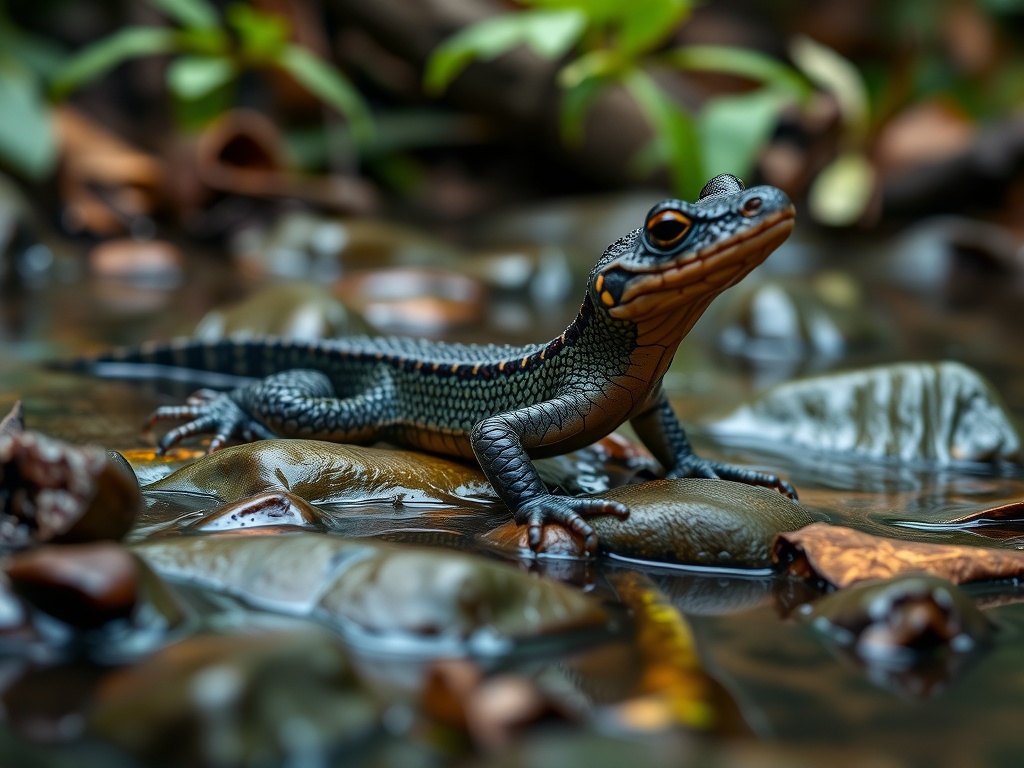
About the Anderson's Crocodile Newt
Anderson's Crocodile Newt is a distinctive amphibian known for its rough, crocodile-like skin and prominent orange markings along its sides and tail. Native to the Ryukyu Islands of Japan and parts of Taiwan, this newt inhabits moist forests and mountain streams. It is a secretive, primarily nocturnal creature that spends much of its life hidden under leaf litter or stones. Due to habitat loss and collection for the pet trade, its populations have been declining, making it a conservation concern.
Fascinating facts
Aquatic Breeder
Anderson's Crocodile Newt relies on clean, freshwater bodies for breeding and development of its aquatic larvae.
Armored Appearance
Its spiky, warty skin and ridged body mimic the look of a miniature crocodile, aiding in camouflage among leaf litter.
Toxic Defense
This species secretes potent toxins from its skin glands to deter predators and can display its orange warning coloration when threatened.
Detailed description
Anderson's Crocodile Newt (Echinotriton andersoni) is a robust, medium-sized salamander, typically reaching 12–18 cm in total length. Its most distinctive feature is the heavily textured, warty skin, especially along the dorsum and tail, which is reminiscent of crocodilian armor. The dorsal coloration is generally dark brown to black, contrasting sharply with vivid orange or yellow lateral markings that run along the ribs and tail base—these serve as aposematic signals to potential predators. The body is dorsoventrally flattened, with a broad, triangular head and prominent parotoid glands behind the eyes. Limbs are relatively short and sturdy, adapted for terrestrial movement through dense leaf litter. The tail is laterally compressed, aiding in swimming during the breeding season. Anderson's Crocodile Newt is primarily terrestrial outside of the breeding season, spending much of its time concealed under rocks, logs, or dense vegetation in moist subtropical forests. It is a nocturnal species, emerging at night to forage. The species is solitary except during the breeding season, and exhibits a secretive lifestyle, making field observations challenging. Its skin secretes potent toxins as a defense mechanism, and the bright coloration warns of its unpalatability.
Did you know?
When threatened, this newt can arch its back and push out its ribs to expose toxic glands, making it less appealing to predators.
Research & sources
Wikipedia summary
Anderson's crocodile newt, Anderson's newt, Ryukyu spiny newt, or Japanese warty newt is a species of salamander in the family Salamandridae found in the Ryukyu Islands of Japan, and, at least formerly, Mount Guanyin in northern Taiwan, where it is now believed to be extinct.
Behaviour & social structure
Anderson's Crocodile Newt is predominantly nocturnal, remaining hidden during daylight hours to avoid desiccation and predation. It is a slow-moving, deliberate forager, preying on a variety of invertebrates such as earthworms, insects, snails, and small crustaceans. The newt employs a sit-and-wait hunting strategy, relying on its cryptic coloration and stillness to ambush prey. Social interactions are minimal outside the breeding season; individuals are territorial and may display threat postures if confronted by conspecifics. During the rainy season, adults migrate short distances to breeding ponds or slow-moving streams. They are known to exhibit homing behavior, returning to the same breeding sites annually. Defensive behaviors include arching the body and raising the tail to expose the bright warning coloration, and secreting skin toxins when threatened.
Reproduction & life cycle
Breeding occurs from late winter to early spring (typically February to April), coinciding with increased rainfall. Males arrive at aquatic breeding sites first and establish territories. Courtship involves a series of tactile and chemical cues; the male performs a tail-fanning display to waft pheromones toward the female. Fertilization is internal, with the male depositing a spermatophore that the female picks up with her cloaca. Females lay 20–60 eggs singly or in small clusters, attaching them to submerged vegetation or detritus in shallow water. The eggs are gelatinous and measure about 3–4 mm in diameter. Embryonic development lasts 3–4 weeks, depending on temperature. Larvae are fully aquatic, possessing external gills and a well-developed tail fin. Metamorphosis into terrestrial juveniles occurs after 3–5 months. There is no parental care after egg deposition.
Adaptations & survival
Echinotriton andersoni exhibits several adaptations for survival in its humid, subtropical environment. The rough, warty skin not only provides camouflage among leaf litter but also houses granular glands that secrete potent tetrodotoxin-like substances, deterring predators. The bright lateral coloration is an example of aposematism, warning of its toxicity. Its flattened body and short limbs facilitate movement through dense undergrowth and narrow crevices. The ability to absorb water through the skin allows it to remain hydrated in moist microhabitats. During dry periods, the newt can enter a state of reduced metabolic activity (aestivation) to survive unfavorable conditions. Its breeding strategy, with aquatic larvae and terrestrial adults, allows exploitation of both aquatic and terrestrial resources.
Cultural significance
In the Ryukyu Islands, Anderson's Crocodile Newt is occasionally referenced in local folklore as a mysterious forest dweller, but it does not have a prominent role in traditional mythology. Its striking appearance has made it a subject of fascination among naturalists and herpetology enthusiasts. In recent years, its rarity and unique appearance have unfortunately increased its desirability in the exotic pet trade, exacerbating conservation concerns. There are no known traditional medicinal or culinary uses.
Recent research
Recent molecular phylogenetic studies have clarified the evolutionary relationships within the genus Echinotriton, confirming the distinctiveness of E. andersoni from its mainland relatives. Ongoing research focuses on its population genetics, toxin composition, and habitat requirements, with the aim of informing conservation strategies. A 2021 study highlighted the species' sensitivity to environmental pollutants and the critical importance of undisturbed breeding sites. Captive breeding and reintroduction trials are being explored as potential tools for population recovery. The extinction of the Taiwanese population has prompted further investigation into the impacts of habitat alteration and invasive species.
Videos
Habitat
Forests near freshwater streams and ponds
 Elevated Terrain
Mountain
High-altitude environments with varying climates and specialized wildlife adapted to rugged terrain and thin air.
 Global
Forest
Wooded areas with significant tree cover and diverse plant and animal communities.
 Global
Freshwater
Lakes, rivers, and wetlands with diverse aquatic ecosystems.
Conservation
The Anderson's Crocodile Newt is currently classified as Endangered on the IUCN Red List.
Threats & challenges
Major threats to Anderson's Crocodile Newt include habitat loss and fragmentation due to deforestation, agricultural expansion, and urban development in the Ryukyu Islands. Illegal collection for the international pet trade has significantly reduced wild populations. Pollution of breeding sites and the introduction of invasive predators (such as fish and bullfrogs) further threaten larvae and eggs. The species is now extinct in Taiwan, with only a few isolated populations remaining in Japan. Population trends are declining, and the species is listed as Vulnerable by the IUCN. Conservation challenges include enforcing legal protection, habitat restoration, and curbing illegal trade. Captive breeding programs have been initiated but are still in early stages.
Taxonomy
Scientific name
Echinotriton andersoni
- Kingdom
- Animalia
- Phylum
- Chordata
- Class
- Amphibia
- Order
- Caudata
- Family
- Salamandridae
- Genus
- Echinotriton
- Species
- andersoni
Community notes
Share your observations about the Anderson's Crocodile Newt.
No community notes yet. Be the first!
Discover more wildlife
More fascinating animals from the encyclopedia.