
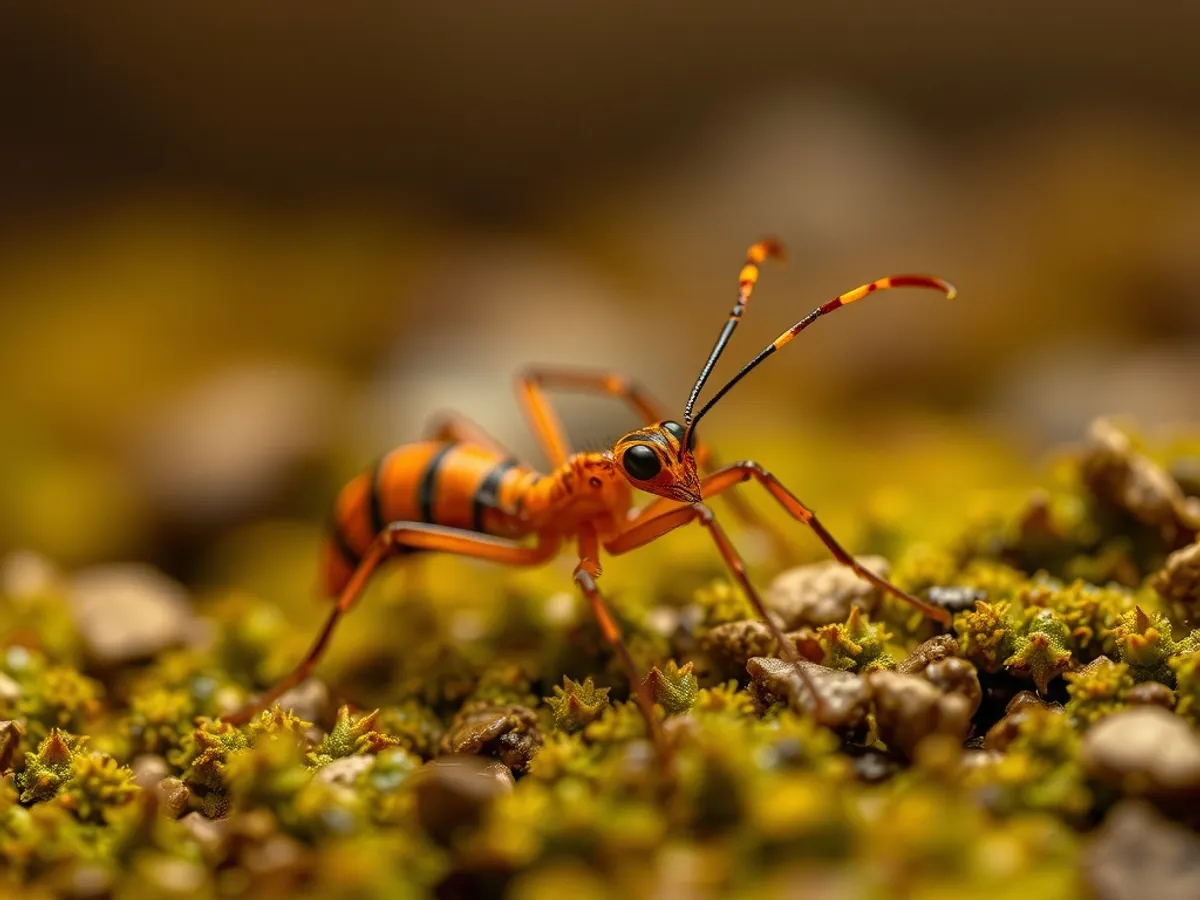
About the Firebrat
The firebrat is a small, wingless insect known for its elongated, carrot-shaped body covered in silvery scales. It thrives in warm, humid environments, often seeking out areas near ovens, boilers, and furnaces in human dwellings. Firebrats are nocturnal and extremely agile, quickly darting away from light or disturbance. They feed primarily on starchy materials such as flour, paper, and fabrics, sometimes becoming a minor household pest. Despite their name, firebrats do not bite or sting and are harmless to humans.
Fascinating facts
Heat Lovers
Firebrats are specially adapted to live in very warm places and prefer temperatures above 32°C (90°F).
Primitive Insect
Firebrats belong to one of the most ancient insect orders, Zygentoma, which has existed for over 300 million years.
Household Pest
They can damage books, wallpaper, and stored foods by feeding on starchy materials commonly found in homes.
Detailed description
The firebrat (Thermobia domestica) is a small, primitive insect measuring 6–12 mm in length, with a flattened, elongated body that tapers toward the rear. Its coloration is mottled gray and brown, providing camouflage among debris and dust. The body is covered in fine, silvery scales, and it possesses long, slender antennae and three distinct tail-like appendages (cerci and a central filament) at the posterior end. Firebrats are wingless, reflecting their ancient evolutionary lineage within the order Zygentoma. Their exoskeleton is thin and flexible, allowing them to squeeze into narrow crevices. Adapted for rapid movement, firebrats are highly agile and can dart quickly to escape predators or disturbances. They are primarily nocturnal, remaining hidden during the day and emerging at night to forage. Firebrats exhibit solitary behavior, though they may aggregate in favorable microhabitats with optimal warmth and humidity. Their mouthparts are adapted for chewing, enabling them to feed on a wide range of starchy and proteinaceous materials, including book bindings, wallpaper paste, and natural fibers. Unlike many insects, firebrats can survive for extended periods without food, provided they have access to moisture.
Did you know?
Firebrats are among the few insects that thrive in human homes year-round, often living close to hot water pipes or furnaces.
Research & sources
Wikipedia summary
The firebrat is a small insect in the order Zygentoma.
Behaviour & social structure
Firebrats are cryptic and nocturnal, spending daylight hours concealed in warm, humid microhabitats such as behind ovens, in boiler rooms, or within insulation near heat pipes. They are negatively phototactic, actively avoiding light. Firebrats are omnivorous scavengers, feeding on carbohydrates (flour, cereals, paper, glue) and proteins (dead insects, dried meat). They use their long antennae to navigate and locate food sources in the dark. While generally solitary, firebrats may form loose aggregations in optimal environments, likely due to pheromonal cues or shared microclimate preferences. They exhibit thigmotaxis, preferring to remain in contact with surfaces on multiple sides. When threatened, firebrats rely on their speed and agility to escape rather than defensive behaviors. Their daily routine consists of foraging at night and remaining inactive during the day.
Reproduction & life cycle
Firebrats reproduce sexually, with courtship involving antennal contact and pheromone signaling. Mating occurs year-round in warm indoor environments. Females lay clusters of 50–60 eggs in protected crevices, often near heat sources. Eggs are oval, white, and measure approximately 0.8 mm in length. Incubation lasts 12–13 days at optimal temperatures (37–41°C), but development slows significantly at lower temperatures. Upon hatching, nymphs resemble miniature adults and undergo 10–14 molts before reaching maturity, a process that can take 2–4 months depending on environmental conditions. Firebrats exhibit no parental care; eggs and nymphs are left to develop independently. Adults may live up to 2–3 years, with females capable of producing several hundred offspring in their lifetime.
Adaptations & survival
Firebrats are highly specialized for survival in warm, humid environments. Their optimal temperature range is 32–41°C, and they can tolerate brief exposures up to 45°C. Specialized heat-shock proteins allow them to survive thermal stress. Their flattened bodies and flexible exoskeletons enable them to exploit narrow crevices, providing protection from predators and desiccation. Firebrats have evolved efficient water-conservation mechanisms, including the ability to absorb atmospheric moisture and minimize water loss through their cuticle. Their digestive enzymes allow them to break down cellulose and other complex carbohydrates, facilitating exploitation of a wide range of household materials. The silvery scales covering their bodies may provide some protection against desiccation and predation.
Cultural significance
Firebrats have little direct cultural significance, but they are sometimes referenced in literature and pest control manuals as household nuisances. Unlike silverfish, they are less commonly associated with folklore or superstition. Their presence in homes has prompted the development of integrated pest management strategies, but they are not known to transmit disease or cause significant economic damage. In scientific research, firebrats serve as model organisms for studies on insect physiology, thermotolerance, and primitive insect evolution.
Recent research
Recent studies have focused on the firebrat's remarkable heat tolerance, with research identifying specific heat-shock proteins and molecular mechanisms underlying their survival at high temperatures. Genomic analyses have provided insights into their evolutionary relationship with other Zygentoma, such as silverfish (Lepisma saccharina). Ongoing research explores their digestive enzymes and potential applications in biotechnology, particularly for cellulose degradation. Behavioral studies have examined aggregation cues, revealing the role of pheromones and environmental factors in group formation. Firebrats are also used in laboratory settings to study insect development, molting, and adaptation to extreme environments.
Sources
Videos
Habitat
Warm indoor environments, especially near heat sources
 Arid Regions
Desert
Arid lands with minimal rainfall, extreme temperatures, and specialized wildlife adapted to harsh conditions.
 Various Continental Regions
Grassland
Open areas dominated by grasses rather than trees, supporting numerous herbivores and their predators.
 Elevated Terrain
Mountain
High-altitude environments with varying climates and specialized wildlife adapted to rugged terrain and thin air.
 Global
Forest
Wooded areas with significant tree cover and diverse plant and animal communities.
Conservation
The Firebrat is currently classified as Least Concern on the IUCN Red List.
Threats & challenges
Firebrats face few natural predators in indoor environments, though spiders, centipedes, and some predatory beetles may prey on them. Their main challenges are fluctuations in temperature and humidity, as they are highly sensitive to desiccation and cold. Human pest control measures, such as sanitation, exclusion, and insecticide application, can reduce local populations, but firebrats are resilient and capable of recolonizing suitable habitats. There are no significant conservation concerns, and the species is considered widespread and abundant globally, especially in human dwellings. Population trends remain stable, with no evidence of decline.
Taxonomy
Scientific name
Thermobia domestica
- Kingdom
- Animalia
- Phylum
- Arthropoda
- Class
- Insecta
- Order
- Zygentoma
- Family
- Lepismatidae
- Genus
- Thermobia
- Species
- domestica
Community notes
Share your observations about the Firebrat.
No community notes yet. Be the first!
Discover more wildlife
More fascinating animals from the encyclopedia.