
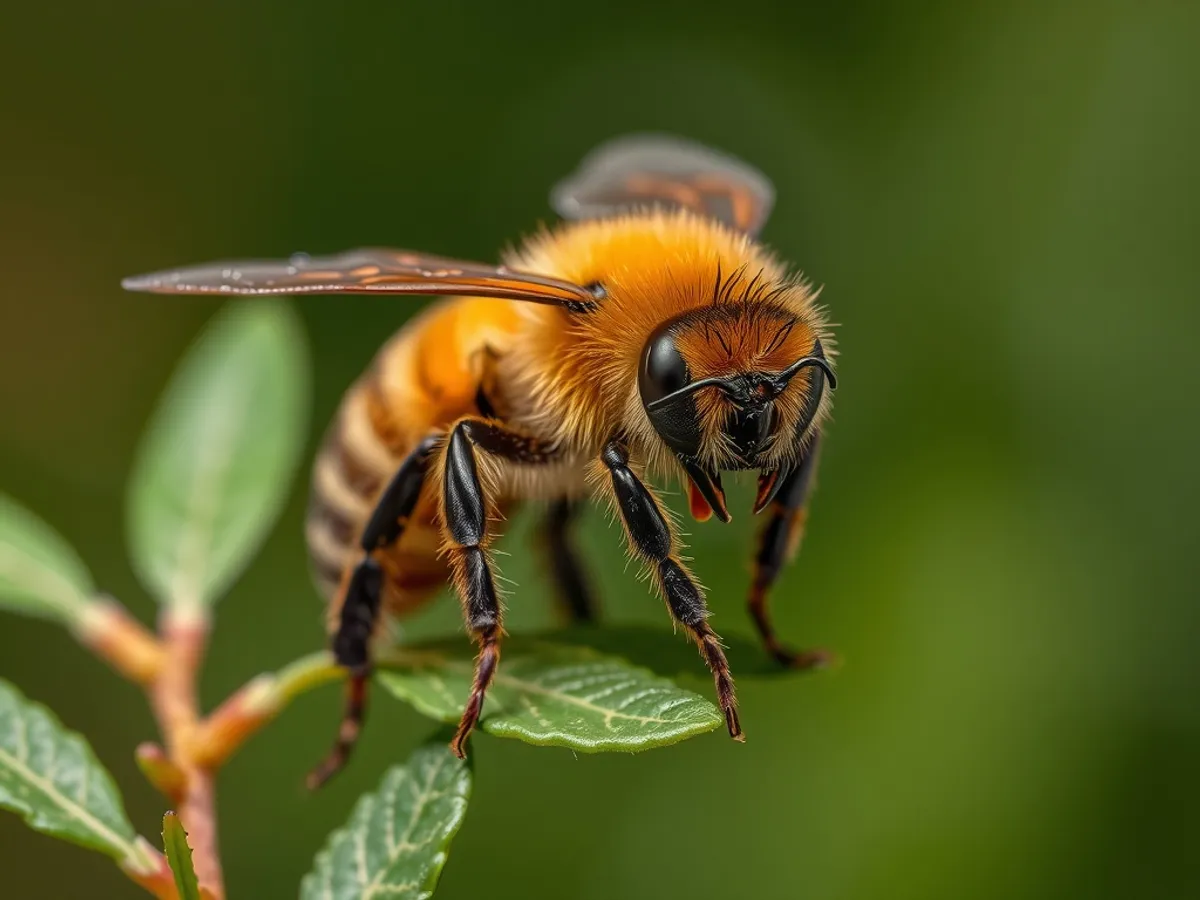
About the Giant Honeybee
The Giant Honeybee is a large social bee native to South and Southeast Asia, renowned for building massive, exposed honeycombs on high tree branches and cliffs. These bees are larger than most other honeybee species, with workers often reaching up to 20 mm in length. They display remarkable communal defense behaviors, such as shimmering waves to deter predators. Giant Honeybees play a vital role in pollinating wild and cultivated plants within their range. Due to habitat loss and honey hunting, some local populations are under pressure but the species overall remains widespread.
Fascinating facts
Largest Honeybee
The Giant Honeybee is the largest species of honeybee, with worker bees that can measure up to 20 mm in length.
Massive Exposed Nests
They build single, huge, exposed combs on tall branches or cliffs, sometimes more than a meter wide.
Shimmering Defense
Their unique shimmering behavior involves coordinated abdominal flipping to create a wave-like motion that confuses or scares off predators.
Detailed description
The Giant Honeybee (Apis dorsata) is one of the largest members of the genus Apis, with workers typically measuring 17–20 mm in length and queens reaching up to 22 mm. Their bodies are robust and covered in dense golden-brown hairs, aiding in pollen collection and thermoregulation. Unlike cavity-nesting honeybees, A. dorsata constructs single, massive, exposed combs—sometimes exceeding 1.5 meters in length—suspended from high tree branches, cliffs, or even under the eaves of buildings. Colonies can contain tens of thousands of individuals, organized into a complex eusocial structure comprising a single queen, thousands of female workers, and a smaller number of drones (males). The species is renowned for its coordinated defensive behavior, most notably the 'shimmering' or 'wave' response, where hundreds of bees flip their abdomens in a synchronized motion to deter predators such as hornets and birds. Foraging occurs over large distances, with workers capable of flying several kilometers in search of nectar and pollen. The Giant Honeybee is a key pollinator for both wild flora and important crops, such as mango, coconut, and cotton. Their annual migratory behavior, known as 'bee-line migration,' involves entire colonies relocating over hundreds of kilometers in response to seasonal changes in floral resources. Apis dorsata exhibits remarkable nest-site fidelity, often returning to the same locations year after year.
Did you know?
Giant Honeybees are the primary source of wild honey in many Asian cultures, and honey hunting from their massive combs is a dangerous traditional practice.
Research & sources
Behaviour & social structure
Apis dorsata is diurnal, with peak foraging activity occurring in the early morning and late afternoon when floral resources are abundant and temperatures are moderate. Workers communicate food source locations through a 'waggle dance' performed on the vertical surface of the comb, similar to other honeybee species but adapted for exposed nests. The species is highly defensive, with workers capable of delivering painful stings and releasing alarm pheromones that rapidly recruit nestmates for mass attacks. Shimmering behavior is a unique collective defense, triggered by visual or vibrational cues from approaching threats. Colonies exhibit strong site fidelity, often forming aggregations of multiple nests in favored locations. Feeding behavior is strictly herbivorous, focusing on nectar and pollen from a wide range of flowering plants. Unlike cavity-nesting bees, A. dorsata does not store large honey reserves, as exposed combs are vulnerable to environmental fluctuations and predation.
Reproduction & life cycle
Reproduction in Apis dorsata follows the typical honeybee pattern of a single, mated queen laying eggs in hexagonal brood cells. Queens mate during nuptial flights with multiple drones, storing sperm for lifelong use. Egg-laying is continuous in favorable conditions, with the queen capable of laying up to 2,000 eggs per day. Brood development includes egg (3 days), larval (6–7 days), pupal (12–14 days), and adult stages, totaling approximately 21–24 days for workers. Drones are produced seasonally, primarily during the main breeding season, which coincides with peak floral abundance (often late spring to early summer). Swarming and colony migration are integral to the reproductive cycle, with new queens produced for colony fission or to replace aging queens. Parental care is provided by worker bees, who feed and protect the developing brood.
Adaptations & survival
Apis dorsata exhibits several adaptations for survival in exposed environments. Their large body size enhances thermoregulation and flight endurance, allowing for long-distance foraging and migration. Dense body hairs improve pollen collection and provide insulation against temperature extremes. The exposed nesting strategy reduces competition with cavity-nesting species and enables rapid colony relocation. Shimmering defense is a sophisticated behavioral adaptation, deterring predators through visual confusion and coordinated mass stinging. The species' ability to synchronize migration with flowering cycles ensures access to optimal food resources. Their acute vision and sensitivity to polarized light aid in navigation and foraging efficiency.
Cultural significance
The Giant Honeybee holds significant cultural and economic importance in South and Southeast Asia. Traditional honey hunting, especially among indigenous groups like the Gurung of Nepal, is both a livelihood and a ritual, often accompanied by elaborate ceremonies and taboos. Apis dorsata honey is prized for its medicinal properties and unique flavor, sometimes commanding high market prices. The bee features in local folklore, symbolizing industriousness, cooperation, and the harmony of nature. In some regions, the shimmering defense display is interpreted as a spiritual or mystical phenomenon.
Recent research
Recent studies have focused on the biomechanics and neural basis of shimmering behavior, revealing complex visual processing and social coordination. Genetic research has clarified the evolutionary relationships among Asian honeybee species, highlighting the divergence of A. dorsata from cavity-nesting relatives. Ongoing ecological research examines the species' role in crop pollination and its responses to land-use change. Conservation initiatives are exploring sustainable honey harvesting techniques and the impact of agrochemicals on bee health. Notably, studies have documented the impacts of climate change on migratory timing and colony aggregation patterns.
Sources
The Giant Honey Bee, Apis dorsata: Biology and Management
H. Randall Hepburn & Sarah E. Radloff (2011)
scientificThe Giant Honeybee, Apis dorsata: Nesting Biology, Behavior, and Conservation
Jürgen Tautz, H. R. Hepburn, and others (2003)
scientificThe Giant Honey Bee, Apis dorsata: Nesting Biology, Management and Honey Hunting
J. Woyke, S. Wilde, M. Wilde (2012)
scientificVideos
Habitat
Tropical and subtropical forests, open woodlands, cliffs, and human settlements
 Various Continental Regions
Grassland
Open areas dominated by grasses rather than trees, supporting numerous herbivores and their predators.
 Elevated Terrain
Mountain
High-altitude environments with varying climates and specialized wildlife adapted to rugged terrain and thin air.
 Global
Forest
Wooded areas with significant tree cover and diverse plant and animal communities.
Conservation
The Giant Honeybee is currently classified as Least Concern on the IUCN Red List.
Threats & challenges
Major threats to Apis dorsata include habitat loss due to deforestation, agricultural expansion, and urbanization, which reduce suitable nesting and foraging sites. Unsustainable honey hunting, often involving the destruction of nests, poses significant local pressures. Pesticide exposure and competition from introduced bee species (such as Apis mellifera) further impact populations. Climate change may alter flowering phenology and disrupt migratory patterns. While the species is currently classified as Least Concern by the IUCN, some regional populations are declining, and traditional honey hunting practices are increasingly regulated to promote sustainable harvests.
Taxonomy
Scientific name
Apis dorsata
- Kingdom
- Animalia
- Phylum
- Arthropoda
- Class
- Insecta
- Order
- Hymenoptera
- Family
- Apidae
- Genus
- Apis
- Species
- dorsata
Community notes
Share your observations about the Giant Honeybee.
No community notes yet. Be the first!
Discover more wildlife
More fascinating animals from the encyclopedia.