
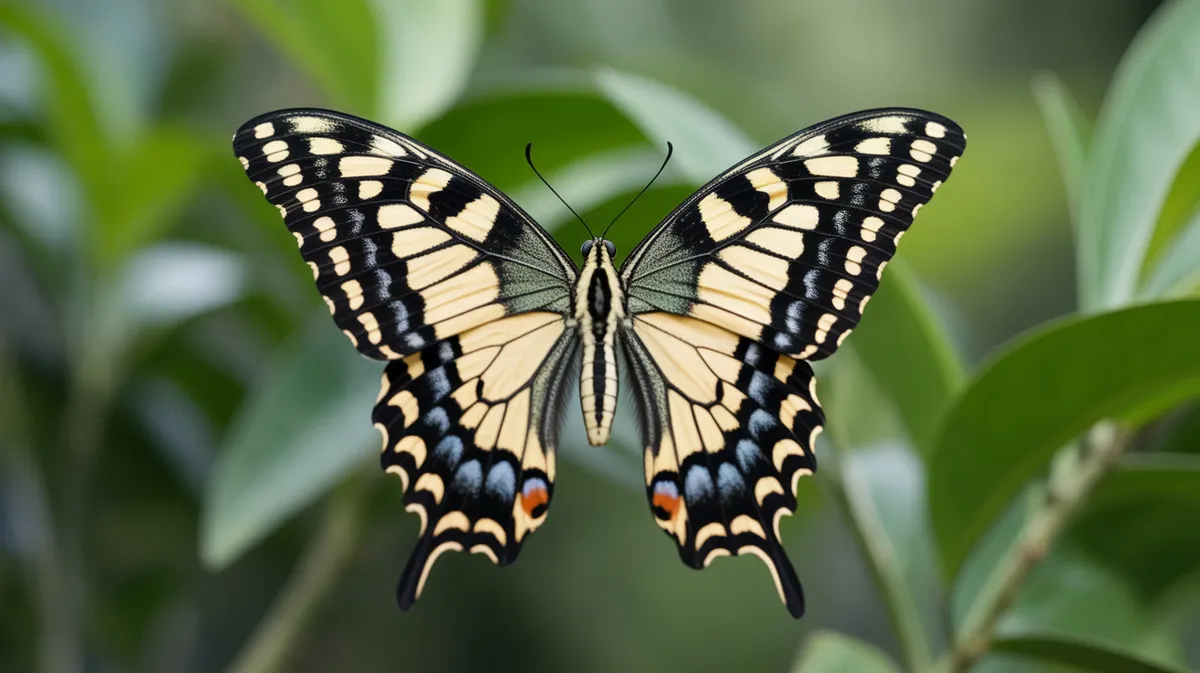
About the Giant Swallowtail Butterfly
North America's largest butterfly, Papilio cresphontes spans up to about 18 cm and traces a black wing crossed by two converging bands of yellow spots that meet at the wingtip, forming a shallow X when the wings are spread. Its caterpillar is one of the animal kingdom's best impersonations of a fresh bird dropping: lumpy, glossy, mottled brown and white, and utterly unappetising to birds that hunt by search image. Disturb it and the disguise gives way to chemical warfare, as a fleshy forked organ called the osmeterium everts behind the head and smears the attacker with terpene acids distilled from its host plants. Those hosts are almost all members of the citrus family, which is why Florida and Gulf Coast growers know the larva as the "orange dog" and why the butterfly has expanded northward as gardeners plant hardy prickly-ash and hoptree. Adults are strong, gliding fliers that often flutter their forewings while nectaring, keeping their body weight partly airborne on flimsy blossoms. Females scatter eggs singly on tender new leaf flushes rather than clustering them, spreading the risk of losing a whole brood. The species has been pushing steadily north over recent decades, now breeding well into the Great Lakes region and southern Ontario.
Fascinating facts
Largest Butterfly in North America
With a wingspan up to 15 cm (6 inches), the Giant Swallowtail holds the title of the largest butterfly species in North America.
Citrus Lover
The larvae, nicknamed 'orange dogs,' primarily feed on the leaves of citrus trees and related plants.
Chemical Defense
When threatened, the caterpillar extends a red, forked organ called the osmeterium, which releases a pungent odor to repel predators.
Detailed description
The Giant Swallowtail Butterfly (Papilio cresphontes) is the largest butterfly species in North America, with an impressive wingspan ranging from 10 to 16 centimeters (4 to 6.3 inches). Its wings are predominantly black, adorned with striking yellow bands and spots, while the hindwings feature elongated tails that mimic the appearance of a swallow’s tail. The ventral (underside) wing surfaces are lighter, with yellow and orange hues, aiding in camouflage when at rest. The body is robust, with a yellow lateral stripe running along the thorax and abdomen. Larvae, known as 'orange dogs,' are masters of mimicry, resembling bird droppings to deter predators. Adults exhibit a graceful, gliding flight interspersed with rapid wing beats, often seen basking in sunlight or feeding on nectar. The species is univoltine to multivoltine depending on latitude, with up to three generations per year in southern regions. Giant Swallowtails are solitary, with no true social structure, but may aggregate at rich nectar sources. Their life cycle includes egg, five larval instars, pupal (chrysalis), and adult stages, with each stage exhibiting unique morphological and behavioral adaptations.
Did you know?
Despite their beauty, Giant Swallowtail caterpillars are sometimes considered pests in commercial citrus orchards due to their appetite for citrus leaves.
Research & sources
Behaviour & social structure
Giant Swallowtails are diurnal and highly active during warm, sunny days. Adults are strong fliers, often patrolling large territories in search of mates or suitable host plants for oviposition. They exhibit a characteristic 'bouncing' flight pattern, which may help evade predators. Feeding primarily on nectar, they visit a wide array of flowers, including lantana, azalea, and wild cherry, using their long proboscis to access deep floral nectaries. Caterpillars feed voraciously on the leaves of Rutaceae family plants, especially citrus, and are considered pests in commercial groves. When threatened, larvae display an osmeterium—an orange, forked gland that emits a foul-smelling chemical to deter predators. Adults are generally solitary but may be seen in loose aggregations at abundant food sources. They spend nights roosting on the undersides of leaves or branches.
Reproduction & life cycle
Mating occurs primarily in late spring and summer, with males actively patrolling territories to locate receptive females. Courtship involves aerial displays and pheromone signaling. Females lay single, spherical, pale yellow eggs on the upper surfaces of host plant leaves. The incubation period lasts 4–10 days, depending on temperature. Larvae progress through five instars over 2–4 weeks, then pupate by attaching themselves to stems or branches with silk. The pupal stage lasts 10–20 days in summer but may overwinter in diapause in northern populations. There is no parental care; after oviposition, the female does not tend to the eggs or larvae. In warmer climates, multiple generations (up to three) may occur annually.
Adaptations & survival
Giant Swallowtails possess several notable adaptations. Larvae exhibit remarkable camouflage, mimicking bird droppings to avoid visual predators such as birds and lizards. The osmeterium, unique to swallowtail caterpillars, secretes volatile compounds (including isobutyric and 2-methylbutyric acids) that repel ants and other invertebrate predators. Adults’ bold coloration serves as a warning (aposematism) and provides disruptive camouflage among dappled sunlight. Their large wings and powerful flight muscles enable long-distance dispersal and rapid escape from threats. The elongated tails on the hindwings may deflect attacks away from vital body parts. Adults have a long proboscis, allowing them to exploit a wide range of nectar sources, including those inaccessible to other pollinators.
Cultural significance
The Giant Swallowtail is admired for its size and beauty, often featured in butterfly gardens and educational programs. In the southern United States, it is both celebrated as a pollinator and reviled as a citrus pest. The butterfly is a symbol of transformation and resilience in various cultures. Its striking appearance has inspired artwork, stamps, and conservation campaigns. In some Native American traditions, butterflies are considered messengers or symbols of renewal, though specific references to Papilio cresphontes are rare.
Recent research
Recent research has focused on the chemical ecology of the Giant Swallowtail’s osmeterium, revealing complex blends of deterrent compounds. Studies on larval host plant selection have highlighted the butterfly’s adaptability to both native and introduced Rutaceae species. Climate change modeling suggests potential range expansion northward as temperatures rise. Genetic studies have clarified the species’ relationship with closely related swallowtails, confirming its distinct status. Ongoing research is examining the impacts of neonicotinoid pesticides on larval development and adult behavior.
Sources
Papilio cresphontes Cramer, 1777: Giant Swallowtail
Butterflies of America; Opler, P.A. & Krizek, G.O. (1984)
scientificThe Giant Swallowtail, Papilio cresphontes Cramer (Lepidoptera: Papilionidae): Its Biology and Status as a Citrus Pest
University of Florida, Entomology and Nematology Department (2017)
scientificThe Giant Swallowtail, Papilio cresphontes Cramer: Its Biology and Control
R. L. Metcalf & W. H. Luckmann (1978)
scientificVideos
Habitat
Woodlands, citrus groves, gardens, and deciduous forests
 Various Continental Regions
Grassland
Open areas dominated by grasses rather than trees, supporting numerous herbivores and their predators.
 Elevated Terrain
Mountain
High-altitude environments with varying climates and specialized wildlife adapted to rugged terrain and thin air.
 Global
Forest
Wooded areas with significant tree cover and diverse plant and animal communities.
 Global
Freshwater
Lakes, rivers, and wetlands with diverse aquatic ecosystems.
Conservation
The Giant Swallowtail Butterfly is currently classified as Least Concern on the IUCN Red List.
Threats & challenges
While the Giant Swallowtail is currently listed as Least Concern, localized threats include habitat loss due to agricultural expansion, pesticide use in citrus groves, and climate change affecting host plant availability. Larvae are often targeted by pest control measures in commercial citrus operations. Natural enemies include birds, wasps, spiders, and parasitic flies. Despite these pressures, the species remains widespread and adaptable, with stable populations across most of its range. However, ongoing monitoring is recommended, especially in areas of intensive agriculture and urbanization.
Taxonomy
Scientific name
Papilio cresphontes
- Kingdom
- Animalia
- Phylum
- Arthropoda
- Class
- Insecta
- Order
- Lepidoptera
- Family
- Papilionidae
- Genus
- Papilio
- Species
- cresphontes
Community notes
Share your observations about the Giant Swallowtail Butterfly.
No community notes yet. Be the first!
Discover more wildlife
More fascinating animals from the encyclopedia.