
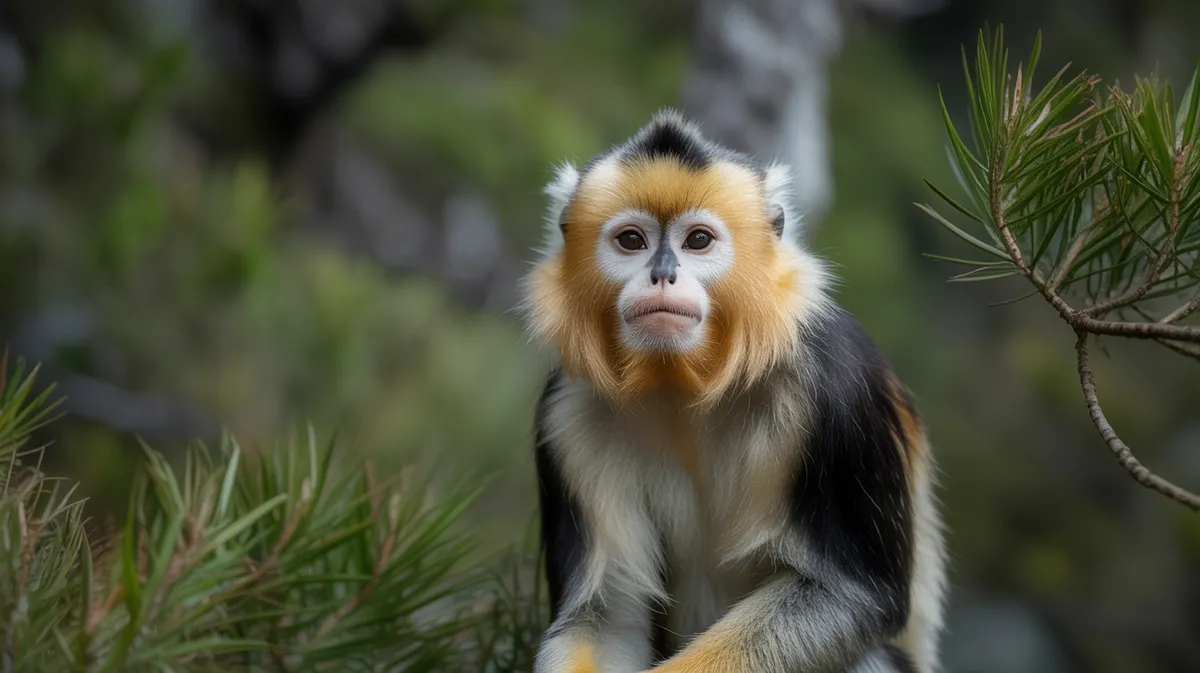
About the Golden Snub-nosed Monkey
Rhinopithecus roxellana lives higher and colder than almost any other non-human primate, ranging through the temperate montane forests of central China's Qinling, Minshan and Qionglai mountains up to 3,400 m, where snow lies for months. Its face is a startling powder blue, its coat a long golden mantle, and its nose is reduced to two upturned nostrils sitting almost flush with the face - an arrangement often explained as frostbite avoidance, though the evidence for that is thin and the trait is more likely a product of sexual selection and shared ancestry within the snub-nosed group. The winter diet is dominated by lichen, a food so nutrient-poor that few mammals can live on it; the monkeys strip it from old-growth conifer branches, which ties their survival directly to mature forest that logging removes. Their social system is unusual and hierarchical: small one-male family units cluster into bands, and bands aggregate into troops that can exceed 400 individuals, a multi-level society more like that of hamadryas baboons or geladas than of most Asian monkeys. Infants are handled and even nursed by females other than the mother, a form of allomaternal care rare among monkeys.
Fascinating facts
Social Structure
Golden Snub-nosed Monkeys live in multi-level societies, with several family groups forming large bands that can reach hundreds of individuals.
Cold Adaptation
Their thick, long fur provides insulation against the extreme cold of their high-altitude forest habitats.
Forest Dwellers
They are primarily arboreal, spending most of their lives in the trees of mountainous, temperate forests.
Detailed description
The golden snub-nosed monkey (Rhinopithecus roxellana) is a medium-sized Old World monkey distinguished by its dense, long golden-orange fur and a unique upturned, flattened nose with forward-facing nostrils, an adaptation to its cold, high-altitude environment. Adults exhibit marked sexual dimorphism: males are substantially larger, measuring 62–76 cm in body length and weighing 16–20 kg, while females are 48–58 cm and weigh 8–10 kg. The species' face is hairless and pale blue, with infants born greyish and developing their characteristic coloration by the age of two. Golden snub-nosed monkeys are highly arboreal and spend most of their lives in the forest canopy, rarely descending to the ground. They live in complex multi-level societies, with groups sometimes exceeding 400 individuals, organized into one-male units, all-male units, and larger bands. Their vocal repertoire is among the most sophisticated of non-human primates, including over 18 distinct call types used for social cohesion, alarm, and coordination. The monkeys are primarily folivorous but display seasonal dietary flexibility, consuming lichens, young leaves, fruits, seeds, buds, bark, and occasionally insects. Adapted to harsh winters, they possess thick underfur and behavioral strategies such as huddling for warmth. Their reproductive cycle is tightly linked to seasonal food availability, and females typically give birth to a single offspring in spring. The species is endemic to temperate montane forests at elevations of 1,500–3,400 meters, primarily in the provinces of Sichuan, Gansu, Hubei, and Shaanxi.
Did you know?
Despite living in freezing mountain environments, these monkeys are one of the few primate species that can endure heavy snowfall and temperatures as low as -8°C (17°F).
Research & sources
Wikipedia summary
The golden snub-nosed monkey is an Old World monkey in the subfamily Colobinae. It is endemic to a small area in temperate, mountainous forests of central and Southwest China. They inhabit these mountainous forests of Southwestern China at elevations of 1,500–3,400 m (4,900–11,200 ft) above sea level. The Chinese name is Sichuan golden hair monkey (四川金丝猴). It is also widely referred to as the Sichuan snub-nosed monkey. Of the three species of snub-nosed monkeys in China, the golden snub-nosed monkey is the most widely distributed throughout China.
Behaviour & social structure
Golden snub-nosed monkeys are diurnal and highly social, spending daylight hours foraging, grooming, and interacting within their multi-tiered social groups. Their daily routine involves early morning and late afternoon feeding bouts, interspersed with periods of rest and social grooming, which reinforces group cohesion. Foraging is mostly arboreal, with individuals moving through the canopy in coordinated fashion, led by dominant males or matriarchs. During winter, they rely heavily on lichens and bark, while in summer and autumn, their diet shifts to include more fruits and leaves. Social interactions are complex, with frequent affiliative behaviors such as grooming, play among juveniles, and vocal exchanges. Aggression is rare but may occur during the mating season or over food resources. Alarm calls alert group members to predators such as raptors or terrestrial carnivores. The species exhibits fission-fusion dynamics, with smaller units forming and merging throughout the year depending on resource availability.
Reproduction & life cycle
Breeding in golden snub-nosed monkeys is seasonal, with mating occurring from August to October and births peaking between March and May, coinciding with increased food availability. Females exhibit visible estrus and solicit copulation through vocalizations and body postures. Gestation lasts approximately 200–215 days. Typically, a single infant is born, weighing around 400–500 grams. Mothers are the primary caregivers, but allomaternal care (care by other group members) is common, especially from subadult females. Infants cling to their mothers for the first few months and begin to explore independently at 3–4 months. Weaning occurs at about one year. Sexual maturity is reached at 4–5 years for females and 7 years for males. Reproductive success is influenced by social rank and group stability.
Adaptations & survival
Golden snub-nosed monkeys are uniquely adapted to cold, montane environments. Their thick, double-layered fur provides insulation against subzero temperatures, and their upturned noses reduce frostbite risk by minimizing exposed mucosa. Behavioral adaptations include huddling in groups to conserve heat and altering activity patterns to maximize sun exposure. Their digestive system is specialized for a high-fiber diet, with an enlarged, multi-chambered stomach hosting symbiotic bacteria to break down lichens and tough plant materials. The species' flexible social structure allows for efficient resource use and predator avoidance. Their strong, prehensile hands and feet facilitate agile movement through the forest canopy.
Cultural significance
In Chinese culture, the golden snub-nosed monkey is regarded as a symbol of good fortune and is featured in folklore and traditional art. Its striking appearance has inspired legends, and it is sometimes associated with the mythical 'Monkey King' (Sun Wukong) from the classic novel Journey to the West. The species is a flagship for conservation efforts in China, raising public awareness about the importance of protecting montane forest ecosystems. There are no significant records of the species being used in traditional medicine in recent decades, reflecting increased legal protection and cultural value as a living national treasure.
Recent research
Recent research has focused on the species' complex social organization, vocal communication, and dietary ecology. Studies using GPS tracking and remote sensing have revealed detailed patterns of habitat use and seasonal migration within forest fragments. Genetic analyses have highlighted low genetic diversity in isolated populations, prompting recommendations for habitat corridors. Behavioral studies have documented sophisticated vocal exchanges and evidence of cultural transmission of foraging techniques. Conservation genetics and landscape ecology are active research areas, with ongoing efforts to monitor population trends and assess the effectiveness of protected areas. Notably, a 2022 study documented the impact of climate change on lichen availability, underscoring the species' vulnerability to environmental shifts.
Videos
Habitat
Montane temperate forests


Conservation
The Golden Snub-nosed Monkey is currently classified as Endangered on the IUCN Red List.
Threats & challenges
The primary threats to golden snub-nosed monkeys are habitat loss and fragmentation due to logging, agricultural expansion, and infrastructure development. Poaching, though reduced, still occurs for traditional medicine and the pet trade. Climate change poses an emerging threat by altering forest composition and reducing the availability of key food resources. The species' fragmented populations are vulnerable to genetic bottlenecks and inbreeding. Despite legal protection and the establishment of several nature reserves, enforcement remains inconsistent. Population estimates suggest fewer than 15,000 individuals remain in the wild, with some subpopulations numbering only a few hundred, increasing their risk of local extinction.
Taxonomy
Scientific name
Rhinopithecus roxellana
- Kingdom
- Animalia
- Phylum
- Chordata
- Class
- Mammalia
- Order
- Primates
- Family
- Cercopithecidae
- Genus
- Rhinopithecus
- Species
- roxellana
Community notes
Share your observations about the Golden Snub-nosed Monkey.
No community notes yet. Be the first!
Discover more wildlife
More fascinating animals from the encyclopedia.