
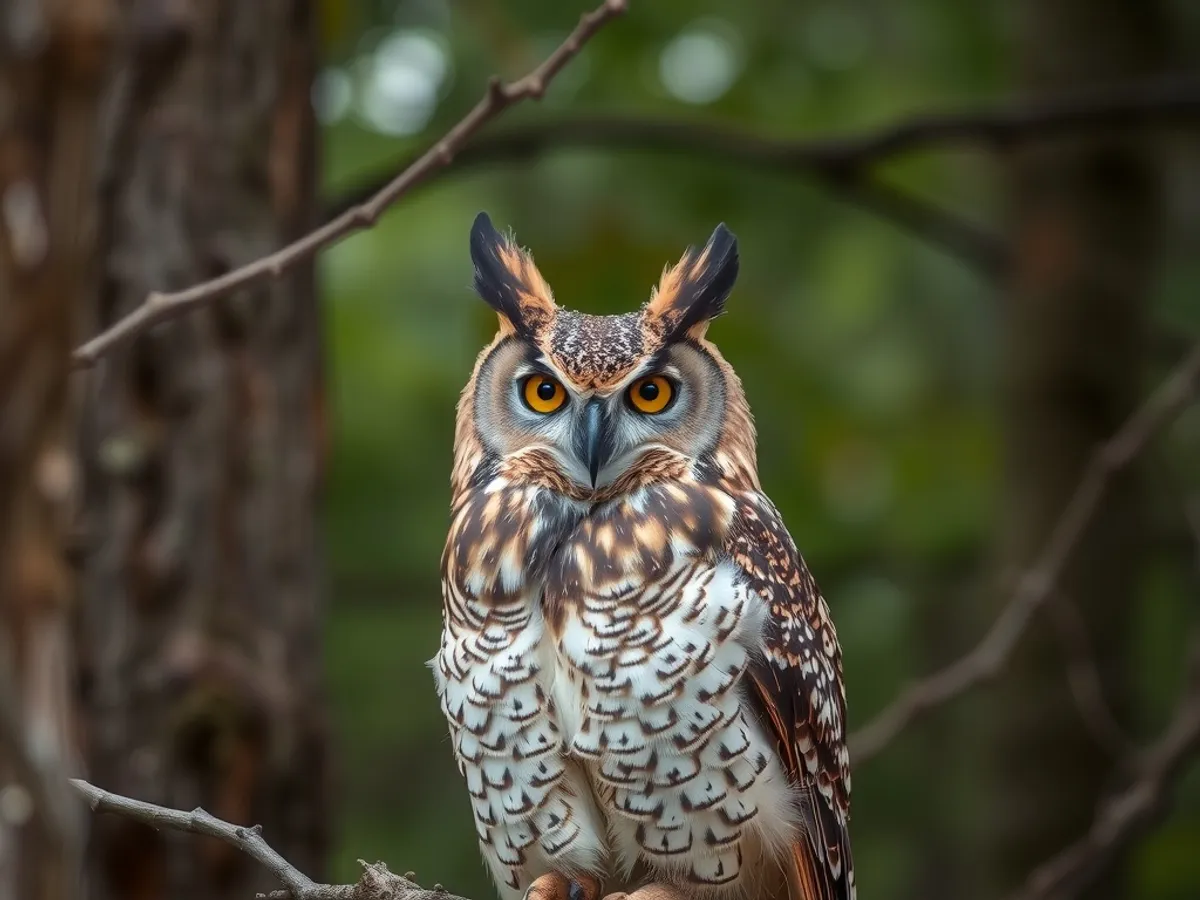
About the Great Horned Owl
Bubo virginianus is the most widespread owl in the Americas and by some measures the most powerful, with a crushing grip estimated at around 130 kg per square centimetre in the talons - enough to sever the spine of prey larger than itself. It is a generalist to an almost absurd degree, taking everything from beetles and scorpions to Canada geese, herons, porcupines and other owls, and it is one of the few predators anywhere that routinely kills and eats striped skunks. That is possible because owls have a poor sense of smell and simply do not care about the spray; great horned owls are frequently found reeking of it. Contrary to the usual assumption, they build nothing - they commandeer the old stick nests of red-tailed hawks, crows and squirrels, or use cliff ledges and tree hollows, and they nest astonishingly early, incubating in January or February with snow on their backs so that the young fledge when prey is abundant. The "horns" are not ears at all but tufts of feather used in signalling and camouflage; the actual ear openings are asymmetrically placed on the skull, one higher than the other, letting the bird locate a mouse in total darkness by the tiny difference in arrival time between ears.
Fascinating facts
Impressive Hunter
The Great Horned Owl can take down prey as large as rabbits, hawks, and even other owls, making it one of North America's top nocturnal predators.
Silent Flight
Specialized feathers on the Great Horned Owl’s wings muffle the sound of flight, allowing it to approach prey silently in the dark.
Early Breeder
Great Horned Owls are among the earliest nesting birds in North America, sometimes laying eggs as early as January—even in freezing temperatures.
Detailed description
The Great Horned Owl (Bubo virginianus) is among the largest and most powerful owls in the Americas, with adults typically measuring 46–63 cm (18–25 in) in length and sporting a wingspan of 101–145 cm (40–57 in). Weighing between 910–2,500 g (2–5.5 lbs), females are generally larger than males, a common trait among raptors. Its plumage is highly variable but usually features a complex pattern of mottled gray, brown, and buff, providing exceptional camouflage against tree bark and foliage. The most distinctive features are its prominent feather tufts or 'horns' (not true ears) and large, forward-facing yellow eyes set in a broad facial disk, which enhances sound localization. The beak is dark and sharply hooked, designed for tearing flesh. The feet are large and heavily feathered, equipped with powerful talons capable of exerting up to 300 psi of crushing force. The Great Horned Owl is primarily nocturnal, with exceptional low-light vision and acute hearing, aided by asymmetrical ear placement. It is a solitary and territorial species, occupying home ranges that can span several square kilometers. This owl is highly adaptable, occupying diverse habitats from dense forests and swamps to open grasslands, deserts, and even urban parks. Its deep, resonant hooting call is a signature sound of North American nights, used for territory defense and mate attraction.
Did you know?
The Great Horned Owl is one of the only animals known to regularly prey upon skunks, thanks to its extremely limited sense of smell.
Research & sources
Wikipedia summary
The great horned owl, also known as the tiger owl or the hoot owl, is a large owl native to the Americas. It is an extremely adaptable bird with a vast range and is the most widely distributed true owl in the Americas. Its primary diet is rabbits and hares, rats and mice, and voles, although it freely hunts any animal it can overtake, including rodents and other small mammals, larger mid-sized mammals, birds, reptiles, amphibians, and invertebrates.
Behaviour & social structure
Great Horned Owls are primarily crepuscular and nocturnal, becoming most active during twilight and nighttime hours. They hunt from elevated perches, using their keen vision and hearing to detect prey before swooping down in near-silent flight. Their diet is highly opportunistic, including mammals (rabbits, hares, rodents, skunks), birds (including other raptors), reptiles, amphibians, and large insects. They are known for their ability to take down prey larger than themselves, such as domestic cats or even young raccoons. Hunting is typically solitary, and prey is swallowed whole or torn into manageable pieces. Great Horned Owls are fiercely territorial, with pairs defending nesting and hunting grounds year-round. They communicate through a variety of vocalizations—most famously a series of deep hoots, but also screeches, barks, and bill clapping. During the day, they roost in secluded spots, relying on their camouflage to avoid detection. Juveniles may disperse widely after fledging, but adults generally remain within their established territories.
Reproduction & life cycle
Breeding season varies geographically but generally begins in late winter (January–February in northern areas, earlier in the south). Great Horned Owls are monogamous, forming long-term pair bonds that may last for life. Courtship involves mutual hooting duets, aerial displays, and food offerings. They do not build their own nests, instead appropriating abandoned nests of other large birds (e.g., hawks, crows, herons), or using tree cavities, cliff ledges, or even human structures. The female lays 1–4 eggs (usually 2–3), which she incubates for 28–35 days while the male provides food. Chicks hatch altricial (helpless and downy) and are brooded by the female for the first two weeks. Both parents feed the young, which fledge at 6–7 weeks but may remain dependent for several months. Reproductive success is influenced by food availability and weather conditions.
Adaptations & survival
The Great Horned Owl exhibits numerous adaptations for nocturnal predation. Its large eyes have a high density of rod cells, providing excellent night vision, though the eyes are fixed in their sockets, necessitating head rotation of up to 270 degrees. The facial disk and asymmetrical ear openings enable precise sound localization, allowing detection of prey under snow or vegetation. Specialized flight feathers have a serrated leading edge, muffling wing noise for silent flight. Powerful talons and a zygodactyl foot arrangement (two toes forward, two backward) provide a strong grip for capturing and killing prey. Dense feathering insulates against cold and muffles sound. Behavioral flexibility and a broad diet contribute to its success in diverse and changing environments.
Cultural significance
The Great Horned Owl holds a prominent place in the folklore and mythology of many Indigenous peoples across the Americas, often symbolizing wisdom, power, or as a harbinger of change or death. In modern culture, its haunting hoots and nocturnal habits have made it an emblem of the wild and mysterious. It is frequently featured in literature, art, and as a mascot for sports teams and educational institutions. The owl's image is also used in environmental education to promote conservation and awareness of raptor ecology.
Recent research
Recent research has focused on the Great Horned Owl's role as an apex predator in urban ecosystems, its impact on prey populations, and its interactions with other raptors such as Red-tailed Hawks and Barred Owls. Studies using stable isotope analysis have revealed dietary flexibility and shifts in response to urbanization. Ongoing banding and telemetry projects are elucidating dispersal patterns, territory sizes, and survival rates. There is growing interest in the effects of environmental contaminants, such as anticoagulant rodenticides, on owl health and reproduction. Advances in acoustic monitoring are improving our understanding of population densities and vocal communication.
Videos
Habitat
Forests, woodlands, grasslands, deserts, wetlands, and urban areas
 Arid Regions
Desert
Arid lands with minimal rainfall, extreme temperatures, and specialized wildlife adapted to harsh conditions.
 Various Continental Regions
Grassland
Open areas dominated by grasses rather than trees, supporting numerous herbivores and their predators.
 Elevated Terrain
Mountain
High-altitude environments with varying climates and specialized wildlife adapted to rugged terrain and thin air.
 Global
Forest
Wooded areas with significant tree cover and diverse plant and animal communities.
Conservation
The Great Horned Owl is currently classified as Least Concern on the IUCN Red List.
Threats & challenges
Currently classified as Least Concern by the IUCN, the Great Horned Owl has a stable and widespread population. However, localized threats include habitat loss due to deforestation and urbanization, secondary poisoning from rodenticides, vehicle collisions, and entanglement in fencing or fishing line. In some regions, illegal shooting or trapping persists, though legal protections are in place. Climate change may alter prey availability and habitat suitability in the future. Despite these challenges, the species' adaptability and generalist habits have allowed it to thrive even in human-altered landscapes.
Taxonomy
Scientific name
Bubo virginianus
- Kingdom
- Animalia
- Phylum
- Chordata
- Class
- Aves
- Order
- Strigiformes
- Family
- Strigidae
- Genus
- Bubo
- Species
- virginianus
Where to see a great horned owl
13 zoos and aquariums in 2 countries are recorded as keeping this species.
 Alaska Zoo🇺🇸 Anchorage, United States
 Houston Zoo🇺🇸 Houston, United States
 Brevard Zoo🇺🇸 Melbourne, United States
 Caldwell Zoo🇺🇸 Tyler, United States
- 🦁Charles Paddock Zoo🇺🇸 Atascadero, United States
Community notes
Share your observations about the Great Horned Owl.
No community notes yet. Be the first!
Discover more wildlife
More fascinating animals from the encyclopedia.