
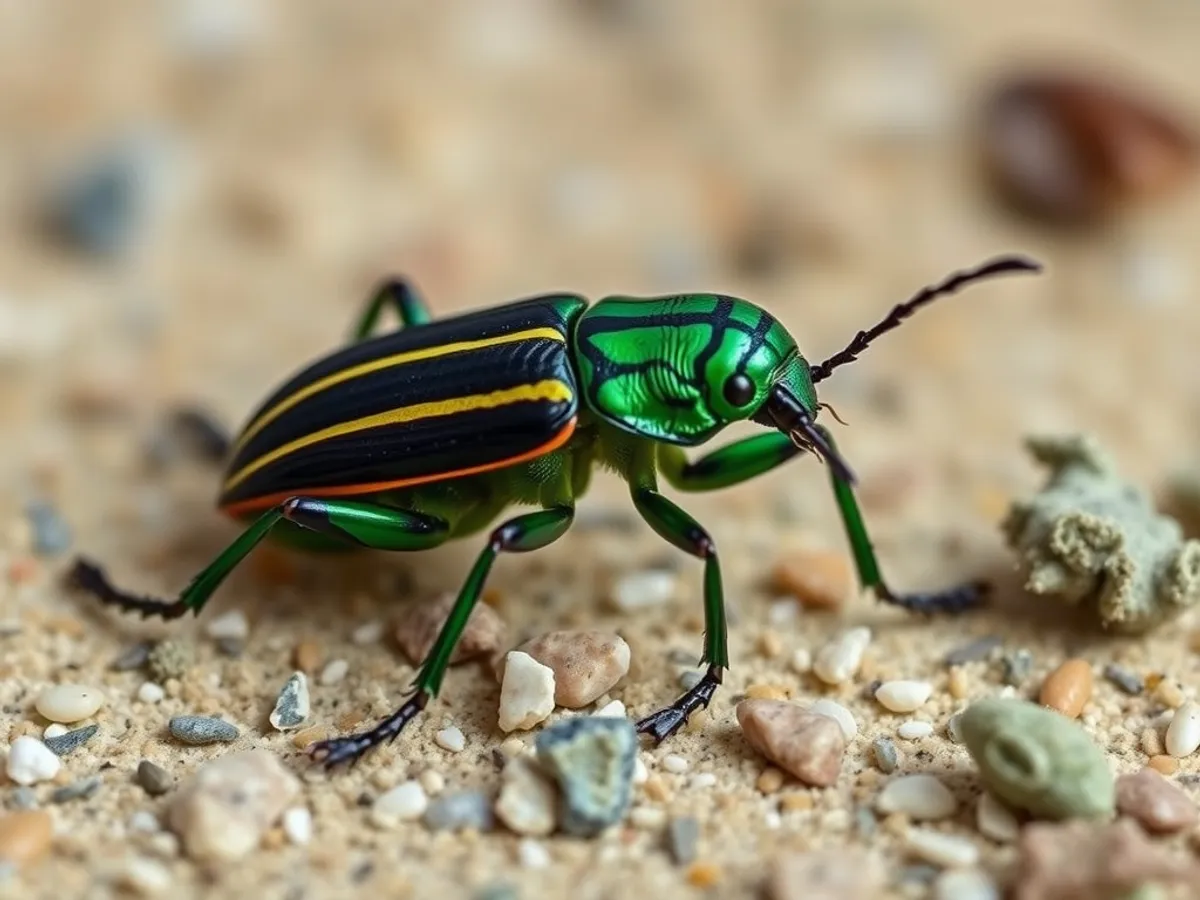
About the Green tiger beetle
The green tiger beetle is a strikingly vibrant ground beetle known for its metallic green coloration and impressive speed. Found across Europe and parts of Asia, this beetle inhabits open, sandy, or heathland environments where it actively hunts small insects. Its powerful mandibles and exceptional eyesight make it a formidable predator among invertebrates. The green tiger beetle is also recognized for its rapid running ability, often darting quickly to capture prey or evade threats.
Fascinating facts
Blazing Speed
The green tiger beetle can reach speeds up to 60 centimeters per second, making it one of the fastest insects relative to its body size.
Formidable Jaws
It has large, sickle-shaped mandibles that it uses to grasp and crush prey, often overpowering insects of similar size.
Sun-Loving Hunter
Green tiger beetles are highly active on sunny days, relying on warmth to power their rapid movements and hunting behavior.
Detailed description
The green tiger beetle (Cicindela campestris) is a medium-sized ground beetle, measuring 12–15 mm in length, with a striking metallic green coloration on its elytra and thorax, often displaying iridescent hues under sunlight. Its elytra are marked with distinctive cream or yellowish spots, aiding in camouflage among dappled ground cover. The beetle possesses large, prominent compound eyes, providing exceptional vision for detecting movement and prey. Its long, slender legs are adapted for rapid running, making it one of the fastest insects relative to body size, capable of short bursts up to 60 cm/s. The mandibles are robust and sickle-shaped, specialized for grasping and dismembering prey. Antennae are filiform and unclubbed, serving as tactile and olfactory sensors. The ventral side is typically bronze or coppery, and the body is covered with fine setae, particularly on the legs. Adults are diurnal and highly active in warm, sunny conditions, while larvae are fossorial, constructing vertical burrows in sandy soils. The species exhibits solitary behavior outside of the breeding season, with individuals maintaining and defending territories. Its life cycle includes complete metamorphosis: egg, larva, pupa, and adult stages, with larvae spending up to two years underground before emerging as adults.
Did you know?
Despite their small size, green tiger beetles can run so fast that their eyes can't process images quickly enough, causing them to stop frequently while hunting.
Research & sources
Wikipedia summary
Cicindela campestris, commonly called the green tiger beetle, is a widespread Eurasian species of tiger beetle. It is the type species of the large genus Cicindela.
Behaviour & social structure
Green tiger beetles are visual predators, relying on acute eyesight to detect and pursue small arthropods, such as ants, spiders, and caterpillars. Adults hunt by sprinting in short, rapid bursts, pausing frequently to reassess and locate prey. They capture prey with their powerful mandibles, often subduing animals nearly their own size. The beetles are most active during warm, sunny days, retreating to shaded areas or burrows during cooler or overcast periods. They exhibit territoriality, with individuals defending prime hunting grounds from conspecifics using threat displays and brief chases. When threatened, adults may take flight for short distances, aided by well-developed wings. Larvae are ambush predators, waiting at the entrance of their burrows to snatch passing invertebrates. Both adults and larvae are primarily solitary, though aggregations may occur in areas of high prey density.
Reproduction & life cycle
Breeding occurs in spring and early summer, typically from April to June, coinciding with peak adult activity. Males locate females visually and initiate mating by grasping the female's thorax with their pale-colored mandibles, often remaining attached for extended periods to guard against rival males. Females lay eggs singly in sandy or loose soil, selecting sites with optimal warmth and moisture. After hatching, larvae dig vertical burrows up to 20 cm deep, where they reside for one to two years, depending on environmental conditions. Larvae undergo three instars, molting between stages, and overwinter in their burrows. Pupation occurs within the burrow, and newly emerged adults may remain underground until the following spring. There is minimal parental care beyond egg-laying, with survival dependent on the suitability of the chosen site.
Adaptations & survival
Cicindela campestris has evolved several adaptations for predatory efficiency and survival in open, sandy habitats. Its metallic coloration provides camouflage among vegetation and sunlit soil, while also serving as a warning to potential predators. The beetle's long legs and lightweight body facilitate rapid running and agile maneuvering. Enlarged compound eyes grant a wide field of vision, critical for both hunting and predator avoidance. Larvae possess a heavily sclerotized head and thorax, forming a plug at the burrow entrance for protection and ambush. Both adults and larvae can secrete defensive chemicals from abdominal glands to deter predators. The species' ability to thermoregulate behaviorally—basking in the sun or retreating to shade or burrows—enables it to exploit variable microclimates in its habitat.
Cultural significance
The green tiger beetle has long fascinated naturalists and entomologists for its vivid coloration and predatory prowess. In some European folklore, tiger beetles are associated with speed and agility, and their presence is considered an indicator of healthy, undisturbed habitats. The species is sometimes used in environmental education to illustrate insect diversity and the importance of invertebrate predators in ecosystems. There are no significant traditional uses or mythological associations beyond its role as a charismatic insect in natural history.
Recent research
Recent research on Cicindela campestris has focused on its role as a bioindicator for habitat quality and ecosystem health, due to its sensitivity to soil disturbance and pollution. Studies have investigated larval burrow microclimates and the impact of climate change on developmental rates. Genetic analyses have explored population structure and gene flow across fragmented landscapes. Ongoing research includes the effects of land management practices on beetle abundance and diversity, as well as the biomechanics of its rapid running and predatory strategies. The species is also a model organism for studying visual predation and thermoregulatory behavior in insects.
Videos
Habitat
Open sandy or heathland areas
 Various Continental Regions
Grassland
Open areas dominated by grasses rather than trees, supporting numerous herbivores and their predators.
 Elevated Terrain
Mountain
High-altitude environments with varying climates and specialized wildlife adapted to rugged terrain and thin air.
 Global
Forest
Wooded areas with significant tree cover and diverse plant and animal communities.
Conservation
The Green tiger beetle is currently classified as Least Concern on the IUCN Red List.
Threats & challenges
Although currently assessed as Least Concern, the green tiger beetle faces localized threats from habitat loss, particularly due to agricultural intensification, afforestation, and urban development, which reduce the availability of open, sandy soils. Overgrazing and trampling by livestock can compact soil, making it unsuitable for larval burrows. Pesticide use may indirectly reduce prey availability or directly harm beetle populations. Climate change may alter the distribution and phenology of the species, with potential range shifts northward. Despite these challenges, the species remains widespread and locally abundant in many areas, benefiting from its adaptability and high reproductive potential.
Taxonomy
Scientific name
Cicindela campestris
- Kingdom
- Animalia
- Phylum
- Arthropoda
- Class
- Insecta
- Order
- Coleoptera
- Family
- Cicindelidae
- Genus
- Cicindela
- Species
- campestris
Community notes
Share your observations about the Green tiger beetle.
No community notes yet. Be the first!
Discover more wildlife
More fascinating animals from the encyclopedia.