
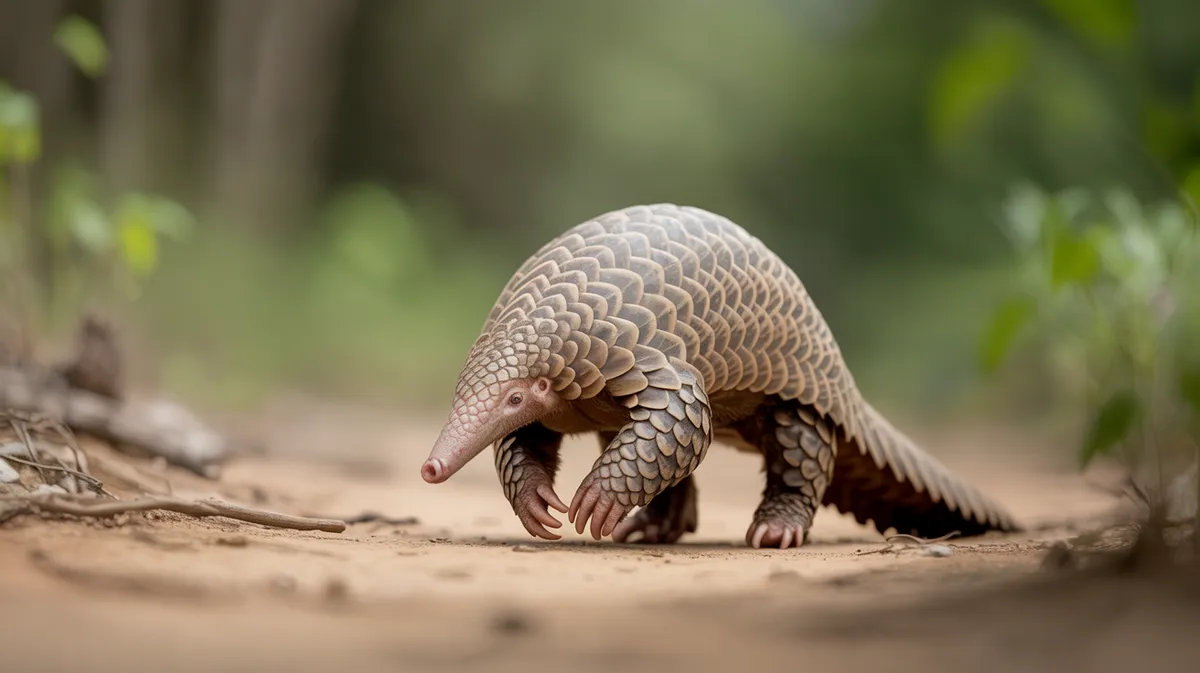
About the Indian Pangolin
The Indian Pangolin is a nocturnal, solitary mammal covered in large, protective keratin scales. Found across the Indian subcontinent, it is specialized for feeding on ants and termites, using its long, sticky tongue to extract prey from nests. When threatened, the pangolin curls into a tight ball, using its tough scales as armor. Its digging claws and keen sense of smell aid in finding food and constructing burrows. Due to illegal hunting and habitat loss, the Indian Pangolin is increasingly rare and threatened in the wild.
Fascinating facts
Scale Armor
Their overlapping scales are made of keratin, the same protein as human fingernails, and provide exceptional defense against predators.
Long Tongue
The Indian Pangolin’s tongue can extend up to 40 cm, longer than its head and body combined, perfect for extracting insects from deep within nests.
Nocturnal Lifestyle
They are strictly nocturnal, emerging only at night to forage for ants and termites, and spend the daytime curled up in deep burrows.
Detailed description
The Indian pangolin (Manis crassicaudata) is a medium-sized, nocturnal mammal distinguished by its robust body covered with 160–200 overlapping, keratinous scales that provide formidable protection against predators. Adults typically measure 84–122 cm in total length, with the tail accounting for 33–47 cm, and weigh between 10–16 kg, though larger individuals have been recorded. The head is small and conical, with reduced external ears and eyes adapted for night vision. The tongue is exceptionally long—extending up to 40 cm—muscular, and sticky, enabling efficient extraction of ants and termites from deep within nests. Forelimbs are short but powerfully muscled, equipped with three elongated, curved claws adapted for digging. The hind limbs are longer and support the animal's weight during bipedal movement, which is sometimes observed when foraging. The Indian pangolin is solitary, occupying extensive home ranges marked by scent glands. It constructs deep, multi-chambered burrows for resting and rearing young, often reusing or expanding abandoned burrows of other animals. Its sense of smell is highly developed, compensating for poor eyesight, and is crucial for locating insect prey. The skin beneath the scales is thick and tough, and the coloration of the scales varies from yellowish-brown to dark brown, often reflecting the local soil color. When threatened, the pangolin curls into a tight ball, tucking its head under its tail, rendering it nearly impervious to most predators.
Did you know?
Despite their armored appearance, Indian Pangolins are excellent swimmers and can cross small rivers when needed.
Research & sources
Wikipedia summary
The Indian pangolin, also called thick-tailed pangolin and scaly anteater, is a pangolin native to the Indian subcontinent. Like other pangolins, it has large, overlapping scales on its body which act as armour. The colour of its scales varies depending on the colour of the earth in its surroundings. It can also curl itself into a ball as self-defence against predators such as the tiger. It is an insectivore feeding on ants and termites, digging them out of mounds and logs using its long claws, which are as long as its fore limbs. It is nocturnal and rests in deep burrows during the day.
Behaviour & social structure
Indian pangolins are strictly nocturnal, emerging from their burrows shortly after dusk to forage. They are solitary and highly secretive, with individuals maintaining exclusive territories that may overlap only at the edges. Foraging is primarily terrestrial, though they are capable climbers and may ascend termite mounds or fallen logs. Their diet consists almost exclusively of ants and termites, which they locate using an acute sense of smell. Feeding involves tearing open nests with powerful foreclaws and inserting the long, sticky tongue to capture prey; they can consume thousands of insects in a single night. Indian pangolins are non-vocal, relying on chemical cues for communication. They spend the daylight hours resting in deep burrows, which can be over 2 meters deep and several meters long, providing stable microclimates and protection from predators and extreme weather. Social interactions are rare outside of the breeding season, and individuals are generally intolerant of conspecifics.
Reproduction & life cycle
Reproduction in Indian pangolins is poorly documented due to their elusive nature, but available evidence suggests a polygynous mating system. Breeding can occur year-round, with some regional peaks linked to monsoon seasons. After mating, the female undergoes a gestation period of approximately 65–70 days, typically giving birth to a single offspring, though twins are rare. The newborn is covered in soft, pale scales that harden within a few days. The young remain in the maternal burrow for the first few weeks, during which the mother nurses them with milk. As the juvenile grows, it may ride on the mother's tail during foraging excursions. Weaning occurs at around three months, but the young may remain with the mother for up to six months before dispersing to establish their own territories. Parental care is exclusively maternal, with no involvement from the male.
Adaptations & survival
The Indian pangolin exhibits several remarkable adaptations for its specialized insectivorous lifestyle. The most distinctive are its large, overlapping keratin scales, which provide armor against predators and are unique among mammals. Its elongated, sticky tongue is anchored deep in the chest, allowing it to probe into insect nests. The absence of teeth is compensated by a muscular, keratin-lined stomach that grinds ingested insects, aided by small stones and sand swallowed during feeding. Strong, curved foreclaws enable efficient excavation of termite mounds and burrows. The pangolin's ability to roll into a tight, armored ball is a highly effective defense mechanism. Its metabolic rate is low, reducing food requirements and allowing survival in habitats with patchy insect resources. Nocturnality and fossorial (burrowing) habits help avoid predators and extreme temperatures.
Cultural significance
Historically, Indian pangolins have appeared in local folklore and traditional medicine across South Asia. Their scales have been used in Ayurveda and traditional Chinese medicine for purported healing properties, including treatment of skin diseases and as aphrodisiacs, though these uses lack scientific basis. Pangolin meat is sometimes consumed as a delicacy or for supposed medicinal benefits. In some cultures, pangolins are considered symbols of protection and resilience due to their defensive behavior. However, increasing awareness of their endangered status has led to their depiction as flagship species in regional conservation campaigns.
Recent research
Recent research has focused on pangolin ecology, trade dynamics, and conservation genetics. Molecular studies have clarified the phylogenetic relationships within the genus Manis and highlighted significant genetic diversity among Indian pangolin populations. Camera trap surveys and radio-telemetry are being used to study habitat use, movement patterns, and population densities, though data remain sparse due to the animal's secretive habits. Conservation organizations are investigating the feasibility of captive breeding and rehabilitation, but success has been limited by the species' specialized diet and stress sensitivity. Ongoing studies are also assessing the impact of illegal trade and developing forensic tools for identifying pangolin derivatives in markets.
Sources
Indian Pangolin (Manis crassicaudata): Ecology, Distribution, and Conservation Status
Mahmood, T., Challender, D., Khatiwada, A., et al. (2019)
scientificEcology and Conservation Status of the Indian Pangolin (Manis crassicaudata) in Sri Lanka
Perera, P. & Karawita, K. (2020)
scientificVideos
Habitat
Forest
 Various Continental Regions
Grassland
Open areas dominated by grasses rather than trees, supporting numerous herbivores and their predators.
 Elevated Terrain
Mountain
High-altitude environments with varying climates and specialized wildlife adapted to rugged terrain and thin air.
 Global
Forest
Wooded areas with significant tree cover and diverse plant and animal communities.
Conservation
The Indian Pangolin is currently classified as Endangered on the IUCN Red List.
Threats & challenges
The Indian pangolin faces severe threats from illegal hunting and poaching, primarily driven by demand for its scales and meat in traditional medicine and as a luxury food, especially in East and Southeast Asia. Habitat loss and fragmentation due to agricultural expansion, urbanization, and deforestation further exacerbate population declines. Road mortality and accidental capture in traps set for other animals are additional risks. The species is classified as Endangered by the IUCN, with populations believed to be declining rapidly across its range. Enforcement of wildlife protection laws is often inadequate, and illegal trade networks are sophisticated and difficult to dismantle. Conservation challenges include a lack of reliable population data, limited public awareness, and difficulties in breeding pangolins in captivity.
Taxonomy
Scientific name
Manis crassicaudata
- Kingdom
- Animalia
- Phylum
- Chordata
- Class
- Mammalia
- Order
- Pholidota
- Family
- Manidae
- Genus
- Manis
- Species
- crassicaudata
Community notes
Share your observations about the Indian Pangolin.
No community notes yet. Be the first!
Discover more wildlife
More fascinating animals from the encyclopedia.