
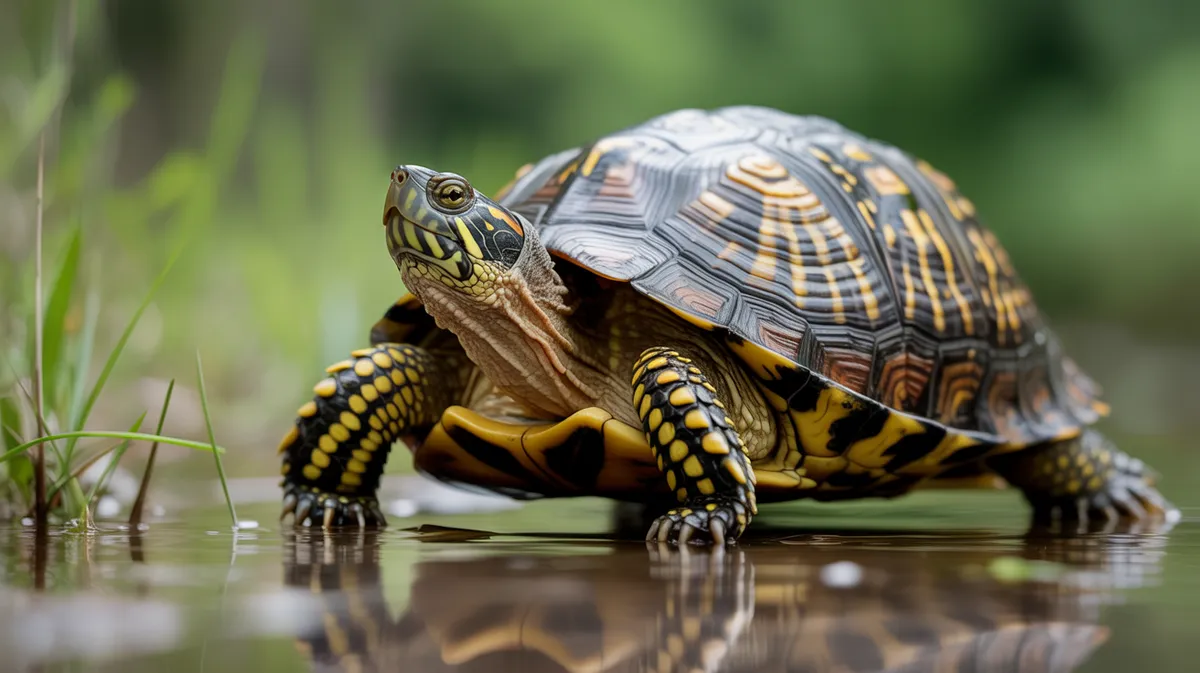
About the Keeled Box Turtle
The Keeled Box Turtle is a medium-sized terrestrial turtle known for the prominent three keels, or ridges, running along the length of its domed carapace. Native to Southeast Asia, this species prefers moist, forested hills and mountainous regions, often near streams or other freshwater sources. It is primarily terrestrial but is capable of swimming and will sometimes take to the water. The Keeled Box Turtle is recognized for its defensive behavior, as it can tightly close its hinged plastron to protect itself from predators. Due to habitat loss and illegal collection for the pet trade, its populations are declining.
Fascinating facts
Natural Armor
The Keeled Box Turtle can close its shell tightly thanks to a hinged plastron, protecting it from predators.
Forest Dweller
This turtle prefers moist, leafy forests and mountainous terrain, where it is well-camouflaged among the undergrowth.
Distinctive Keels
Its carapace has three strong, raised keels, making it easy to distinguish from other box turtles.
Detailed description
The Keeled Box Turtle (Cuora mouhotii) is a medium-sized terrestrial turtle, typically reaching a carapace length of 15–20 cm (6–8 in), though some individuals may grow slightly larger. Its most distinctive feature is the presence of three pronounced longitudinal keels on the high-domed, brown to dark olive carapace, which provides both camouflage and structural strength. The plastron is yellowish to brown with dark blotches and is hinged, allowing the turtle to close its shell tightly for protection. The head is relatively small, with a pointed snout and a yellowish to olive coloration, often marked with dark streaks. Limbs are robust and covered in scales, adapted for digging and terrestrial movement, with slightly webbed toes that aid occasional swimming. Keeled Box Turtles are primarily crepuscular, being most active at dawn and dusk, and spend much of the day hidden under leaf litter or in burrows to avoid predators and desiccation. They are solitary by nature, coming together only during the breeding season. Their omnivorous diet includes a variety of fruits, fungi, invertebrates, and occasionally small vertebrates, reflecting their adaptability to diverse forest environments. The species exhibits remarkable longevity, with individuals in captivity living over 30 years, though wild lifespans are less well documented.
Did you know?
Despite their terrestrial habits, Keeled Box Turtles are surprisingly good swimmers and will sometimes escape danger by diving into water.
Research & sources
Wikipedia summary
The keeled box turtle is a species of turtle in the family Geoemydidae. The species is endemic to Asia.
Behaviour & social structure
Keeled Box Turtles are predominantly terrestrial and exhibit secretive, shy behavior, spending much of their time concealed under logs, rocks, or dense vegetation. They are opportunistic feeders, foraging on the forest floor for fallen fruits, berries, mushrooms, insects, earthworms, snails, and carrion. Feeding is typically solitary, and aggressive interactions are rare outside of the breeding season. When threatened, they exhibit a unique defensive behavior by retracting their head, limbs, and tail, then closing the plastral hinge to form a tight seal, deterring most predators. Activity peaks during the wet season and after rainfall, when humidity is high and food is abundant. They are known to dig shallow burrows for shelter and may aestivate during periods of extreme dryness or heat. Social interactions are minimal, with individuals maintaining overlapping home ranges but rarely engaging in direct contact.
Reproduction & life cycle
Breeding in Cuora mouhotii generally occurs during the early rainy season (April to July), coinciding with increased food availability. Courtship involves the male following and gently biting the female's shell or limbs. Females lay 1–3 clutches per year, each containing 1–4 elongated, brittle-shelled eggs, which are typically deposited in shallow nests dug in moist soil or leaf litter. Incubation lasts 70–100 days, depending on temperature and humidity, with higher temperatures accelerating development. There is no parental care after oviposition; hatchlings are independent from birth and must fend for themselves. Sexual maturity is reached at approximately 7–10 years of age, and reproductive output is relatively low, contributing to the species' vulnerability.
Adaptations & survival
The Keeled Box Turtle's most notable adaptation is its hinged plastron, which allows it to close its shell tightly, providing effective protection from predators such as mammals and birds. The three keels on the carapace not only strengthen the shell but also help shed water and debris, aiding camouflage in leaf litter. Its cryptic coloration blends seamlessly with the forest floor, reducing predation risk. The species is tolerant of a range of humidity levels and can survive in both evergreen and deciduous forests, as well as in disturbed habitats. Slight webbing on the toes enables limited swimming, allowing escape from terrestrial threats and access to aquatic food sources. Behavioral adaptations include burrowing and seasonal activity shifts to avoid extreme environmental conditions.
Cultural significance
In parts of Southeast Asia, the Keeled Box Turtle has been used in traditional medicine, where it is believed to have healing properties, though scientific evidence is lacking. It occasionally appears in local folklore as a symbol of longevity and resilience, reflecting its ability to survive in harsh environments. The species is sometimes kept as a pet, which has contributed to over-collection from the wild. However, it does not hold the same widespread cultural or religious significance as some other Asian turtle species.
Recent research
Recent research has focused on the phylogenetic relationships within the genus Cuora, with molecular studies clarifying the taxonomic status of C. mouhotii and its subspecies. Conservation genetics studies have revealed low genetic diversity in some populations, underscoring the need for habitat connectivity. Field studies have documented the species' habitat preferences, movement patterns, and dietary breadth, providing insights for habitat management. Ongoing research aims to develop captive breeding protocols to support reintroduction efforts. There is also increasing interest in the species' role in forest ecosystem functioning, particularly its contribution to seed dispersal and invertebrate population control.
Videos
Habitat
Forest and mountainous regions near freshwater
 Elevated Terrain
Mountain
High-altitude environments with varying climates and specialized wildlife adapted to rugged terrain and thin air.
 Global
Forest
Wooded areas with significant tree cover and diverse plant and animal communities.
 Global
Freshwater
Lakes, rivers, and wetlands with diverse aquatic ecosystems.
Conservation
The Keeled Box Turtle is currently classified as Endangered on the IUCN Red List.
Threats & challenges
Cuora mouhotii faces severe threats from habitat loss due to deforestation, agricultural expansion, and infrastructure development throughout its range in Southeast Asia. Illegal collection for the international pet trade and traditional medicine markets has led to significant population declines. The species is listed as Endangered on the IUCN Red List and is included in Appendix II of CITES, restricting international trade. Fragmented populations and low reproductive rates further exacerbate vulnerability. Conservation challenges include weak law enforcement, lack of habitat protection, and insufficient ecological data for effective management. Recent surveys indicate ongoing population declines, with some local extinctions reported.
Taxonomy
Scientific name
Cuora mouhotii
- Kingdom
- Animalia
- Phylum
- Chordata
- Class
- Reptilia
- Order
- Testudines
- Family
- Geoemydidae
- Genus
- Cuora
- Species
- mouhotii
Community notes
Share your observations about the Keeled Box Turtle.
No community notes yet. Be the first!
Discover more wildlife
More fascinating animals from the encyclopedia.