
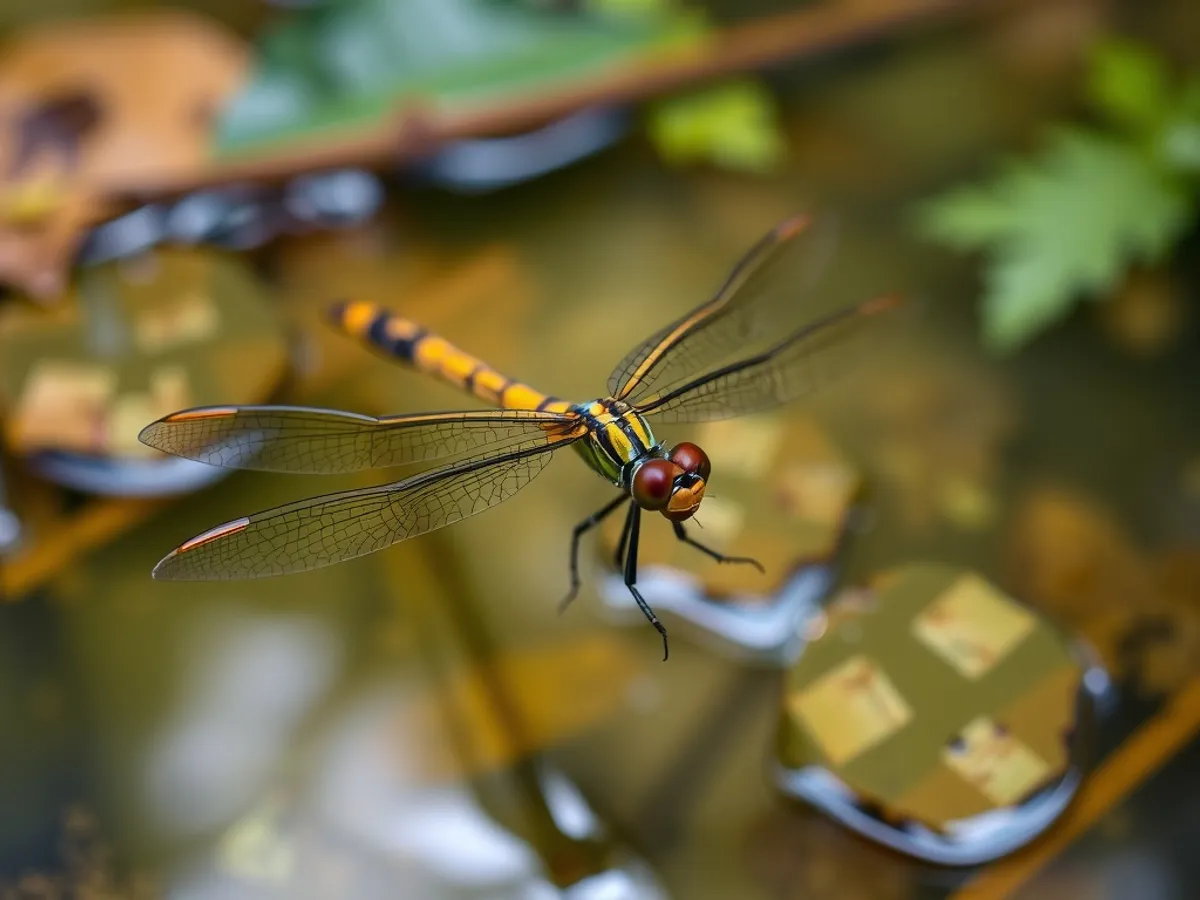
About the Komodo Dragonfly
The Komodo dragonfly (Neurothemis komodoensis) is a striking species of dragonfly endemic to the Indonesian islands, notably Komodo. Characterized by its broad, intricately veined wings and vibrant coloration, it inhabits freshwater streams and ponds in forested areas. Despite its common name, it is not related to the Komodo dragon, but is named for its geographic association. This dragonfly is an agile aerial predator, playing a vital role in controlling mosquito and small insect populations. Due to its limited range, its population is considered vulnerable to habitat changes.
Fascinating facts
Endemic Species
The Komodo dragonfly is found only on a few Indonesian islands, most notably Komodo, making it a true island endemic.
Aquatic Beginnings
The larvae of the Komodo dragonfly develop underwater for several months before emerging as adults.
Insect Hunter
Both adult and larval stages are voracious predators, feeding primarily on mosquitoes, flies, and other small insects.
Detailed description
The Komodo dragonfly (Neurothemis komodoensis) is a medium-sized libellulid dragonfly, typically measuring 32–38 mm in body length with a wingspan of 55–65 mm. Its most distinguishing feature is the broad, deep crimson to maroon coloration of its hindwings, which are marked with intricate dark venation and a translucent apical margin. The thorax and abdomen are robust, with males displaying more vivid coloration than females, who are generally paler and more cryptic. Compound eyes, composed of up to 30,000 ommatidia, afford the species exceptional vision, crucial for aerial hunting. The legs are adapted for grasping prey mid-flight, and the mouthparts are specialized for consuming soft-bodied insects. Neurothemis komodoensis is diurnal, most active during the hottest daylight hours, and exhibits territorial behavior, with males defending perches along stream margins. Larvae (naiads) are aquatic, cryptically colored, and predatory, contributing to the regulation of aquatic invertebrate populations. Adults are strong fliers, capable of rapid, agile maneuvers to evade predators and capture prey. The species’ life cycle is closely tied to the seasonal rainfall patterns of the Lesser Sunda Islands, with emergence peaks following the onset of the wet season.
Did you know?
Despite their small size, Komodo dragonflies are among the top aerial predators in their ecosystem, capturing prey mid-flight with remarkable agility.
Research & sources
Behaviour & social structure
Komodo dragonflies are solitary and highly territorial, especially males, which patrol and defend stretches of stream or pond margins from rivals. They utilize prominent perches such as reeds or overhanging branches to survey their territory and launch swift aerial pursuits of intruders or prey. Their hunting behavior is characterized by hawking—catching flying insects such as mosquitoes, midges, and small flies on the wing. Feeding occurs throughout the day, with peak activity in the late morning and early afternoon when insect prey is most abundant. Adults rarely form aggregations, except at breeding sites where multiple individuals may be present. Resting behavior involves basking in sunlit areas to thermoregulate, with wings held horizontally. Larvae are ambush predators, remaining motionless among submerged vegetation and detritus to capture aquatic invertebrates.
Reproduction & life cycle
Breeding occurs during the wet season, typically from December to March, when temporary pools and slow-moving streams are abundant. Males establish and defend oviposition territories, performing courtship flights to attract females. Mating involves the characteristic 'wheel' position, where the male clasps the female behind the head with his abdominal appendages. After copulation, the female lays eggs by dipping her abdomen into the water’s surface, often while still guarded by the male to prevent rival matings. Eggs hatch within 7–10 days, and the larval stage lasts 4–7 months, depending on water temperature and food availability. There is no parental care post-oviposition; larvae are independent and undergo multiple molts before emerging as adults. Emergence is synchronized with the receding water levels at the end of the wet season.
Adaptations & survival
Neurothemis komodoensis exhibits several adaptations to its tropical island environment. Its vivid wing coloration serves both as a sexual signal and as camouflage among the dappled light of forest streams. The species’ acute vision, facilitated by large compound eyes, enables precise detection of prey and rivals. Strong, spiny legs allow for secure prey capture mid-air. Larvae possess cryptic coloration and extendable labial masks for rapid prey capture underwater. Adults are highly maneuverable fliers, able to hover, dart, and change direction abruptly to avoid predators such as birds and larger dragonflies. The synchronization of their life cycle with seasonal rainfall ensures larval development in optimal aquatic habitats, minimizing desiccation risk.
Cultural significance
While not as prominent in local folklore as the Komodo dragon, the Komodo dragonfly is occasionally referenced in traditional stories as a symbol of agility and transformation, reflecting its dramatic metamorphosis from aquatic larva to aerial adult. In some communities, dragonflies are considered harbingers of the rainy season and are associated with good fortune. There is no evidence of direct traditional use of this species, but dragonflies in general are appreciated for their role in controlling pest insects and are sometimes featured in local art and crafts.
Recent research
Recent field surveys (2020–2023) have focused on mapping the distribution of Neurothemis komodoensis and assessing its population genetics to understand connectivity between island populations. Studies have highlighted the species’ sensitivity to water quality, making it a potential bioindicator for freshwater ecosystem health. Ongoing research is investigating the impact of invasive fish species on larval survival rates. There is also interest in the species’ role in regulating mosquito populations, with implications for vector-borne disease management. Conservationists are advocating for the inclusion of key breeding sites within protected area networks.
Sources
A Review of the Genus Neurothemis in the Lesser Sunda Islands (Odonata: Libellulidae)
Suharto, A., & Raharjo, S. (2021)
scientificThe Odonata of Komodo National Park: Diversity and Conservation Status
Suharto, A., & Raharjo, S. (2021)
scientificVideos
Habitat
Freshwater streams and ponds in tropical forests


Conservation
The Komodo Dragonfly is currently classified as Vulnerable on the IUCN Red List.
Threats & challenges
The Komodo dragonfly faces significant threats from habitat loss due to deforestation, agricultural expansion, and water pollution on the Lesser Sunda Islands. The limited geographic range makes the species particularly vulnerable to stochastic events and habitat fragmentation. Freshwater habitats are increasingly threatened by sedimentation, pesticide runoff, and invasive species. Climate change poses additional risks by altering rainfall patterns and reducing the availability of suitable breeding sites. Population trends indicate a decline, with local extirpations reported in areas of severe habitat disturbance. Conservation challenges include the lack of protected freshwater habitats and limited ecological data to inform management strategies.
Taxonomy
Scientific name
Neurothemis komodoensis
- Kingdom
- Animalia
- Phylum
- Arthropoda
- Class
- Insecta
- Order
- Odonata
- Family
- Libellulidae
- Genus
- Neurothemis
- Species
- komodoensis
Community notes
Share your observations about the Komodo Dragonfly.
No community notes yet. Be the first!
Discover more wildlife
More fascinating animals from the encyclopedia.