
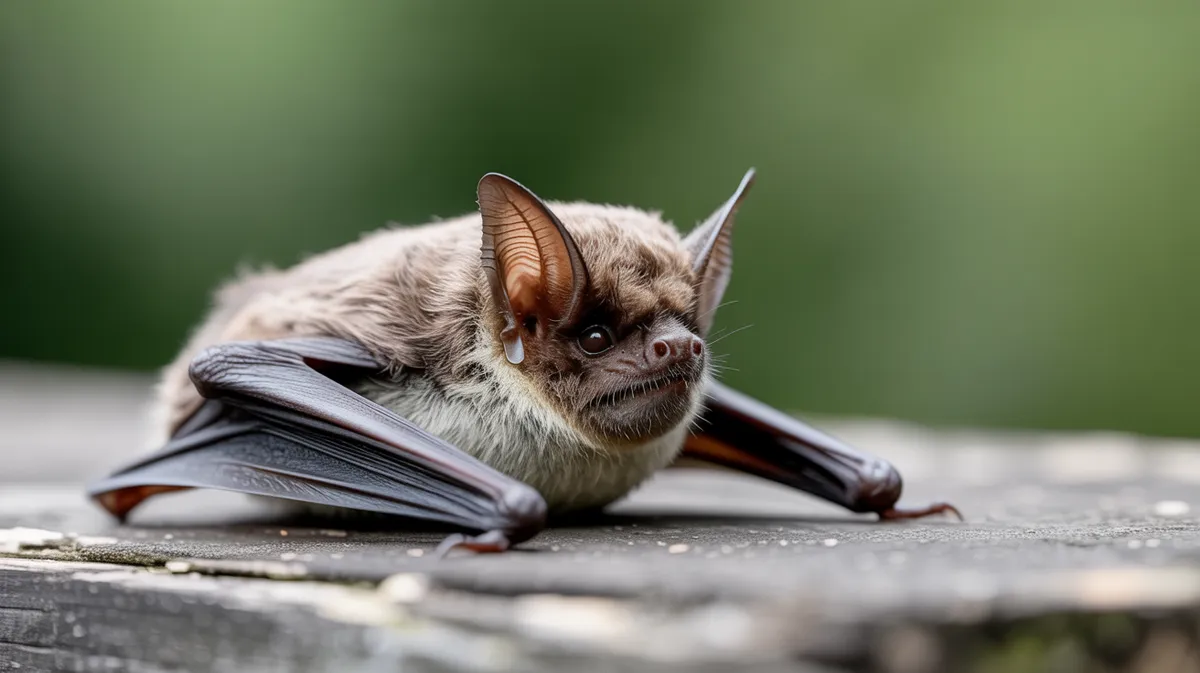
About the Little Brown Bat
Myotis lucifugus was, until recently, one of the most abundant mammals in North America, a 7 g insectivore capable of eating hundreds of mosquitoes and midges in an hour and hibernating in caves in enormous aggregations. Then in February 2006 a caver photographed bats with white fuzz on their muzzles in Howe Caverns near Albany, New York. The fungus, later named Pseudogymnoascus destructans and traced to a European origin where bats are resistant to it, thrives in the cold, humid conditions of hibernacula. It invades the skin of hibernating bats and, crucially, does not kill them directly: it irritates them awake. Each arousal from torpor burns a large slice of a bat's carefully budgeted fat reserve, and infected bats rouse far too often, then fly out into a winter landscape with no insects and starve. The result has been one of the fastest declines of any North American mammal - white-nose syndrome has killed well over six million bats, with little brown bat losses exceeding 90 percent across the northeastern United States, and some hibernacula that held tens of thousands are now empty. A small number of survivors persist and may be developing resistance, which is now the focus of intense research.
Fascinating facts
Echolocation Experts
Little Brown Bats use sophisticated echolocation to navigate and hunt, emitting high-frequency sounds that bounce off objects and return to their sensitive ears.
Nighttime Hunters
These bats are strictly nocturnal, emerging at dusk and feeding on mosquitoes, moths, and other flying insects throughout the night.
Hibernation Specialists
During winter, Little Brown Bats hibernate in caves or mines, drastically lowering their body temperature and metabolism to survive when insects are scarce.
Detailed description
The Little Brown Bat (Myotis lucifugus) is a small vesper bat, typically weighing between 5 and 14 grams, with a forearm length of 36–40 mm and a wingspan ranging from 22 to 27 cm. Its fur is glossy and ranges from light to dark brown, with a paler underside and darker face and wing membranes. The ears are short and rounded, with a tragus that is long and narrow, aiding in precise echolocation. This species is highly adaptable, occupying diverse habitats such as forests, wetlands, and urban environments, and often roosts in tree cavities, caves, attics, and under bridges. Little Brown Bats are nocturnal and exhibit crepuscular activity peaks, emerging at dusk to forage. They are agile fliers, capable of rapid, acrobatic maneuvers to capture flying insects mid-air. Socially, they form large maternity colonies in summer, sometimes numbering in the thousands, while males and non-reproductive females may roost singly or in small groups. In winter, they hibernate in cool, humid sites (hibernacula), often in caves or mines, where they can reduce their metabolic rate and survive for months without feeding. Their echolocation calls are frequency-modulated, typically ranging from 40 to 90 kHz, allowing them to detect and track small insect prey with remarkable accuracy. The Little Brown Bat is a keystone insectivore, consuming up to half its body weight in insects nightly, and plays a vital role in controlling pest populations.
Did you know?
Despite their tiny size, Little Brown Bats can live longer than most mammals of similar size, with some recorded at over 30 years old in the wild.
Research & sources
Wikipedia summary
The little brown bat or little brown myotis is an endangered species of mouse-eared microbat found in North America. It has a small body size and glossy brown fur. It is similar in appearance to several other mouse-eared bats, including the Indiana bat, northern long-eared bat, and Arizona myotis, to which it is closely related. Despite its name, the little brown bat is not closely related to the big brown bat, which belongs to a different genus.
Behaviour & social structure
Little Brown Bats exhibit strong site fidelity, often returning to the same summer and winter roosts year after year. Foraging activity peaks shortly after sunset and again before sunrise, with individuals covering foraging ranges of 1–3 km from their roosts. They primarily hunt over water bodies and forest edges, using echolocation to detect prey such as moths, beetles, caddisflies, and mosquitoes. Their hunting style involves rapid, erratic flight patterns and aerial hawking, but they may also glean insects from surfaces. Social interactions are pronounced in maternity colonies, where females engage in mutual grooming and vocal communication. During hibernation, bats cluster together to conserve heat, entering torpor states that drastically reduce heart rate and respiration. Daily routines are dictated by temperature, prey availability, and reproductive status, with bats spending daylight hours roosting and grooming.
Reproduction & life cycle
The breeding season for Little Brown Bats occurs in late summer and early autumn, with mating typically taking place at swarming sites near hibernacula. Females store sperm over winter and delay fertilization until spring (delayed fertilization). Gestation lasts approximately 50–60 days, with most births occurring in June or early July. Females give birth to a single pup per year, which is born hairless and blind but grows rapidly. Pups begin to fly at 18–21 days old and are weaned by four weeks. Maternity colonies provide warmth and protection, with communal care observed among females. Males do not participate in parental care and often roost separately during the breeding season.
Adaptations & survival
Little Brown Bats possess several adaptations for insectivory and nocturnal life. Their sophisticated echolocation system enables them to detect prey and navigate in complete darkness. The wing morphology, with long, narrow wings, allows for maneuverable flight and efficient energy use. Thermoregulatory adaptations include the ability to enter torpor and hibernation, reducing metabolic demands during periods of food scarcity. Delayed fertilization ensures that young are born when insect prey is abundant. Their fur provides insulation, while specialized foot and claw structures allow them to hang inverted for extended periods. Social behaviors, such as clustering and grooming, enhance survival and reduce parasite loads.
Cultural significance
While not as prominent in folklore as some Old World bat species, the Little Brown Bat is often associated with North American rural and suburban life, sometimes viewed as a beneficial insect controller. In some Indigenous cultures, bats are symbols of rebirth and intuition. Public perception has shifted in recent years due to concerns over disease transmission, though there is little evidence linking this species to zoonotic outbreaks. Educational programs increasingly highlight the ecological importance of bats, promoting conservation and dispelling myths.
Recent research
Recent research has focused on the epidemiology and management of white-nose syndrome, including studies on bat immune responses, microbiome interactions, and potential biological control agents. Genetic studies have revealed significant population structure and gene flow among subspecies, with ongoing work to clarify taxonomic relationships. Acoustic monitoring has advanced understanding of bat activity patterns and habitat use, aiding in conservation planning. Ongoing research also examines the impacts of climate change on hibernation phenology and reproductive timing.
Videos
Habitat
Forests, near water sources, and human structures
 Elevated Terrain
Mountain
High-altitude environments with varying climates and specialized wildlife adapted to rugged terrain and thin air.
 Global
Forest
Wooded areas with significant tree cover and diverse plant and animal communities.
 Global
Freshwater
Lakes, rivers, and wetlands with diverse aquatic ecosystems.
Conservation
The Little Brown Bat is currently classified as Endangered on the IUCN Red List.
Threats & challenges
The most significant threat to Little Brown Bat populations is white-nose syndrome (WNS), a fungal disease caused by Pseudogymnoascus destructans, which has decimated colonies across eastern North America since its discovery in 2006. WNS disrupts hibernation, causing bats to deplete fat reserves and die before spring. Additional threats include habitat loss from deforestation and urbanization, disturbance of roost and hibernation sites, pesticide exposure reducing prey availability, and climate change altering hibernation patterns. Population declines have been severe, with some regions experiencing losses exceeding 90%. Conservation challenges include protecting hibernacula, managing human disturbance, and developing treatments for WNS.
Taxonomy
Scientific name
Myotis lucifugus
- Kingdom
- Animalia
- Phylum
- Chordata
- Class
- Mammalia
- Order
- Chiroptera
- Family
- Vespertilionidae
- Genus
- Myotis
- Species
- lucifugus
Community notes
Share your observations about the Little Brown Bat.
No community notes yet. Be the first!
Discover more wildlife
More fascinating animals from the encyclopedia.