
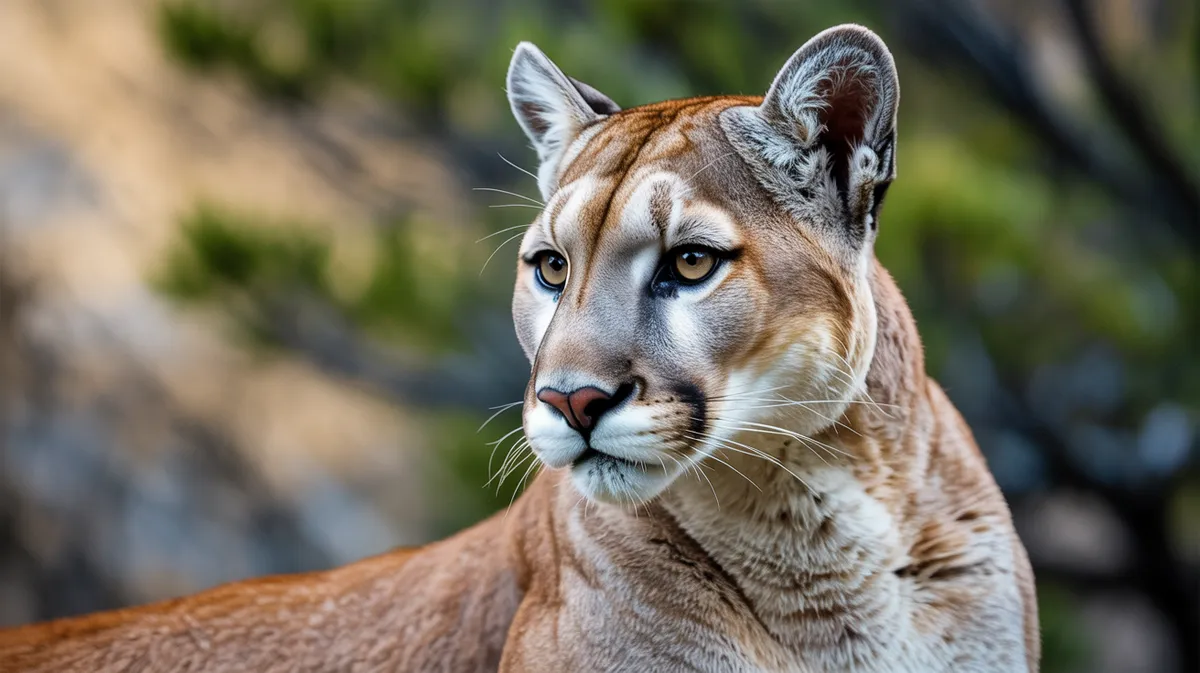
About the Mountain Lion
The mountain lion has the largest north-to-south range of any wild land mammal in the Americas, from the Canadian Yukon to the southern Andes — which is why it carries more common names than almost any animal: puma, cougar, panther, catamount. Despite its size it is not a "big cat" in the technical sense, because it cannot roar: its hyoid bone is fully ossified rather than flexible, so it purrs, chirps and screams instead. Genetically it sits closer to the cheetah than to leopards or jaguars. It is an ambush hunter built for one explosive attack rather than a chase, with hind legs longer than its forelegs that power vertical leaps of around five metres. After a kill it drags and caches the carcass under vegetation, returning to feed over several days instead of gorging at once. Solitary and territorial, individuals hold enormous home ranges and communicate mostly through scent and scrape marks rather than direct encounters. A persistent misconception is that "black panthers" are melanistic mountain lions — no melanistic puma has ever been verified; those animals are melanistic leopards or jaguars.
Fascinating facts
Wide Range
Mountain Lions have the largest range of any wild terrestrial mammal in the Western Hemisphere, spanning from Canada to the southern Andes in South America.
Excellent Vision
They have exceptional night vision, which allows them to be effective nocturnal hunters and ambush prey with stealth.
Diet Specialist
Their primary prey are deer, but they also hunt smaller mammals, birds, and even livestock when natural prey is scarce.
Detailed description
The mountain lion (Puma concolor) is a large, slender felid distinguished by its uniform tawny coat, powerful musculature, and exceptionally long tail, which can comprise nearly one-third of its total body length. Adult males typically weigh between 53–100 kg (117–220 lbs) and measure 2.4 meters (8 feet) from nose to tail tip, while females are smaller, averaging 29–64 kg (64–141 lbs). Their head is rounded with small, rounded ears and a short, broad muzzle, and their hind legs are notably longer than the forelimbs, enabling impressive leaping ability—mountain lions can leap up to 5.5 meters (18 feet) vertically and 12 meters (40 feet) horizontally. Their retractable claws and keen senses of sight and hearing make them formidable nocturnal and crepuscular hunters. Solitary by nature, mountain lions maintain large, overlapping territories marked by scent and physical signs such as scrapes. They are highly adaptable, inhabiting environments ranging from dense forests and mountainous regions to arid deserts and grasslands, at elevations from sea level up to 4,500 meters (14,800 feet). The species exhibits sexual dimorphism, with males being larger and more robust. Mountain lions are apex predators, primarily preying on ungulates such as deer, but their diet can include smaller mammals, birds, and occasionally livestock. Their elusive behavior and cryptic coloration aid in avoiding detection by both prey and potential threats. Despite their wide distribution, mountain lions are rarely seen due to their secretive habits and preference for rugged, inaccessible terrain.
Did you know?
Despite their size, mountain lions cannot roar; instead, they communicate through whistles, chirps, hisses, and growls.
Research & sources
Wikipedia summary
The cougar, also called puma, mountain lion, catamount and panther is a large small cat native to the Americas. It inhabits North, Central and South America, making it the most widely distributed wild, terrestrial mammal in the Western Hemisphere, and one of the most widespread in the world. Its range spans the Yukon, British Columbia and Alberta provinces of Canada, the Rocky Mountains and areas in the western United States. Further south, its range extends through Mexico to the Amazon Rainforest and the southern Andes Mountains in Patagonia. It is an adaptable generalist species, occurring in most American habitat types. It prefers habitats with dense underbrush and rocky areas for stalking but also lives in open areas.
Behaviour & social structure
Mountain lions are solitary and territorial, with individuals occupying home ranges that can span 50–1,000 square kilometers (19–386 sq mi), depending on habitat quality and prey availability. Males typically have larger territories that overlap with those of several females but rarely with other males. They are primarily crepuscular and nocturnal, hunting most actively during dawn, dusk, and nighttime hours. Mountain lions are ambush predators, relying on stealth and cover to stalk prey before launching a rapid, powerful attack, often aiming for the neck or throat. After a successful kill, they may drag the carcass to a secluded spot and cover it with debris to feed on over several days. Communication is primarily through scent marking, vocalizations (including hisses, growls, and the distinctive 'scream' of females in estrus), and visual cues such as scrapes. Social interactions are generally limited to mating encounters and females with dependent young. They are capable swimmers and climbers, though they prefer to stay on the ground. Daily activity patterns are influenced by prey movements, human presence, and environmental conditions.
Reproduction & life cycle
Mountain lions are polygynous, with males mating with multiple females within their range. Breeding can occur year-round, but in temperate regions, peaks are often observed in late winter and early spring. Females exhibit estrus for 8–11 days, during which they vocalize frequently to attract males. After mating, gestation lasts approximately 82–96 days. Litters typically consist of 1–6 cubs (average 2–3), born in well-concealed dens such as rocky crevices, dense vegetation, or caves. Cubs are born blind and spotted, weighing 200–450 grams (7–16 oz), and are entirely dependent on the mother. The female provides all parental care, nursing the cubs for 2–3 months before gradually introducing them to solid food. Cubs remain with the mother for up to 18–24 months, learning hunting and survival skills, before dispersing to establish their own territories. Juvenile mortality is high due to predation, starvation, and intraspecific aggression.
Adaptations & survival
Mountain lions possess several adaptations for predation and survival in diverse habitats. Their powerful hind limbs enable extraordinary leaping and sprinting abilities, critical for ambush hunting. The long, muscular tail aids in balance during rapid pursuits and agile maneuvers. Their cryptic coloration provides camouflage in varied landscapes, from forests to deserts. Retractable claws and specialized footpads allow for silent stalking and effective climbing. Acute night vision, supported by a high density of rod cells in the retina, facilitates hunting in low-light conditions. Sensitive whiskers and a keen sense of smell enhance environmental awareness. Behavioral flexibility, such as varying activity patterns and diet, allows mountain lions to exploit a wide range of prey and habitats, contributing to their extensive distribution.
Cultural significance
Mountain lions hold a prominent place in the mythology and folklore of Indigenous peoples throughout the Americas, often symbolizing strength, stealth, and guardianship. In North American traditions, they are revered as powerful spirit animals and are featured in stories as protectors or as omens. In South American cultures, particularly among the Inca and Mapuche, the puma is associated with the earth and is a symbol of power and fertility. In modern times, mountain lions are both feared and admired, sometimes regarded as threats to livestock or human safety, but also as icons of wilderness and conservation. Their elusive nature has contributed to numerous legends and reported sightings, especially in regions where they are now rare or extirpated.
Recent research
Recent research has focused on mountain lion ecology in fragmented landscapes, revealing their ability to traverse urban environments and utilize green corridors. GPS collar studies have provided insights into movement patterns, home range sizes, and dispersal behavior, including remarkable long-distance dispersal events by subadult males. Genetic studies highlight the importance of maintaining connectivity between populations to prevent inbreeding depression, as seen in the endangered Florida panther (Puma concolor coryi). Investigations into prey selection and kill rates have shown mountain lions play a crucial role in regulating prey populations and maintaining ecosystem health. Ongoing research addresses the impacts of human development, disease transmission (such as feline leukemia virus outbreaks), and the effectiveness of non-lethal conflict mitigation strategies. Climate change models predict potential range shifts and changes in prey dynamics, emphasizing the need for adaptive management.
Videos
Habitat
Forests, mountains, grasslands, and deserts
 Arid Regions
Desert
Arid lands with minimal rainfall, extreme temperatures, and specialized wildlife adapted to harsh conditions.
 Various Continental Regions
Grassland
Open areas dominated by grasses rather than trees, supporting numerous herbivores and their predators.
 Elevated Terrain
Mountain
High-altitude environments with varying climates and specialized wildlife adapted to rugged terrain and thin air.
 Global
Forest
Wooded areas with significant tree cover and diverse plant and animal communities.
Conservation
The Mountain Lion is currently classified as Least Concern on the IUCN Red List.
Threats & challenges
Despite their 'Least Concern' status globally, mountain lions face significant regional threats. Habitat fragmentation due to urban development, roads, and agriculture reduces available territory and increases mortality from vehicle collisions. Human-wildlife conflict, particularly depredation on livestock, often leads to retaliatory killings. Legal and illegal hunting, especially in areas where they are not protected, further impacts populations. Genetic isolation in fragmented populations can reduce genetic diversity and increase susceptibility to disease. Emerging threats include rodenticide poisoning, disease transmission from domestic animals, and climate change altering prey availability and habitat suitability. Conservation challenges include maintaining habitat connectivity, mitigating human conflict, and monitoring population trends, especially in areas where populations are small or declining.
Taxonomy
Scientific name
Puma concolor
- Kingdom
- Animalia
- Phylum
- Chordata
- Class
- Mammalia
- Order
- Carnivora
- Family
- Felidae
- Genus
- Puma
- Species
- concolor
Where to see a mountain lion
23 zoos and aquariums in 5 countries are recorded as keeping this species.
 San Diego Zoo🇺🇸 San Diego, United States
 Zoo am Meer🇩🇪 Bremerhaven, Germany
 Calgary Zoo🇨🇦 Calgary, Canada
 Houston Zoo🇺🇸 Houston, United States
 North Carolina Zoo🇺🇸 Asheboro, United States
Community notes
Share your observations about the Mountain Lion.
No community notes yet. Be the first!
Discover more wildlife
More fascinating animals from the encyclopedia.