
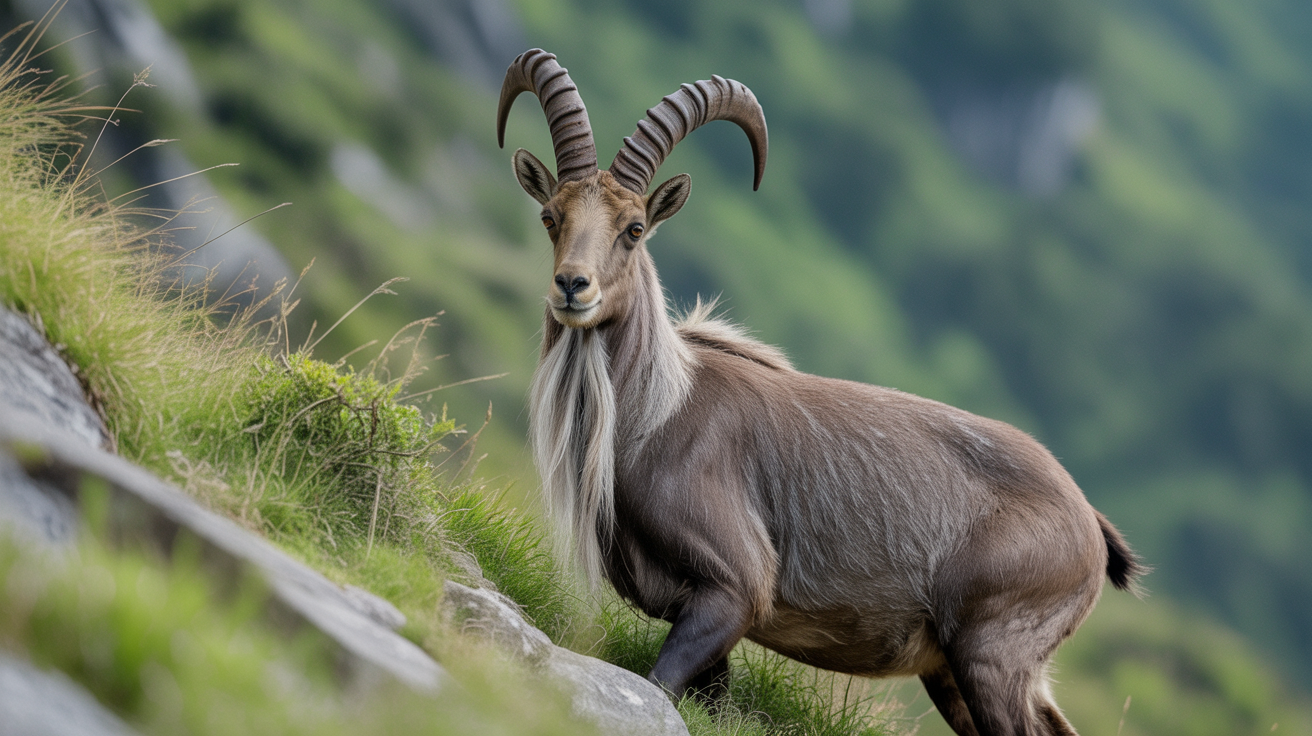
About the Nilgiri Tahr
The Nilgiri Tahr is a robust, sure-footed mountain goat endemic to the Western Ghats of southern India. Sporting a dense, dark brown to gray coat, males develop a distinctive silvery saddle on their backs as they mature. These herbivorous ungulates live in herds and are well-adapted to steep, rocky slopes at high elevations, using their agility to escape predators. Once widespread, their numbers have dwindled due to habitat loss and hunting, making them a symbol of conservation in the region.
Fascinating facts
Expert Climbers
Nilgiri Tahrs are highly agile and can deftly navigate the steep, rocky cliffs of the Western Ghats, making use of their strong hooves and muscular bodies.
Selective Grazers
Their diet consists mainly of grasses, shrubs, and herbs found in the montane grasslands, and they play an important role in shaping the vegetation of their habitat.
Social Structure
Nilgiri Tahrs live in herds that can number from a few individuals to over a dozen, with females and young forming larger groups while adult males are more solitary or form small bachelor groups.
Detailed description
The Nilgiri tahr (Nilgiritragus hylocrius) is a medium-sized, robust caprine with a stocky build, standing about 80–100 cm at the shoulder and weighing between 50–100 kg, with males being significantly larger than females. Males are distinguished by their coarse, dark brown to gray pelage and a prominent silvery-gray saddle patch on their backs, which becomes more pronounced with age, while females are lighter brown and lack the saddle. Both sexes possess short, backward-curving horns, with those of males reaching up to 40 cm in length and being thicker and more rugged than the slender, shorter horns of females. Adapted to steep, rocky montane grasslands, Nilgiri tahrs have specialized hooves with a rubbery core and hard rim, providing exceptional grip and agility on precipitous slopes. Their large eyes are positioned laterally, granting a wide field of vision to detect predators. Socially, they form herds typically ranging from 6 to 20 individuals, though aggregations of over 100 have been observed, especially during the breeding season. Herds are usually matriarchal, led by an older female, while mature males are more solitary or form small bachelor groups, joining female herds primarily during the rut. Nilgiri tahrs are diurnal, spending the cooler hours grazing and resting in the shade during midday heat. Their diet consists mainly of grasses, herbs, and shrubs endemic to the shola-grassland ecosystem, and they play a crucial role in maintaining the ecological balance of these habitats.
Did you know?
The Nilgiri Tahr is the state animal of the Indian state of Tamil Nadu.
Research & sources
Wikipedia summary
The Nilgiri tahr is an ungulate that is endemic to the Nilgiri Hills and the southern portion of the Western and Eastern Ghats in the states of Tamil Nadu and Kerala in southern India. It is the only species in the genus Nilgiritragus and is closely related to the sheep of the genus Ovis.
Behaviour & social structure
Nilgiri tahrs are primarily grazers, feeding on a variety of grasses (notably Chrysopogon, Themeda, and Ischaemum species), sedges, and occasionally browsing on shrubs and herbs. Foraging occurs mainly in the early morning and late afternoon, with midday spent ruminating in sheltered rocky outcrops. Social structure is complex and dynamic; females and juveniles form stable herds, while adult males are generally solitary except during the rut (breeding season), when they compete for access to females. Agonistic behaviors among males include horn clashing, lateral displays, and vocalizations. Communication within herds involves a range of vocalizations, body postures, and scent marking. Nilgiri tahrs are highly vigilant, relying on their keen eyesight and alarm calls to warn of predators such as leopards and wild dogs. They exhibit seasonal altitudinal movements, descending to lower elevations during the monsoon and ascending to higher ridges in the dry season.
Reproduction & life cycle
The breeding season (rut) typically occurs from June to August, coinciding with the southwest monsoon. During this period, dominant males join female herds and compete for mating opportunities through displays and physical contests. Females exhibit estrus for a short period, and after successful mating, gestation lasts approximately 180–190 days. Calving peaks between January and February, with females usually giving birth to a single kid, though twins are rare. Newborns are precocial, able to stand and follow their mothers within hours of birth. Maternal care is pronounced, with mothers nursing and protecting their young in secluded rocky areas for the first few weeks. Juveniles are weaned at around 6 months and gradually integrate into the herd. Sexual maturity is reached at about 2–3 years for females and 3–4 years for males.
Adaptations & survival
Nilgiri tahrs possess several adaptations for life in rugged montane environments. Their specialized hooves provide traction on wet, slippery rocks, while their muscular limbs enable powerful leaps and agile climbing. The dense, water-resistant coat offers insulation against cold, misty conditions prevalent at high elevations. Their cryptic coloration blends with the rocky grassland, aiding in camouflage. Behavioral adaptations include forming herds for increased vigilance and predator detection, as well as seasonal movements to optimize foraging and avoid adverse weather. Evolutionarily, Nilgiri tahrs are distinct from Himalayan tahrs, having diverged from a common ancestor with Ovis (sheep) approximately 2–5 million years ago, as supported by molecular phylogenetic studies.
Cultural significance
The Nilgiri tahr holds considerable cultural and symbolic value in the Western Ghats region. It is the state animal of Tamil Nadu and features prominently in local folklore and traditional art. Historically, the tahr was hunted by indigenous communities and colonial hunters, but today it is a flagship species for conservation in the Nilgiris and Kerala, representing the unique biodiversity of the shola-grassland ecosystem. The animal is also associated with several religious and cultural festivals, and its image is used in regional conservation campaigns to promote environmental awareness.
Recent research
Recent genetic studies have clarified the phylogenetic position of the Nilgiri tahr, confirming its divergence from Himalayan tahrs and close relationship to Ovis (sheep). Ongoing research focuses on population genetics, habitat use, and the impacts of climate change on distribution. Long-term monitoring in protected areas like Eravikulam National Park has provided valuable data on population dynamics, reproductive success, and the effects of invasive species. Conservation programs now emphasize habitat restoration, community engagement, and the use of camera traps and GPS telemetry to track movements and behavior. Notably, a 2022 study highlighted the importance of maintaining habitat corridors between isolated populations to ensure genetic diversity and long-term viability.
Sources
A new genus of Caprinae (Mammalia, Bovidae) from the Indian subcontinent
Ropiquet, A. & Hassanin, A. (2005)
scientificNilgiritragus hylocrius: The IUCN Red List of Threatened Species 2008
Alempath, M. & Rice, C.
conservationEcology and Conservation of the Nilgiri Tahr in the Western Ghats
Prabhakar, A. & Sukumar, R. (2014)
ecologicalVideos
Habitat
Montane grasslands and rocky slopes of the Western Ghats
 Various Continental Regions
Grassland
Open areas dominated by grasses rather than trees, supporting numerous herbivores and their predators.
 Elevated Terrain
Mountain
High-altitude environments with varying climates and specialized wildlife adapted to rugged terrain and thin air.
 Global
Forest
Wooded areas with significant tree cover and diverse plant and animal communities.
Conservation
The Nilgiri Tahr is currently classified as Endangered on the IUCN Red List.
Threats & challenges
The Nilgiri tahr faces significant threats from habitat loss and fragmentation due to expansion of tea, eucalyptus, and wattle plantations, as well as infrastructure development in the Western Ghats. Invasive plant species, such as Acacia and Lantana, degrade native grasslands, reducing food availability. Poaching for meat and horns, though reduced in recent decades, remains a concern. Human disturbance, including tourism and livestock grazing, leads to habitat degradation and disease transmission. Climate change poses emerging risks by altering rainfall patterns and vegetation structure. The global population is estimated at fewer than 3,000 mature individuals, with most subpopulations isolated and vulnerable to stochastic events. Conservation challenges include maintaining habitat connectivity, controlling invasive species, and mitigating human-wildlife conflict.
Taxonomy
Scientific name
Nilgiritragus hylocrius
- Kingdom
- Animalia
- Phylum
- Chordata
- Class
- Mammalia
- Order
- Artiodactyla
- Family
- Bovidae
- Genus
- Nilgiritragus
- Species
- hylocrius
Community notes
Share your observations about the Nilgiri Tahr.
No community notes yet. Be the first!
Discover more wildlife
More fascinating animals from the encyclopedia.