
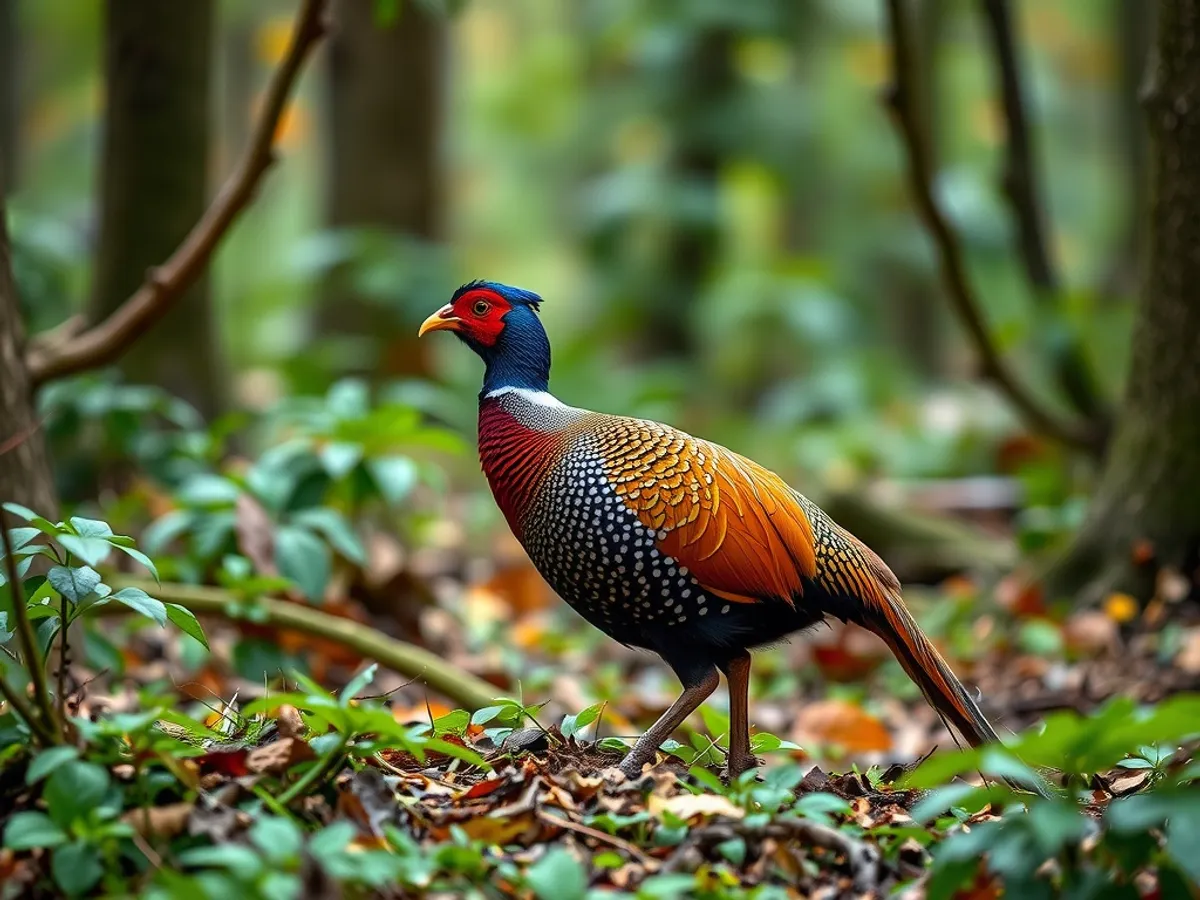
About the Reeves's Pheasant
Reeves's Pheasant is a striking and large game bird native to the temperate forests of central and eastern China. Males are renowned for their spectacular long tail feathers, which can reach lengths up to 2.4 meters, making them one of the longest-tailed pheasants in the world. Their plumage features a bold pattern of golden, white, and chestnut colors, while females are more subdued and cryptically colored. This species is shy and terrestrial, preferring dense undergrowth where it forages for seeds, leaves, and invertebrates. Due to habitat loss and hunting, their wild populations are declining, and they are considered Vulnerable.
Fascinating facts
Record-Breaking Tail
The male Reeves's Pheasant can grow tail feathers measuring up to 2.4 meters (nearly 8 feet), which is the longest tail-to-body ratio among all pheasant species.
Forest Dwellers
These birds inhabit dense, mixed forests where their cryptic coloring and secretive nature help them avoid predators.
Threatened by Habitat Loss
Reeves's Pheasant is listed as Vulnerable due to ongoing habitat destruction and illegal hunting for their striking feathers.
Detailed description
Reeves's Pheasant (Syrmaticus reevesii) is a large, sexually dimorphic pheasant species, with males reaching up to 210 cm in total length, primarily due to their exceptionally long tail feathers, which can measure up to 2.4 meters—among the longest of any bird species. The male's plumage is striking, featuring a white head with a black mask, golden-yellow body feathers edged with black, and chestnut underparts, while the wings are barred with white and black. Females are significantly smaller (up to 75 cm long) and display cryptic brown and buff coloration with subtle patterning, providing camouflage in dense undergrowth. The species has a robust, slightly curved bill adapted for foraging, strong legs for terrestrial locomotion, and short, rounded wings suited for brief, explosive flights. Reeves's Pheasants are primarily ground-dwelling, spending most of their time foraging on the forest floor. Their vocalizations include a series of sharp whistles and cackles, especially during the breeding season. They are generally solitary or found in small groups outside of the breeding season, exhibiting territoriality, particularly among males. The species is adapted to temperate broadleaf and mixed forests with dense shrub layers, which provide both food and cover from predators. Their large size and long tail feathers make them vulnerable to predation and human hunting, but these features also play a key role in sexual selection.
Did you know?
Reeves's Pheasant is the only member of its genus that has been successfully introduced and established small feral populations outside its native range, including in England and France.
Research & sources
Wikipedia summary
Reeves's pheasant is a large pheasant within the genus Syrmaticus. It is endemic to China. It is named after the British naturalist John Reeves, who first introduced live specimens to Europe in 1831.
Behaviour & social structure
Reeves's Pheasants are diurnal and predominantly terrestrial, foraging on the ground for a varied omnivorous diet that includes seeds, berries, leaves, shoots, roots, and a range of invertebrates such as insects, snails, and worms. Foraging is typically conducted in the early morning and late afternoon, with birds relying on their strong legs to scratch through leaf litter. Outside the breeding season, individuals are generally solitary or form loose associations, but during the breeding season, males become highly territorial and display aggressively to rivals. Males perform elaborate courtship displays, fanning their long tails and engaging in ritualized posturing to attract females. Reeves's Pheasants are shy and secretive, preferring to remain concealed in dense vegetation, and will run rather than fly when threatened, resorting to short, rapid flights only as a last resort. Roosting occurs in trees at night, providing safety from ground predators. Vocal communication includes territorial calls, alarm notes, and softer contact calls between mates or family groups.
Reproduction & life cycle
The breeding season for Reeves's Pheasant typically occurs from April to June. Males establish and defend territories, using their impressive tail feathers and vocalizations to attract females. The species is polygynous, with dominant males mating with multiple females. Females construct simple ground nests, often concealed under dense shrubs or grasses. Clutch size ranges from 7 to 14 eggs, with eggs being pale buff or cream-colored. Incubation is performed solely by the female and lasts approximately 24 to 25 days. Chicks are precocial, leaving the nest within hours of hatching and following the mother, who provides protection and guidance but does not feed the chicks directly. Fledging occurs at around 10 to 14 days, but the young remain with the female for several weeks until they are fully independent.
Adaptations & survival
Reeves's Pheasant exhibits several notable adaptations for survival in its native habitat. The cryptic coloration of females provides effective camouflage against predators, especially during nesting. The male's extravagant tail feathers, though a liability in terms of mobility and predation risk, are a product of sexual selection, signaling fitness to potential mates. Their strong legs and feet are well-adapted for scratching and digging in the forest floor for food. The species' preference for dense undergrowth offers both food resources and protection from predators. Behavioral adaptations include secretive habits, rapid terrestrial escape responses, and tree roosting at night. Their omnivorous diet allows them to exploit a wide range of food sources, contributing to their ecological flexibility.
Cultural significance
Reeves's Pheasant has been admired in China for centuries, often symbolizing beauty, nobility, and longevity in traditional art and folklore. The species' spectacular tail feathers have historically been used in ceremonial headdresses and decorative arts. In the West, Reeves's Pheasant was introduced to aviculture in the 19th century and remains popular in ornamental bird collections due to its striking appearance. The bird is sometimes featured in Chinese poetry and painting, representing the elegance of the natural world. However, there are no significant religious or mythological associations compared to some other Asian pheasant species.
Recent research
Recent research on Reeves's Pheasant has focused on population genetics, habitat requirements, and the impacts of habitat fragmentation. Studies using molecular markers have revealed low genetic diversity in some isolated populations, raising concerns about long-term viability. Radio telemetry and camera trap studies have improved understanding of their habitat use, home range sizes, and responses to human disturbance. Conservation biologists are investigating the effectiveness of protected areas and the potential for habitat corridors to connect fragmented populations. Captive breeding and reintroduction programs have been established in China, with ongoing monitoring of released individuals. There is also interest in the evolutionary basis of the male's extreme tail length and its role in sexual selection.
Sources
Handbook of the Birds of the World, Vol. 2: New World Vultures to Guineafowl
del Hoyo, J., Elliott, A., & Sargatal, J. (Eds.) (1994)
scientificSyrmaticus reevesii: The IUCN Red List of Threatened Species 2018
BirdLife International (2018)
conservationVideos
Habitat
Temperate evergreen and deciduous forests with dense undergrowth


Conservation
The Reeves's Pheasant is currently classified as Vulnerable on the IUCN Red List.
Threats & challenges
The primary threats to Reeves's Pheasant are habitat loss and fragmentation due to logging, agricultural expansion, and infrastructure development in central and eastern China. Illegal hunting for meat, feathers, and the live bird trade has also contributed to population declines. The species' conspicuous plumage and long tail feathers make it a target for hunters. Small, isolated populations are vulnerable to genetic bottlenecks and reduced reproductive success. Although the species is listed as Vulnerable by the IUCN and included in CITES Appendix II, enforcement of protective regulations is inconsistent. Recent estimates suggest that fewer than 10,000 mature individuals remain in the wild, with a continuing downward trend. Conservation efforts include habitat protection, captive breeding, and reintroduction programs, but challenges remain due to ongoing habitat degradation and poaching.
Taxonomy
Scientific name
Syrmaticus reevesii
- Kingdom
- Animalia
- Phylum
- Chordata
- Class
- Aves
- Order
- Galliformes
- Family
- Phasianidae
- Genus
- Syrmaticus
- Species
- reevesii
Where to see a reeves's pheasant
1 zoo and aquarium in 1 country are recorded as keeping this species.
Community notes
Share your observations about the Reeves's Pheasant.
No community notes yet. Be the first!
Discover more wildlife
More fascinating animals from the encyclopedia.