
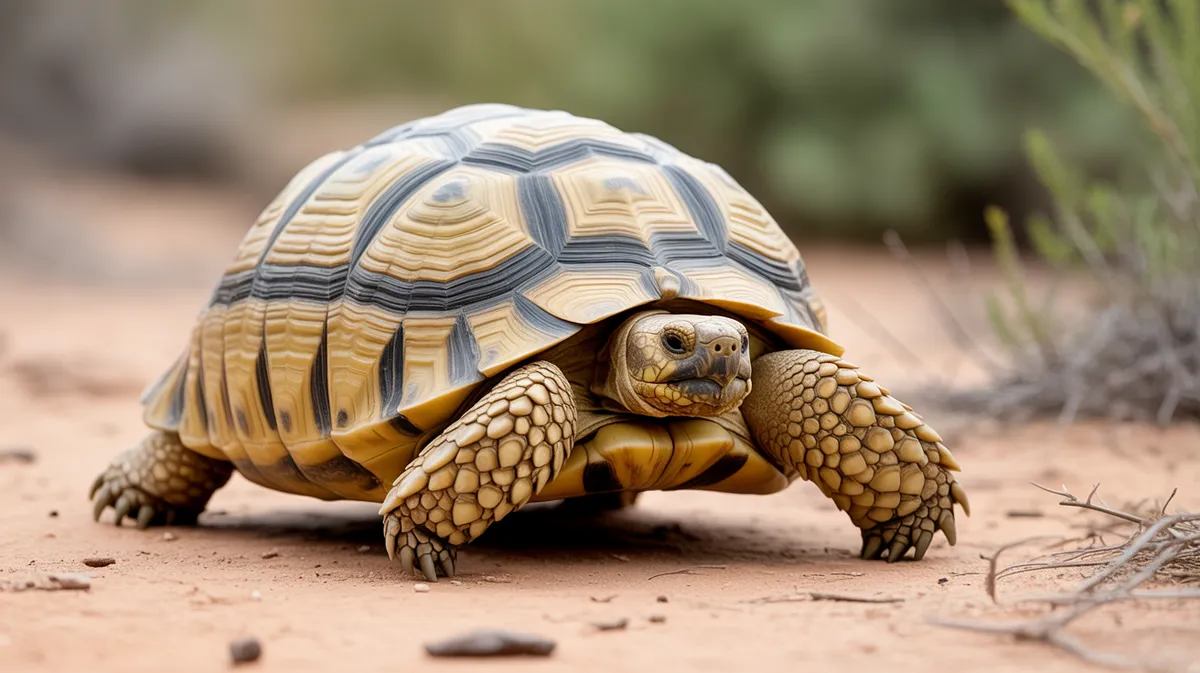
About the Russian Tortoise
The Russian Tortoise is a small, hardy tortoise species native to arid regions of Central Asia, including parts of Russia, Uzbekistan, and Afghanistan. It is easily recognized by its domed, olive to tan shell and four toes on each front foot, distinguishing it from other tortoises. Adapted to extreme climates, the Russian Tortoise can survive both hot summers and cold winters by burrowing underground. They are primarily herbivorous, feeding on a variety of grasses and leafy plants. Popular in the pet trade, these tortoises are known for their gentle disposition and relatively manageable size.
Fascinating facts
Unique Toes
The Russian Tortoise has four toes on each front foot, unlike most tortoises which have five.
Extreme Survivors
They can tolerate a wide range of temperatures and can survive harsh desert climates by burrowing underground.
Plant Eaters
Their diet consists almost entirely of leafy greens, weeds, and flowers, making them strict herbivores.
Detailed description
The Russian Tortoise (Testudo horsfieldii) is a small, robust terrestrial tortoise, typically measuring 13–25 cm (5–10 inches) in carapace length, with females generally larger than males. Its domed shell is olive, tan, or yellowish-brown, often with darker patches, and features a flattened, nearly rectangular shape. The plastron is usually dark brown or black, sometimes with lighter markings. A unique diagnostic feature is the presence of four toes on each foot, unlike most other tortoise species, which have five. The head is blunt with a strong, beak-like mouth adapted for grazing tough vegetation. Russian Tortoises are highly adapted to arid and semi-arid environments, possessing thick, scaly skin that minimizes water loss and powerful limbs for digging extensive burrows, sometimes exceeding 2 meters in length. They are primarily crepuscular, being most active during the cooler parts of the day, and undergo periods of aestivation in extreme summer heat and hibernation during cold winters. Socially, they are mostly solitary but may aggregate in favorable microhabitats, especially during the breeding season. Their longevity is notable, with lifespans commonly exceeding 40 years in the wild and potentially over 50 years in captivity. The species displays marked sexual dimorphism, with males having longer tails and a more concave plastron.
Did you know?
Despite their small size, Russian Tortoises can survive long periods without water by extracting moisture from their food and minimizing water loss.
Research & sources
Wikipedia summary
The Russian tortoise, also commonly known as the Afghan tortoise, the Central Asian tortoise, the four-clawed tortoise, the four-toed tortoise, Horsfield's tortoise, the Russian steppe tortoise, the Soviet Tortoise, and the steppe tortoise, is a threatened species of tortoise in the family Testudinidae. The species is endemic to Central Asia from the Caspian Sea south through Iran, Pakistan and Afghanistan, and east across Kazakhstan to Xinjiang, China. Human activities in its native habitat contribute to its threatened status.
Behaviour & social structure
Russian Tortoises are diurnal but shift activity to early morning and late afternoon to avoid temperature extremes. They are primarily grazers, feeding on a wide variety of fibrous grasses, weeds, and leafy plants, and will occasionally consume flowers and fruits when available. Foraging is typically solitary, and individuals use their keen sense of smell to locate food. During the hottest and coldest periods, they retreat to self-dug burrows, which provide thermal regulation and protection from predators. Burrowing is a significant behavioral adaptation, and individuals may spend up to 9 months per year underground. Aggressive interactions are rare but can occur between males during the breeding season, involving head bobbing, biting, and ramming. Communication is largely visual and tactile, with limited vocalization. Home ranges are relatively small, and tortoises exhibit strong site fidelity, returning to the same burrows year after year.
Reproduction & life cycle
Breeding occurs in spring and early summer, shortly after emergence from hibernation. Males court females with a series of circling, biting, and head bobbing displays. Copulation is often accompanied by vocalizations from the male. Females lay 1–3 clutches per season, each containing 2–6 eggs, in carefully excavated nests within sandy or loamy soil. Incubation lasts 60–80 days, depending on environmental conditions, with temperature influencing the sex ratio of hatchlings (temperature-dependent sex determination). There is no parental care after egg-laying; hatchlings are fully independent upon emergence. Sexual maturity is reached at 10–15 years, depending on growth rates and environmental factors. In the wild, reproductive success is highly variable and influenced by predation, climate, and habitat quality.
Adaptations & survival
Russian Tortoises exhibit several key adaptations for survival in harsh steppe and desert environments. Their compact, domed shell provides protection from predators and prevents water loss. The four-toed, strong-clawed limbs are specialized for digging deep burrows, which buffer against temperature extremes and desiccation. Physiologically, they can tolerate significant dehydration and have efficient kidneys that conserve water. Behaviorally, they adjust activity patterns seasonally, entering hibernation or aestivation as needed. Their herbivorous diet is adapted to sparse, fibrous vegetation, and they can extract moisture from food. The species also exhibits a high tolerance for temperature fluctuations, with the ability to survive both freezing winters and scorching summers.
Cultural significance
The Russian Tortoise holds moderate cultural significance in Central Asia, where it is sometimes featured in folklore as a symbol of longevity, resilience, and wisdom. In some regions, tortoises have been kept as pets for centuries, and their shells occasionally used in traditional crafts. The species gained international attention as one of the first animals to orbit the Moon aboard the Soviet Zond 5 mission in 1968, symbolizing endurance and adaptability. However, there is little evidence of widespread ritual or medicinal use.
Recent research
Recent research has focused on the genetic diversity and taxonomy of Testudo horsfieldii, with molecular studies revealing significant population structure and suggesting the existence of several subspecies. Ongoing ecological studies are investigating the impacts of climate change on hibernation patterns and reproductive success. Conservation research is assessing the effectiveness of trade regulations and captive breeding programs. Notably, satellite telemetry has been used to track movement patterns and habitat use, providing valuable data for habitat management. There is also increasing interest in the species' microbiome and its role in digestion and health.
Videos
Habitat
Desert and semi-desert environments with sandy or loamy soils
 Arid Regions
Desert
Arid lands with minimal rainfall, extreme temperatures, and specialized wildlife adapted to harsh conditions.
 Various Continental Regions
Grassland
Open areas dominated by grasses rather than trees, supporting numerous herbivores and their predators.
 Elevated Terrain
Mountain
High-altitude environments with varying climates and specialized wildlife adapted to rugged terrain and thin air.
Conservation
The Russian Tortoise is currently classified as Vulnerable on the IUCN Red List.
Threats & challenges
The Russian Tortoise is classified as Vulnerable by the IUCN due to ongoing population declines. Major threats include habitat destruction and fragmentation from agriculture, overgrazing by livestock, and infrastructure development. Illegal collection for the international pet trade is a significant pressure, with thousands exported annually despite regulations. Climate change poses additional risks by altering habitat suitability and disrupting hibernation cycles. Invasive plant species and pesticide use further degrade habitat quality. Population trends are negative in many parts of the range, with local extirpations reported. Conservation challenges include weak enforcement of trade regulations, lack of protected areas, and limited public awareness in range countries.
Taxonomy
Scientific name
Testudo horsfieldii
- Kingdom
- Animalia
- Phylum
- Chordata
- Class
- Reptilia
- Order
- Testudines
- Family
- Testudinidae
- Genus
- Testudo
- Species
- horsfieldii
Where to see a russian tortoise
1 zoo and aquarium in 1 country are recorded as keeping this species.

Community notes
Share your observations about the Russian Tortoise.
No community notes yet. Be the first!
Discover more wildlife
More fascinating animals from the encyclopedia.