
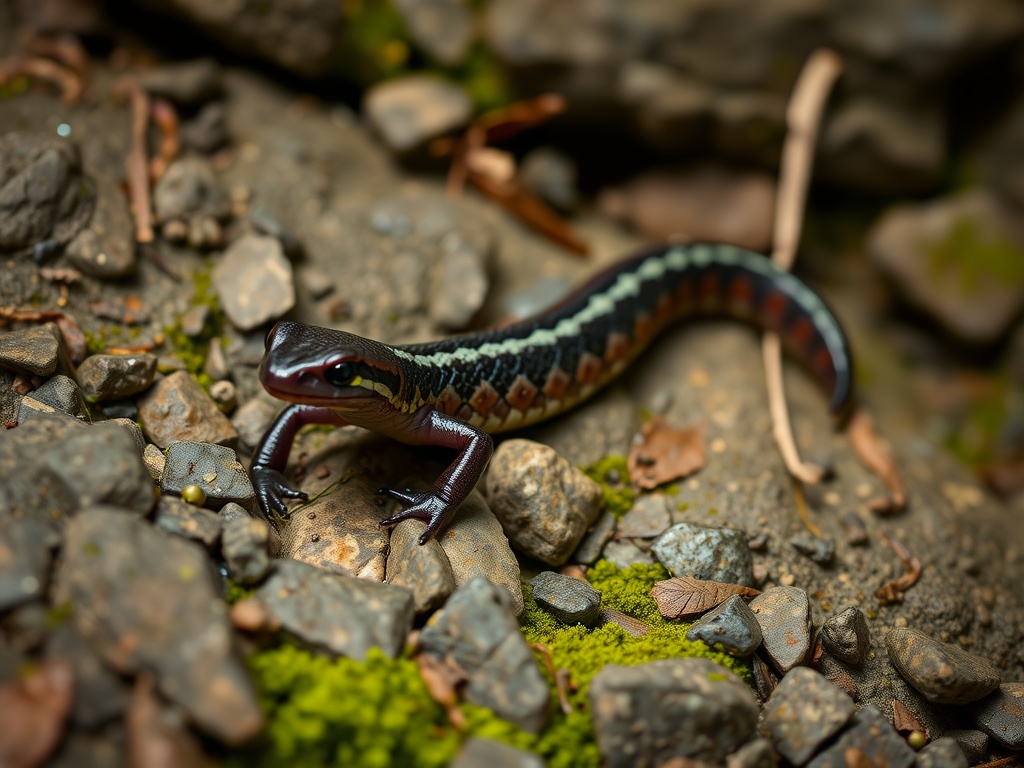
About the Shenandoah Salamander
The Shenandoah Salamander is a small, slender amphibian distinguished by its dark body and a distinctive, narrow stripe running down its back, which may be red, orange, or yellow. This species is endemic to just three isolated mountain peaks within Shenandoah National Park in Virginia, making it one of the rarest salamanders in North America. Adapted to cool, moist talus slopes high in the Blue Ridge Mountains, it is highly sensitive to habitat changes and competition from other salamander species. The Shenandoah Salamander is lungless, respiring entirely through its skin and mouth lining, a trait common among its family.
Fascinating facts
Tiny Range
The Shenandoah Salamander lives on just three mountain ridges within Shenandoah National Park, making its range one of the smallest for any vertebrate in North America.
Breathes Through Skin
This salamander has no lungs and relies entirely on cutaneous (skin) respiration, requiring moist environments to survive.
No Aquatic Larvae
Unlike many amphibians, the Shenandoah Salamander skips the aquatic larval stage and its eggs hatch directly into miniature adults on land.
Detailed description
The Shenandoah Salamander (Plethodon shenandoah) is a small, slender, lungless salamander, typically measuring 7–10 cm (2.8–3.9 in) in total length. Its dorsal surface is marked by a narrow, often irregular stripe that varies in color from red to orange or yellow, bordered by dark brown or black sides flecked with fine white or silver spots. The ventral side is generally dark gray to black. The species lacks lungs, relying entirely on cutaneous (skin) and buccopharyngeal (mouth lining) respiration, which necessitates moist microhabitats. The limbs are relatively short, with four toes on the forelimbs and five on the hindlimbs, typical of plethodontid salamanders. The head is broad with prominent eyes, adapted for nocturnal activity. Shenandoah Salamanders are secretive and primarily terrestrial, spending most of their lives hidden beneath rocks, logs, or within deep leaf litter on north- and northwest-facing talus slopes. Their skin is smooth and sensitive to desiccation, making them highly dependent on stable, humid microclimates found at high elevations (900–1,200 m). Unlike many amphibians, they do not require standing water for any life stage. Their isolated populations on three mountain peaks—Hawksbill, Stony Man, and Pinnacle—are genetically distinct and have very limited dispersal ability.
Did you know?
The entire global population of the Shenandoah Salamander is estimated to occupy less than 7 square kilometers!
Research & sources
Wikipedia summary
The Shenandoah salamander is a small, terrestrial salamander found exclusively in Shenandoah National Park in Virginia. The Shenandoah salamander inhabits a very small range of land on just three mountain peaks. Due to the small habitat range, interspecies competition, and climate change, the population of the Shenandoah salamander is vulnerable to extinction. Mitigating human effects on the habitat of the species will be essential in attempting to preserve and grow the population.
Behaviour & social structure
Shenandoah Salamanders are nocturnal and crepuscular, emerging from their refuges at night or during periods of high humidity to forage. They are sit-and-wait predators, feeding on small invertebrates such as springtails, mites, ants, and beetle larvae. Foraging is mostly solitary, and individuals exhibit territorial behavior, especially during the breeding season, using pheromonal cues to mark and defend microhabitats. Aggressive encounters with conspecifics and the more common Eastern Red-backed Salamander (Plethodon cinereus) are frequent, with the latter often outcompeting Shenandoah Salamanders for optimal moist habitats. During dry or cold conditions, they retreat deep into rock crevices or under thick leaf litter to avoid desiccation and temperature extremes. Activity peaks in spring and fall, with reduced surface activity during hot summer months and winter dormancy.
Reproduction & life cycle
Breeding in Plethodon shenandoah is terrestrial and occurs in late spring to early summer, though precise timing may vary with microclimate. Courtship involves a complex sequence of tactile and chemical cues, including the male rubbing his chin on the female’s head and body. Males deposit a spermatophore (a packet of sperm) on the substrate, which the female picks up with her cloaca. Females lay small clutches of 6–12 eggs in moist, protected crevices beneath rocks or logs, typically in late summer. The eggs are guarded by the female until hatching, which occurs after a direct development period of 6–9 weeks—there is no aquatic larval stage. Hatchlings emerge as miniature adults and are independent from birth. Females likely breed biennially due to the energetic costs of egg production and parental care.
Adaptations & survival
The Shenandoah Salamander exhibits several adaptations for survival in its harsh, restricted environment. Its lungless physiology allows efficient gas exchange in cool, moist microhabitats but makes it highly vulnerable to dehydration. The species’ cryptic coloration and secretive habits reduce predation risk. Direct development eliminates the need for aquatic habitats, a crucial adaptation for life on rocky talus slopes. Behavioral adaptations include nocturnal activity patterns to minimize water loss and aggressive territoriality to secure limited moist refuges. The ability to exploit narrow, rocky crevices provides protection from both predators and environmental extremes. Genetic studies suggest local adaptation to the unique microclimates of each mountain peak.
Cultural significance
Due to its cryptic lifestyle and limited range, the Shenandoah Salamander has little direct cultural significance or presence in folklore. However, it has become a symbol of biodiversity and conservation within Shenandoah National Park and is featured in educational programs highlighting the importance of endemic species and habitat protection. Its status as a federally endangered species under the U.S. Endangered Species Act has made it a flagship for conservation efforts in the Appalachian region.
Recent research
Recent research has focused on the species’ genetic diversity, population structure, and competitive interactions with Plethodon cinereus. Studies using environmental DNA (eDNA) and mark-recapture methods have improved understanding of population sizes and movement patterns. Climate modeling predicts significant habitat loss under future warming scenarios, prompting research into potential assisted migration or habitat management strategies. Ongoing studies are examining the microclimatic requirements of the species and the effects of forest canopy changes on talus slope humidity. Conservation genetics research has confirmed low gene flow between the three populations, underscoring the need for site-specific management.
Sources
A new salamander of the genus Plethodon from Virginia
Highton, R. & Worthington, R.D. (1967)
scientificPlethodon shenandoah: The IUCN Red List of Threatened Species 2023
IUCN SSC Amphibian Specialist Group
conservationVideos
Habitat
Moist, rocky talus slopes in high-elevation mountain forests


Conservation
The Shenandoah Salamander is currently classified as Endangered on the IUCN Red List.
Threats & challenges
The primary threats to the Shenandoah Salamander are habitat restriction, interspecific competition, and climate change. Its entire global range is less than 7 km², confined to three isolated peaks, making populations highly vulnerable to stochastic events. The invasive encroachment of the Eastern Red-backed Salamander intensifies competition for moist microhabitats, often displacing Shenandoah Salamanders to drier, suboptimal areas. Climate change poses a severe risk by altering temperature and humidity regimes, potentially reducing suitable habitat and increasing desiccation risk. Human impacts, such as trail construction, trampling, and air pollution, further degrade habitat quality. Population trends are difficult to assess due to the species’ cryptic nature, but ongoing monitoring suggests numbers are stable but precariously low, with no evidence of recolonization or expansion beyond current sites.
Taxonomy
Scientific name
Plethodon shenandoah
- Kingdom
- Animalia
- Phylum
- Chordata
- Class
- Amphibia
- Order
- Caudata
- Family
- Plethodontidae
- Genus
- Plethodon
- Species
- shenandoah
Community notes
Share your observations about the Shenandoah Salamander.
No community notes yet. Be the first!
Discover more wildlife
More fascinating animals from the encyclopedia.