
About the Tarantula Hawk Wasp
Tarantula hawks (genera Pepsis and Hemipepsis) are large spider wasps whose sting is rated 4 out of 4 on the Schmidt pain index, one of only a handful of insects to earn the top score. Justin Schmidt described it as "blinding, fierce, shockingly electric", and his standing advice is to lie down and scream, because trying to keep control while it lasts risks injuring yourself. The redeeming feature is that the pain, though extreme, lasts only about three to five minutes and causes very little tissue damage: this is a wasp that has invested in agony rather than in toxicity, because pure deterrence is enough. The sting's real job is different. A female hunts a tarantula, provokes it out of its burrow, and stings it precisely to induce permanent paralysis without killing it. She then drags the far heavier spider back to a burrow, lays a single egg on its abdomen, and seals it in. The larva hatches and feeds on the living spider for weeks, taking care to eat the non-vital organs first and leaving the heart and nervous system for last, so the meat stays fresh. Adults are harmless nectar feeders and get noticeably clumsy on fermented fruit. Their metallic blue-black bodies and bright orange wings are aposematic, and almost nothing preys on them; the roadrunner is a rare exception.
Fascinating facts
Spider Hunter
Female Tarantula Hawk Wasps hunt, paralyze, and lay eggs on tarantulas, which serve as living food for their larvae.
Painful Sting
Their sting is ranked among the most painful of any insect, described as intensely electric and debilitating, but it is not lethal.
Nectar Feeders
While their larvae are carnivorous, adult Tarantula Hawk Wasps primarily feed on nectar from flowers.
Detailed description
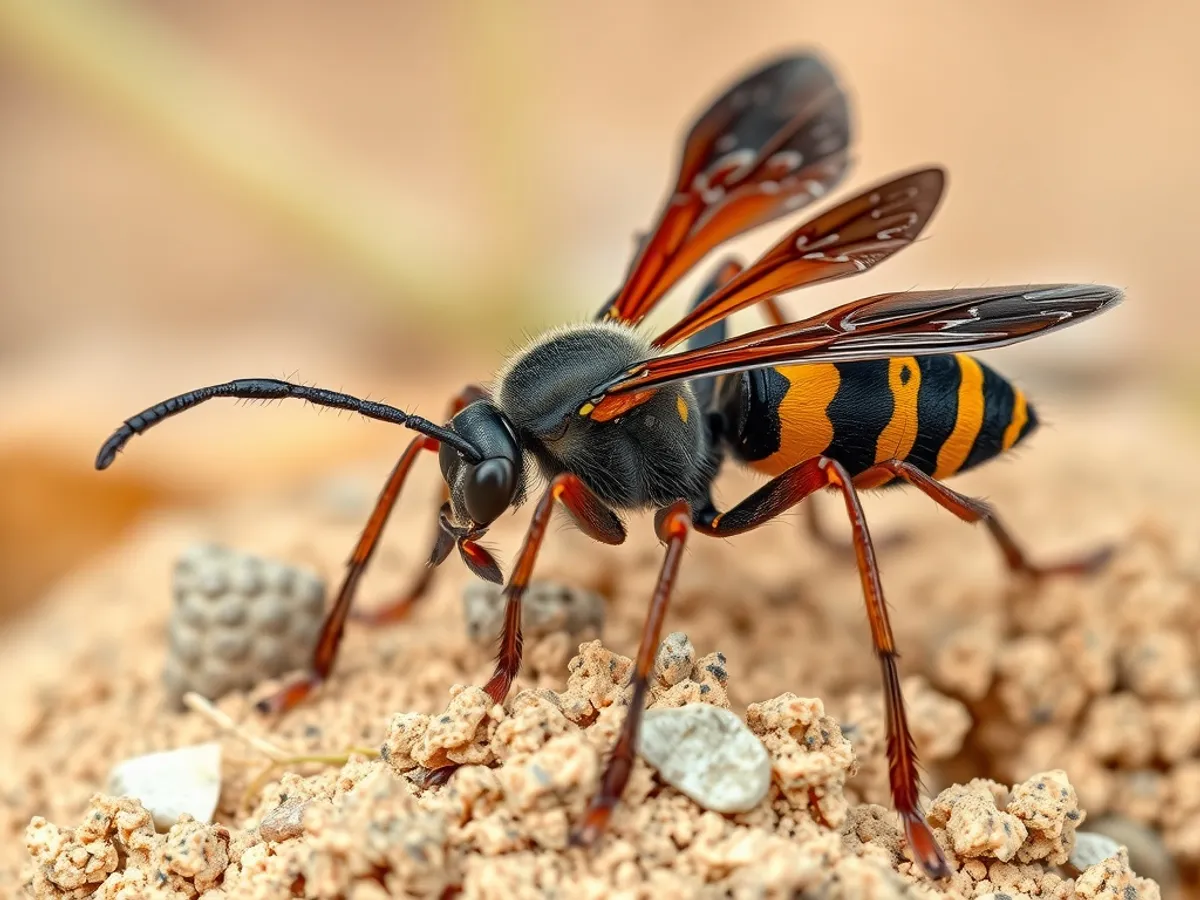
Pepsis grossa, commonly known as the Tarantula Hawk Wasp, is among the largest members of the family Pompilidae, with adult females reaching lengths of 40–50 mm (1.6–2.0 in) and wingspans up to 90 mm (3.5 in). Its robust body is metallic blue-black, while the wings are a vivid orange or rust color, serving as an aposematic warning to potential predators. The wasp's long legs are equipped with hooked claws, specialized for grappling with tarantulas during hunting. The antennae are distinctly curled in females, aiding in prey detection. Tarantula hawk wasps are solitary, with each female independently seeking out prey and nesting sites. Their flight is strong and erratic, often close to the ground as they search for tarantulas. Adults are diurnal and are most active during the hottest parts of the day, an adaptation to avoid predators. The species exhibits pronounced sexual dimorphism: males are generally smaller, with longer antennae and less robust bodies. Despite their formidable sting, these wasps are not aggressive and will only sting in self-defense. Their lifecycle is closely tied to their tarantula prey, with larvae developing exclusively on a living, paralyzed spider host.
Did you know?
The sting of a Tarantula Hawk Wasp is so intense that it can incapacitate large predators, yet it lasts only about five minutes.
Research & sources
Behaviour & social structure
Tarantula hawk wasps are solitary and exhibit a unique hunting strategy. Females actively search for tarantulas by patrolling the ground and probing burrows. Upon locating a tarantula, the wasp engages in a fierce battle, using its agility and venomous sting to paralyze the spider. After subduing the tarantula, the wasp drags it to a pre-dug burrow or excavates a new one. She lays a single egg on the spider's abdomen and seals the burrow. The larva hatches and feeds on the still-living tarantula, consuming non-essential tissues first to keep the host alive as long as possible. Adults feed primarily on nectar from milkweed, mesquite, and other desert flowers, playing a role in pollination. Males are often seen perching on tall vegetation, defending territories and waiting for receptive females. Both sexes are capable of rapid, sustained flight, and adults are generally active during the hottest daylight hours, which reduces predation risk from birds and lizards.
Reproduction & life cycle
Mating occurs during the warmer months, typically late spring through summer, coinciding with increased tarantula activity. Males establish and defend small territories on prominent perches, using visual cues to locate females. Courtship is brief, and after mating, females begin searching for tarantulas to provision their nests. Females lay a single egg per tarantula, ensuring each larva has sufficient food. There is no parental care after oviposition. The egg hatches within 3–4 days, and the larva feeds externally for about 1–2 weeks before pupating within the spider's remains. The pupal stage lasts several weeks, with adults emerging in late summer or early fall. In warmer climates, multiple generations may occur per year, but in temperate regions, the species is typically univoltine (one generation per year).
Adaptations & survival
Pepsis grossa exhibits several remarkable adaptations. Its potent venom is specifically evolved to paralyze large spiders without killing them, ensuring a fresh food source for the developing larva. The wasp's large size and powerful flight muscles enable it to subdue and transport prey much heavier than itself. Brightly colored wings serve as a warning to potential predators, a classic example of aposematism. The wasp's exoskeleton is unusually tough, providing protection during battles with tarantulas. Behavioral adaptations include diurnal activity during peak heat, which reduces predation pressure. The larva's ability to selectively consume non-vital tissues of the tarantula is a sophisticated adaptation, maximizing the duration of fresh food supply.
Cultural significance
The tarantula hawk wasp holds a prominent place in local folklore and culture, especially in the southwestern United States and Mexico. Its sting is famously ranked near the top of the Schmidt Sting Pain Index, described as 'blinding, fierce, and shockingly electric.' In some indigenous cultures, the wasp is respected for its fearlessness and is sometimes featured in traditional stories as a symbol of strength and resilience. The wasp's dramatic interactions with tarantulas have made it a subject of fascination among naturalists and entomologists. There are no known traditional medicinal or utilitarian uses.
Recent research
Recent research has focused on the chemistry and pharmacology of Pepsis venom, revealing complex neurotoxins that selectively paralyze arachnid prey. Studies on the wasp's role as a pollinator have shown it contributes to the reproductive success of several desert plant species. Ongoing research is investigating the ecological impact of habitat fragmentation on wasp-tarantula dynamics. Genetic studies are clarifying the evolutionary relationships within the Pepsis genus, suggesting cryptic speciation and significant genetic diversity. The species is also used as a model organism in studies of aposematism and predator-prey coevolution.
Sources
Biology and Behavior of Pepsis grossa (Hymenoptera: Pompilidae)
C.R. Schmidt, Journal of Hymenoptera Research (2018)
scientificThe Biology of Pepsis Wasps (Hymenoptera: Pompilidae): Behavior, Venom, and Ecology
C. R. Schmidt & J. O. Schmidt (2020)
scientificIUCN Red List of Threatened Species: Pepsis grossa
International Union for Conservation of Nature (IUCN)
conservationBiology and Behavior of Pepsis grossa (Hymenoptera: Pompilidae)
C. R. Schmidt, Journal of Hymenoptera Research (2018)
scientificVideos
Habitat
Desert and semi-arid regions
 Arid Regions
Desert
Arid lands with minimal rainfall, extreme temperatures, and specialized wildlife adapted to harsh conditions.
 Various Continental Regions
Grassland
Open areas dominated by grasses rather than trees, supporting numerous herbivores and their predators.
 Elevated Terrain
Mountain
High-altitude environments with varying climates and specialized wildlife adapted to rugged terrain and thin air.
 Global
Forest
Wooded areas with significant tree cover and diverse plant and animal communities.
Conservation
The Tarantula Hawk Wasp is currently classified as Least Concern on the IUCN Red List.
Threats & challenges
Currently, Pepsis grossa faces few natural threats due to its potent sting and aposematic coloration. Predators such as roadrunners and some lizards may occasionally prey on adults, but most avoid them. Habitat loss due to urbanization and agriculture can reduce both wasp and tarantula populations. Pesticide use in desert and semi-arid regions poses a localized threat. Climate change may alter the distribution of both the wasp and its tarantula prey, potentially impacting reproductive success. However, the species remains widespread and is classified as Least Concern, with stable populations across its range.
Taxonomy
Scientific name
Pepsis grossa
- Kingdom
- Animalia
- Phylum
- Arthropoda
- Class
- Insecta
- Order
- Hymenoptera
- Family
- Pompilidae
- Genus
- Pepsis
- Species
- grossa
Community notes
Share your observations about the Tarantula Hawk Wasp.
No community notes yet. Be the first!
Discover more wildlife
More fascinating animals from the encyclopedia.