
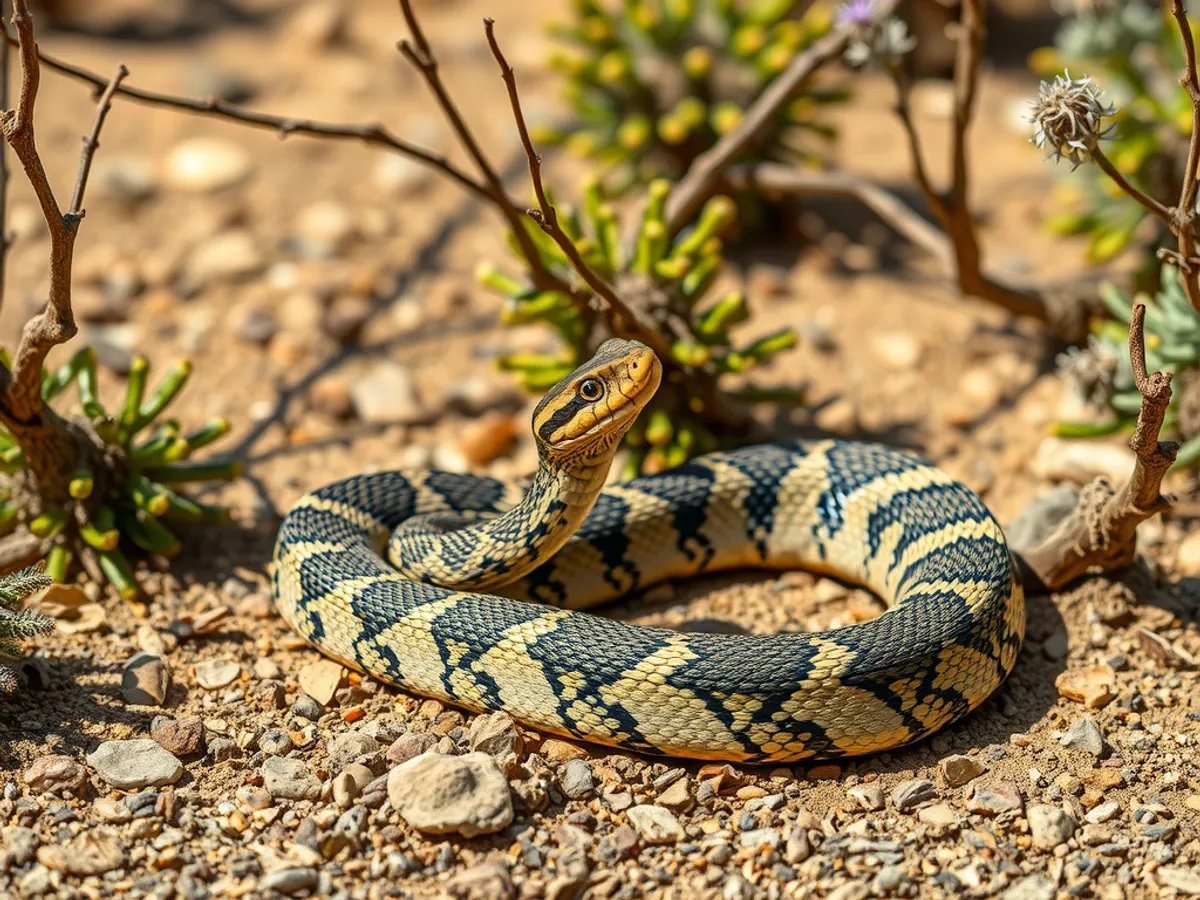
About the Western Diamondback Rattlesnake
The western diamondback (Crotalus atrox) is the rattlesnake responsible for the largest share of serious snakebites in the United States, not because its venom is exceptional but because it is abundant, large, and unusually willing to stand its ground: where many rattlesnakes flee, an atrox will hold position, raise the front third of its body into a coil and rattle furiously. The rattle itself is widely misunderstood. It is made of interlocking keratin segments, and a new one is added at every shed, but a snake sheds two to four times a year depending on how well it has fed, and the end segments break off routinely, so you cannot count the rings to get its age. The muscles that shake it are among the fastest in any vertebrate, contracting 50 to 90 times a second and able to sustain that for hours without fatigue. The pit organs between eye and nostril are extraordinarily sensitive infrared detectors, resolving temperature differences of a few thousandths of a degree, and the snake can build a crude thermal image of a mouse in complete darkness. The black-and-white banded tail gives it the name coon tail. Its worst problem is the rattlesnake roundup, an event held in Texas and elsewhere in which snakes are flushed from dens with gasoline, a practice that also kills every other animal sheltering in the burrow.
Fascinating facts
Venomous Defense
The Western Diamondback injects hemotoxic venom that causes tissue damage and disrupts blood clotting in its prey.
Rattling Warning
It shakes its rattle as a warning signal to potential threats, producing a distinctive buzzing sound.
Desert Dweller
This rattlesnake thrives in arid environments, including deserts, grasslands, and rocky hillsides.
Detailed description
The Western Diamondback Rattlesnake (Crotalus atrox) is a robust pit viper, typically ranging from 90 to 150 cm (3–5 ft) in length, with some individuals exceeding 200 cm (6.5 ft). Its most distinctive features include a series of dark, diamond-shaped dorsal blotches edged in lighter scales, and a prominent rattle composed of interlocking keratin segments at the tail tip. The head is broad and triangular, with heat-sensitive loreal pits located between the eyes and nostrils, enabling precise detection of warm-blooded prey. The dorsal coloration varies from gray to brown, providing effective camouflage in arid habitats. The ventral side is generally pale, and the tail displays alternating black and white bands just before the rattle. Crotalus atrox is equipped with long, hinged fangs that deliver hemotoxic venom, which immobilizes prey and initiates digestion. This species is primarily terrestrial and exhibits a heavy-bodied, sluggish appearance, though it is capable of rapid strikes. Its sensory adaptations, including keen vision and chemoreception via the Jacobson's organ, facilitate nocturnal and crepuscular activity. The Western Diamondback is solitary outside of the breeding season, and individuals may occupy overlapping home ranges but rarely interact except during mating or hibernation.
Did you know?
The Western Diamondback is responsible for the majority of snakebite incidents in the United States, but fatalities are rare due to prompt medical treatment.
Research & sources
Wikipedia summary
The western diamondback rattlesnake or Texas diamond-back is a rattlesnake species and member of the viper family, found in the southwestern United States and Mexico. Like all other rattlesnakes and all other vipers, it is venomous. It is likely responsible for the majority of snakebite fatalities in northern Mexico and the greatest number of snakebites in the U.S. No subspecies are currently recognized.
Behaviour & social structure
Western Diamondbacks are primarily ambush predators, relying on their cryptic coloration and stillness to surprise prey such as rodents, rabbits, birds, and occasionally lizards. They use their heat-sensing pits to locate endothermic animals, especially at night. When threatened, they exhibit a well-known defensive display: coiling, elevating the anterior body, and rapidly vibrating the rattle to produce a warning sound. If the threat persists, they may strike, delivering venom through their hollow fangs. These snakes are generally solitary, except during the mating season or when denning communally in winter. They are most active from dusk to dawn (crepuscular/nocturnal), especially in hot months, and may bask during cooler periods. During extreme heat or cold, they seek shelter in burrows, rock crevices, or under dense vegetation. Western Diamondbacks are known to return to the same hibernacula annually, sometimes sharing these sites with other snake species.
Reproduction & life cycle
Crotalus atrox is ovoviviparous, meaning females give birth to live young rather than laying eggs. Mating typically occurs in the spring (March–May) or sometimes in the fall, with males engaging in ritualized combat for access to females. After mating, females undergo a gestation period of approximately 5–6 months. Litters of 10–20 neonates (range: 4–25) are born in late summer or early fall. The young are fully independent at birth, equipped with functional venom and a pre-button (first rattle segment). There is no parental care post-birth. Sexual maturity is reached at 3–4 years of age, and females may not reproduce every year, depending on environmental conditions and body condition.
Adaptations & survival
The Western Diamondback exhibits several key adaptations for survival in arid and semi-arid environments. Its cryptic coloration and patterning provide camouflage against predators and prey. The rattle serves as an aposematic warning, reducing unnecessary conflict with larger animals. Heat-sensing pits allow for precise detection of warm-blooded prey in low-light conditions. Its venom is a complex mixture of hemotoxins and enzymes, optimized for rapid immobilization and pre-digestion of prey. Behavioral thermoregulation, such as basking and burrow use, helps maintain optimal body temperature. The snake’s metabolism is adapted for periods of food scarcity, allowing it to survive long intervals between meals. Its ability to utilize communal hibernacula reduces individual energy expenditure during overwintering.
Cultural significance
The Western Diamondback holds a prominent place in the folklore and cultural identity of the American Southwest and northern Mexico. It is frequently featured in Native American mythology, symbolizing both danger and protection. The rattle has been used in traditional music, ceremonial attire, and as a talisman. In modern times, the species is often depicted in Western art, music, and as a symbol of the rugged desert landscape. Rattlesnake roundups, controversial events in some communities, highlight ongoing human-wildlife conflict and have spurred educational outreach on snake conservation and safety.
Recent research
Recent research on Crotalus atrox has focused on venom composition and its medical implications, revealing significant intraspecific variation that may influence antivenom efficacy. Studies on movement ecology using radio telemetry have provided insights into home range size, habitat selection, and seasonal activity patterns. Genetic analyses have clarified population structure and gene flow across its range, supporting the lack of recognized subspecies. Ongoing research is investigating the impacts of climate change on hibernation phenology and distribution, as well as the species’ role in controlling rodent-borne diseases. Conservation studies are also evaluating the effects of rattlesnake roundups and public education initiatives on population trends.
Videos
Habitat
Desert and scrubland
 Arid Regions
Desert
Arid lands with minimal rainfall, extreme temperatures, and specialized wildlife adapted to harsh conditions.
 Various Continental Regions
Grassland
Open areas dominated by grasses rather than trees, supporting numerous herbivores and their predators.
 Elevated Terrain
Mountain
High-altitude environments with varying climates and specialized wildlife adapted to rugged terrain and thin air.
 Global
Forest
Wooded areas with significant tree cover and diverse plant and animal communities.
Conservation
The Western Diamondback Rattlesnake is currently classified as Least Concern on the IUCN Red List.
Threats & challenges
While currently listed as Least Concern by the IUCN, the Western Diamondback faces several localized threats. Habitat loss and fragmentation due to urbanization, agriculture, and infrastructure development reduce available territory and denning sites. Persecution by humans, often due to fear or for rattlesnake roundups, results in significant mortality. Road mortality is also a concern in some regions. Despite these pressures, the species remains widespread and adaptable, with stable populations across most of its range. However, continued monitoring is warranted, especially in areas experiencing rapid land-use change.
Taxonomy
Scientific name
Crotalus atrox
- Kingdom
- Animalia
- Phylum
- Chordata
- Class
- Reptilia
- Order
- Squamata
- Family
- Viperidae
- Genus
- Crotalus
- Species
- atrox
Where to see a western diamondback rattlesnake
2 zoos and aquariums in 1 country are recorded as keeping this species.

Community notes
Share your observations about the Western Diamondback Rattlesnake.
No community notes yet. Be the first!
Discover more wildlife
More fascinating animals from the encyclopedia.