
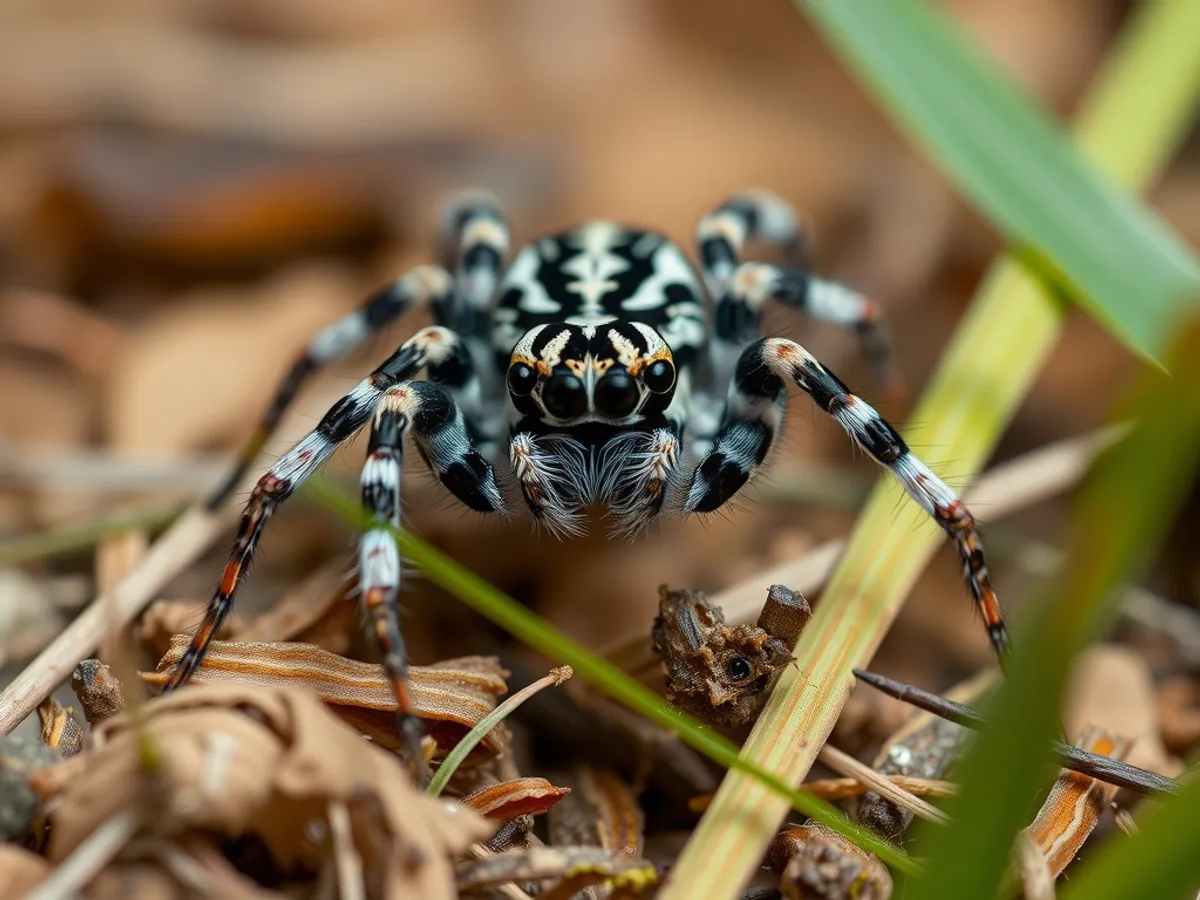
About the Zebra Jumping Spider
Jumping spiders see better than nearly any other invertebrate, and the way they do it is bizarre. The two enormous forward-facing principal eyes are effectively telephoto lenses — a long tube with a tiny, boomerang-shaped retina at the back — which buys extraordinary acuity at the cost of a field of view narrower than a drinking straw. The spider's solution is to move the retina rather than the eye, swinging and scanning it around inside its own head like a searchlight, while six smaller secondary eyes provide near-panoramic motion detection to tell it where to look. It stalks like a cat rather than building a snare, and when it leaps it does not use muscle alone: it pumps haemolymph into its legs under hydraulic pressure to extend them explosively. It always pays out a silk dragline as it goes, which serves as a safety rope and lets it adjust its attitude in mid-air. Males court with elaborate visual dances, which is only possible because the audience can actually see them.
Fascinating facts
Striking Stripes
Their black-and-white striped bodies help them blend into various backgrounds, providing camouflage from predators.
Incredible Jumpers
These spiders can jump over 10 times their body length, powered by sudden changes in blood pressure in their legs.
Keen Eyesight
With eight eyes, including two large central ones, they have some of the best vision among spiders, crucial for hunting and courtship.
Detailed description
The Zebra Jumping Spider (Salticus scenicus) is a small, compact arachnid, typically measuring 5–7 mm in length, with females generally larger than males. Its body is characterized by a bold black-and-white striped pattern, which provides effective camouflage against lichen, bark, and man-made surfaces. The cephalothorax is robust and houses eight eyes, with the anterior median pair being exceptionally large, granting acute binocular vision and depth perception crucial for hunting and navigation. The abdomen is oval and similarly striped, while the legs are short, stout, and covered in fine hairs that aid in grip and sensory perception. Unlike web-building spiders, S. scenicus is an active diurnal hunter, relying on its keen eyesight and powerful hind legs to stalk and leap onto prey, often covering distances up to 10 times its body length. Its hunting strategy is highly visual and involves careful stalking, orientation, and a rapid, calculated jump. The species is solitary, with individuals occupying overlapping territories but rarely interacting outside of courtship or competition for prey. Reproduction involves complex courtship displays, with males performing elaborate dances and vibratory signals to attract females and avoid predation. Eggs are laid in silken sacs hidden in crevices, and spiderlings emerge after several weeks, dispersing soon after hatching. The Zebra Jumping Spider is highly adaptable, thriving in a wide range of habitats from natural woodlands to urban environments, and is notable for its tolerance of human presence.
Did you know?
Despite their tiny size, Zebra Jumping Spiders can recognize and track prey with remarkable precision, rivaling much larger animals in visual acuity.
Research & sources
Behaviour & social structure
Salticus scenicus exhibits predominantly solitary behavior, with each individual maintaining a small hunting territory. It is diurnal, most active during warm daylight hours, and spends considerable time basking and scanning its environment from elevated vantage points. Hunting is visually guided: the spider stalks prey, often small flies or other arthropods, before executing a rapid, precise jump. Prior to leaping, it anchors a silk dragline to the substrate, which acts as a safety tether. Feeding involves injecting venom to immobilize prey, followed by external digestion and ingestion of liquefied tissues. Social interactions are limited, primarily occurring during the breeding season, when males approach females cautiously to avoid being mistaken for prey. Agonistic encounters between conspecifics are rare but can involve visual displays and posturing.
Reproduction & life cycle
Mating in S. scenicus is preceded by elaborate courtship rituals, with males displaying their forelegs and performing rhythmic movements to signal species identity and intent. Courtship may last several minutes, with successful males approaching and mating with receptive females. Females lay 15–25 eggs in a silken sac, typically hidden under bark, stones, or within crevices. Incubation lasts approximately 2–3 weeks, depending on temperature and humidity. Females may guard the egg sac until spiderlings emerge, after which parental care ceases. Spiderlings undergo several molts before reaching maturity, with one or two generations produced per year in temperate regions. Breeding activity peaks in late spring and early summer.
Adaptations & survival
The Zebra Jumping Spider possesses several key adaptations: its large anterior median eyes provide acute vision, enabling precise prey detection and navigation. The muscular hind legs are specialized for jumping, with rapid extension powered by hydraulic pressure rather than muscular contraction alone. The striped coloration offers disruptive camouflage, breaking up the spider’s outline against varied backgrounds. Behavioral adaptations include the use of silk draglines for safety during jumps and the ability to learn and remember spatial locations, enhancing hunting efficiency. Its tolerance for a wide range of microhabitats, including anthropogenic environments, reflects ecological plasticity and evolutionary success.
Cultural significance
While the Zebra Jumping Spider does not hold major roles in folklore or mythology, it is frequently referenced in educational materials and popular science due to its charismatic appearance and fascinating hunting behavior. Its presence in homes and gardens often sparks curiosity rather than fear, and it is sometimes featured in citizen science projects and nature photography. The species serves as a model organism in studies of vision, learning, and predatory behavior, contributing to broader public appreciation of arachnids.
Recent research
Recent research on S. scenicus has focused on its visual system, revealing sophisticated color vision and depth perception previously underestimated in spiders. Studies have demonstrated problem-solving abilities and spatial learning, suggesting higher cognitive functions among jumping spiders. Ongoing research explores the biomechanics of jumping, the molecular basis of venom, and the ecological impacts of urbanization on population dynamics. The species is also used in comparative studies of sexual selection and courtship signaling within Salticidae.
Sources
Salticus scenicus (Araneae: Salticidae): A Review of Its Biology and Behavior
R. R. Jackson & S. D. Pollard (1996)
scientificSalticus scenicus (Araneae: Salticidae): Taxonomy, Distribution, and Behavior
World Spider Catalog, Natural History Museum Bern (2023)
scientificVideos
Habitat
Temperate grasslands, woodlands, gardens, and human dwellings
 Various Continental Regions
Grassland
Open areas dominated by grasses rather than trees, supporting numerous herbivores and their predators.
 Elevated Terrain
Mountain
High-altitude environments with varying climates and specialized wildlife adapted to rugged terrain and thin air.
 Global
Forest
Wooded areas with significant tree cover and diverse plant and animal communities.
Conservation
The Zebra Jumping Spider is currently classified as Least Concern on the IUCN Red List.
Threats & challenges
Currently, S. scenicus faces minimal direct threats and is classified as Least Concern by conservation authorities. However, local populations may be affected by habitat loss, pesticide use, and urban development, which can reduce prey availability and suitable nesting sites. Climate change may also alter distribution patterns, but the species’ adaptability and broad ecological tolerance mitigate many potential risks. There is no evidence of significant population decline, and the species remains common throughout its range.
Taxonomy
Scientific name
Salticus scenicus
- Kingdom
- Animalia
- Phylum
- Arthropoda
- Class
- Arachnida
- Order
- Araneae
- Family
- Salticidae
- Genus
- Salticus
- Species
- scenicus
Community notes
Share your observations about the Zebra Jumping Spider.
No community notes yet. Be the first!
Discover more wildlife
More fascinating animals from the encyclopedia.